Why React Hiring Is Harder Than It Looks
React’s dominance creates a paradox: the talent pool is massive, but the quality floor is low. A developer can learn React basics in a weekend. Building a production-grade React application with proper state management, performance optimization, and testing takes years of practice.
Every job listing for “frontend React developer” attracts hundreds of applications. Most hiring processes can’t distinguish between someone who’s built 3 todo apps and someone who’s shipped a React application handling 10,000+ concurrent users. At Pavago, we see this exact problem when clients come to us after cycling through 2–3 Upwork freelancers who claimed React expertise but couldn’t deliver.
The React Skill Stack: What to Actually Test For
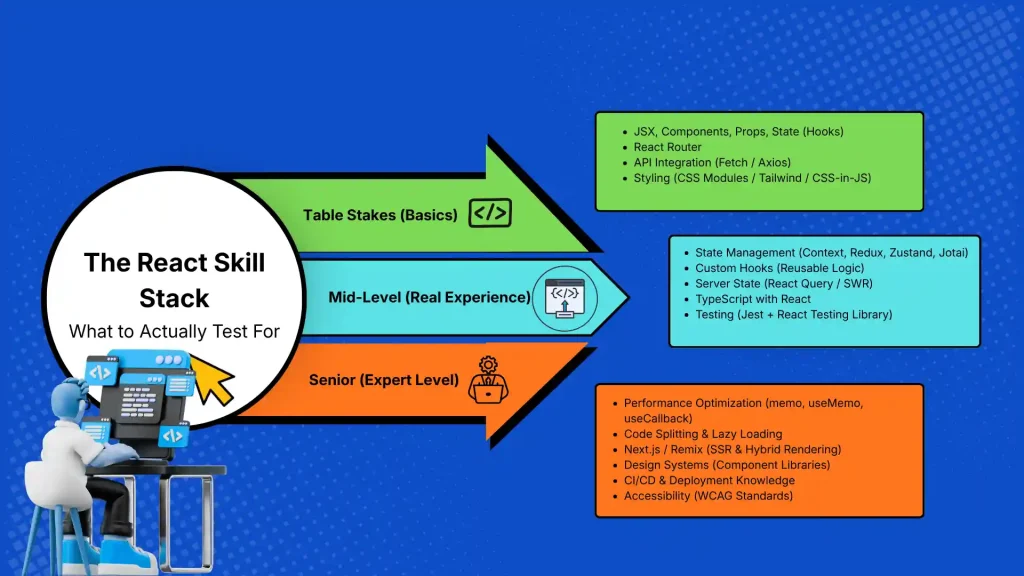
Not all React knowledge is equal. Here’s the skill hierarchy from table stakes to genuine expertise:
Table Stakes (Every React Developer Should Have)
- JSX, components, props, state (functional components with hooks)
- React Router for navigation
- Basic API integration (fetch/axios)
- CSS-in-JS or CSS modules or Tailwind
Mid-Level (Proves Real Project Experience)
- State management: Context API, Redux Toolkit, Zustand, or Jotai
- Custom hooks that encapsulate reusable logic
- React Query / SWR for server state management
- TypeScript with React (not just JavaScript)
- Testing: Jest + React Testing Library
Senior (Proves Architecture-Level Thinking)
- Performance: React.memo, useMemo, useCallback, code splitting, lazy loading
- Next.js or Remix for server-side rendering / hybrid rendering
- Design system implementation: building and maintaining component libraries
- CI/CD integration: understanding how React builds deploy in production
- Accessibility: WCAG compliance in React components
For available React talent, browse our offshore front end developer page. For the full hire engineering category, we have specialists across the entire frontend stack.
Our 5-Step Process for Hiring React Developers
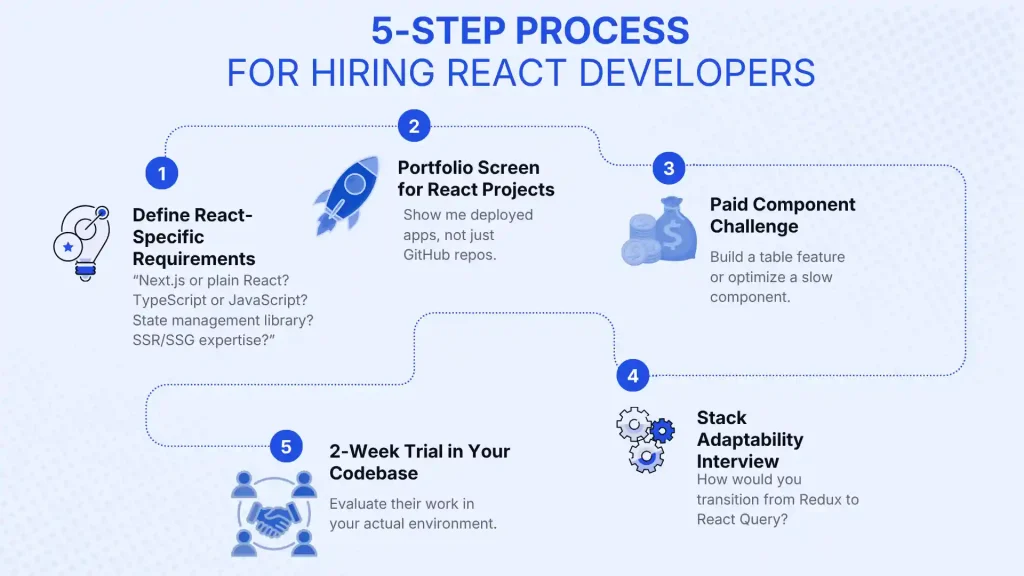
Step 1: Define React-Specific Requirements
Before you write a JD, answer: Are you using Next.js or plain React? TypeScript or JavaScript? Which state management library? Do they need to work with an existing design system or build one? Does the role require SSR/SSG knowledge? These specifics cut your candidate pool to the relevant subset immediately.
Step 2: Portfolio Screen for React-Specific Work
Ask for live deployed React projects, not just GitHub repos. A deployed application reveals: load performance, responsive behavior, error handling in production, and whether the developer understands deployment. GitHub repos show code quality but not production readiness.
Step 3: Paid Component Challenge ($100–$200, 3–4 hours)
Give a practical challenge that mirrors your actual work:
- For mid-level: Build a data table component with sorting, filtering, and pagination from a provided API endpoint. Evaluate: TypeScript usage, state management approach, loading/error states, code structure.
- For senior: Take an existing slow React component (you provide it) and optimize it. Explain what caused the performance issue and why your fix works. Evaluate: profiling methodology, understanding of React rendering behavior, communication of trade-offs.
Step 4: Stack Adaptability Interview
This is where we catch the biggest screening failure: framework-locked developers. A developer who’s only built in Create React App may not understand Next.js’s file-based routing or server components. A Redux-only developer may struggle with React Query’s caching paradigm. Ask: “You’ve been using [Library X]. Our project uses [Library Y]. Walk me through how you’d approach the transition.”
Candidates who have a learning methodology—read docs, build a small prototype, compare patterns to what they know—are adaptable. Candidates who say “I’d just learn it” without specifics usually can’t. For more evaluation frameworks, see our interview questions for offshore candidates.
Step 5: 2-Week Trial in Your Codebase
Nothing replaces working in your actual codebase. During the trial, evaluate: how quickly do they understand your component architecture? Do they follow existing patterns or introduce inconsistencies? How do they handle code review feedback? Do they write tests?
For structuring the trial and onboarding, our onboarding remote employees guide covers the 30/60/90 framework that maximizes signal from the trial period.
We placed design and development talent for OneNine that integrated seamlessly and delivered strong results. The OneNine case study shows how we structured the screening and placement for their technical team.
What Does a Frontend React Developer Cost?
| Level | U.S. Salary | Offshore Monthly | React-Specific Skills |
|---|---|---|---|
| Junior (1–2 yrs) | $60K–$80K | $800–$1,500 | Basic React + hooks, simple state, CRA/Vite |
| Mid (2–5 yrs) | $80K–$120K | $1,500–$3,000 | TypeScript, state management, testing, API integration |
| Senior (5+ yrs) | $120K–$160K+ | $3,000–$5,000 | Next.js/Remix, performance optimization, design systems, architecture |
Pakistan, South Africa, and Eastern Europe produce the strongest React talent pools at the mid and senior levels. For companies comparing offshore hiring models, our guide on hire an offshore development team covers team structures and cost comparisons.
Frequently Asked Questions
What does a frontend React developer do?
Builds user interfaces using React.js and its ecosystem. Core work: creating reusable components, managing application state, integrating with backend APIs, optimizing rendering performance, writing tests, and ensuring responsive and accessible design. Modern React developers often work with TypeScript, Next.js, and design systems.
How much does a React developer cost?
U.S.: $60K–$160K+/year. Freelance: $40–$150/hour. Offshore dedicated: $800–$5,000/month depending on seniority.
React vs Angular vs Vue: which should I hire for?
React has the largest ecosystem and talent pool. Angular is strongest for enterprise applications with complex forms and strict architecture. Vue is lightweight and fast for smaller projects. If you’re starting a new project and don’t have a strong reason to choose otherwise, React gives you the most hiring flexibility.
Should I hire a React developer or a full stack developer?
If your product’s frontend is complex (dashboards, interactive UIs, real-time features), a React specialist produces better frontend quality than a full stack generalist. If your frontend is simple and you need one person to handle both sides, full stack is more practical.
How do I test React skills?
Paid component challenge (3–4 hours, $100–$200). Mid-level: build a data table with sorting/filtering from an API. Senior: optimize a slow component and explain the fix. Always evaluate TypeScript usage, state management, and testing alongside the core solution.
Can I hire a React developer from another country?
Yes. React development is one of the most commonly offshored frontend specializations. The tooling is cloud-based (GitHub, Figma, Slack), the work is deliverable-based, and code quality is objectively evaluable through pull request reviews. Visit our managing remote employees guide for collaboration frameworks.
React Talent Is Everywhere. React Expertise Isn’t.
The process matters more than the platform. Five steps: define React-specific requirements, screen portfolios for deployed work, run a paid component challenge, test stack adaptability, and trial in your codebase. Skip any step and you’re betting on a resume. Follow all five and you’ll hire someone who builds React applications that actually ship.
Hire Frontend React Developers Through Pavago
React, Next.js, TypeScript specialists. Screened for stack adaptability and production experience, not just tutorial knowledge. 100+ frontend developers vetted.
Mid-level React devs from $1,500/mo | Senior from $3,000 | Free replacements