For the past three years, offshore hiring has quietly shifted from a cost-saving tactic to a mainstream strategy.
Mid-market SaaS companies, bootstrapped e-commerce brands, and even traditional service firms are pulling from talent pools in Latin America, Pakistan, the Philippines, South Africa, and Eastern Europe.
At Pavago, we’ve watched this trend accelerate firsthand. Our team screened over 100 candidates per month in 2024 and placed 82 people into U.S.-based companies across marketing, sales, operations, finance, and support functions.
And here’s the truth you don’t hear often: Offshore hiring works, but only when you understand the reality behind the buzzwords.
This article breaks down what actually happens when companies hire across borders: the good, the bad, and what leaders must solve to make it sustainable.
Why Offshore Recruitment Took Off (And Why It’s Not Slowing Down)
1. Salary Inflation in North America
Between 2020–2023, salary expectations for mid-level roles in the U.S. jumped 20–40%.
A marketing manager who cost $70K five years ago now costs $150K or more, and often comes with weaker output.
Parker Cox, CEO of Pavago, explains it plainly:
“A lot of companies aren’t hiring offshore because it’s cheaper. They’re hiring offshore because the local market stopped making sense. You were paying premium prices for average talent.”
2. Talent Density Has Globalized
This is the “hidden variable” most founders never see when it comes to global talent acquisition.
When you screen as many candidates as we do, you quickly realize the global top 1% absolutely exists –
and they’re hungry for opportunity. Many outperform their U.S. counterparts not because they’re cheaper, but because they simply have more to prove.
3. Remote Work Removed the Psychological Barrier
Before 2020, hiring in another country felt “weird.” How do you communicate? How do you make sure your offshore employees are actually working?
By 2023, no one cared. Slack is Slack. Asana is Asana. Zoom is Zoom. You have several tools at your disposal to ensure your offshore team is in sync and as productive as an in-house team.
The Real Advantages of Offshore Hiring (Backed by Data, Not Theory)
1. You Can Actually Afford A-Players
This is the core advantage – talent density per dollar.
A U.S. company paying $150K for a single marketing manager can hire:
…for roughly that same cost offshore.
But here’s the nuance: The goal isn’t “cheap talent.” It’s “high-output teams you can actually afford to assemble.”
Parker puts it this way:
“The U.S. isn’t running out of talent. It’s running out of affordable talent.”
2. The Speed Advantage (Massively Overlooked)
Most companies underestimate this.
Local hiring cycles are 6-12 weeks long on average. On the other hand, because the offshore market is significantly larger, you have several capable candidates for one role, so you simply move faster.
If you hire globally through an experienced offshore recruitment agency like Pavago, you get pre-vetted candidate profiles within 48 hours, and your offshore employee is finalized and onboarded in just 3 weeks.
3. Stronger Work Ethic + Lower Entitlement
This is the uncomfortable truth you can’t write on LinkedIn without getting yelled at, but every founder knows it: Global A-players often work harder because the opportunity means more.
They are not “cheap labor.” They are motivated labor.
They are A-players that you can recruit on a small business budget.
The Cons & Pain Points (Based on Our Experience)
Most articles list generic drawbacks like “time zones” and “communication issues.” Those matter, but they’re not the killers.
These are:
1. The Quality Variance Is Enormous
This is the #1 reason offshore hiring has a reputation problem.
For every top-tier candidate, there are dozens who simply shouldn’t be hired – at any price point.
Pavago’s Recruitment Lead, Amna Zia, notes:
“The biggest red flag is when companies chase low cost. They hire the first $500/month candidate they see and then blame ‘offshore hiring’ when it goes wrong.”
The gap between the offshore top 1% and the offshore average is bigger than the gap in the U.S. An experienced global recruitment agency can spot the difference almost immediately.
2. Companies Don’t Onboard Offshore the Same Way They Onboard Local
This kills 40% of offshore placements across the industry.
Most SMBs:
- Don’t document expectations
- Don’t create clear KPIs
- Don’t give role clarity
- Don’t provide early feedback loops
In other words, they skip the fundamentals of remote employee onboarding, and as a result, the hire flounders.
4. Compliance & Contracting Risks
U.S. companies frequently skip:
- Proper contracts
- Country-specific tax guidelines
- Intellectual property clauses
- Background verification
Bad idea.
If you don’t know how to set this up, you’re inviting risk.
This is where partnering with a reputable offshore recruitment agency like Pavago helps – because these protections, checks, and compliance steps are already built into the process.
The Most Common Failure Modes (A Framework Pavago Uses Internally)
After hundreds of interviews and dozens of placements, Pavago now evaluates every candidate using a simple but highly effective model called The Four Alignments.
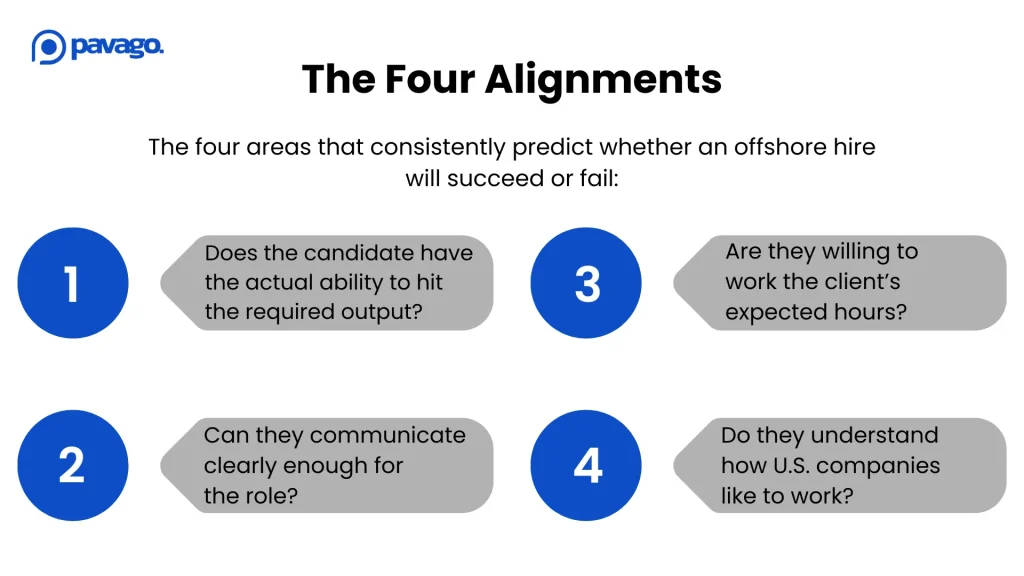
When companies skip even one of these, failure rates skyrocket.
Where Offshore Hiring Works Exceptionally Well
Based on Pavago’s success rate:
- Marketing (PPC, Content, Design) – 95% success rate
- Sales/SDR roles – consistent, predictable
- IT & Engineering – extremely strong
- Finance / Bookkeeping – high IQ, high detail orientation
- Ops & Back-Office – elite offshore domain
Patterns we see repeatedly:
- Offshore marketers out-execute U.S. mid-level marketers in raw output
- Offshore SDRs beat U.S. SDRs on consistency
- Offshore finance talent is extremely reliable and detail-focused
Where Offshore Hiring Still Struggles
Even with access to top-tier global talent, there are certain categories of roles where offshore hiring can still be challenging or less efficient:
- Roles requiring deep U.S. legal/regulatory expertise
- High-context creative direction
- C-suite leadership roles (unless hybrid)
- Industries with strict licensure requirements
What Pavago’s CEO Wants Companies to Know Before Hiring Globally
Parker’s comments on global hiring were incredibly blunt (and painfully accurate):
“Hiring globally doesn’t fix your hiring problems. It magnifies them. If your local onboarding sucks, offshore onboarding will fail faster.”
In other words: global talent isn’t a shortcut. If your processes are unclear, if expectations aren’t documented, or if accountability is loose, those cracks become chasms the moment you bring on a remote hire.
And then came the second point – equally direct, but the part most founders don’t hear enough:
“But if you run a tight ship – clear expectations, clear KPIs, real accountability – offshore talent will outperform local talent at the same price point every single time.”
When companies have strong systems, offshore talent becomes a force multiplier: more ownership, fewer excuses, a higher work ethic, and performance that rivals (or surpasses) domestic hires. The advantage compounds as the team grows.
The message is simple: Offshore hiring works brilliantly, but only for companies that already operate with clarity, structure, and discipline.
The Future of Hiring Is Not “Offshore.” It’s “Borderless.”
The companies that win over the next decade will be the ones that build teams like investment portfolios:
- U.S. strategic roles
- Offshore execution pods
- Hybrid leadership
- Lean org charts
- High output per dollar
The world won’t go back to local-only talent markets.
And Parker sums it up perfectly: “Once a founder sees what an offshore A-player can do, they never go back.”
Book a call with Pavago and see what a borderless A-player team could look like for you.