What Does a Java Backend Developer Actually Do?
Java backend developers build and maintain the server-side systems that applications depend on. While frontend developers handle what users see, Java backend developers handle what makes everything work underneath.
| Function | What It Includes | Why It Matters |
|---|---|---|
| API development | Build RESTful and GraphQL APIs using Spring Boot | APIs are how your frontend, mobile app, and third-party integrations communicate with your system. |
| Microservices | Design, build, and maintain independent services that communicate via messaging | Microservices architecture allows scaling individual components without rewriting the whole system. |
| Database integration | Design schemas, write queries, manage data access layers with Hibernate/JPA | Data integrity and query performance directly affect application speed and reliability. |
| Authentication & security | Implement OAuth2, JWT, role-based access control, encryption | Security breaches are existential threats. Java’s security ecosystem is one reason enterprises choose it. |
| Performance optimization | Profiling, caching (Redis/Memcached), connection pooling, JVM tuning | Backend performance determines whether your app handles 100 users or 100,000. |
| CI/CD & deployment | Build pipelines, containerization (Docker), orchestration (Kubernetes) | Automated deployment reduces errors and speeds up release cycles. |
Java’s position in backend development is unique: it’s the most common language for enterprise systems, financial services, healthcare applications, and large-scale data processing. Companies choose Java for its type safety, performance, and the maturity of its ecosystem (Spring Framework has been battle-tested for 20+ years). At Pavago, Java backend is one of our most requested technical roles.
The Java Skill Stack: What Separates Junior From Senior
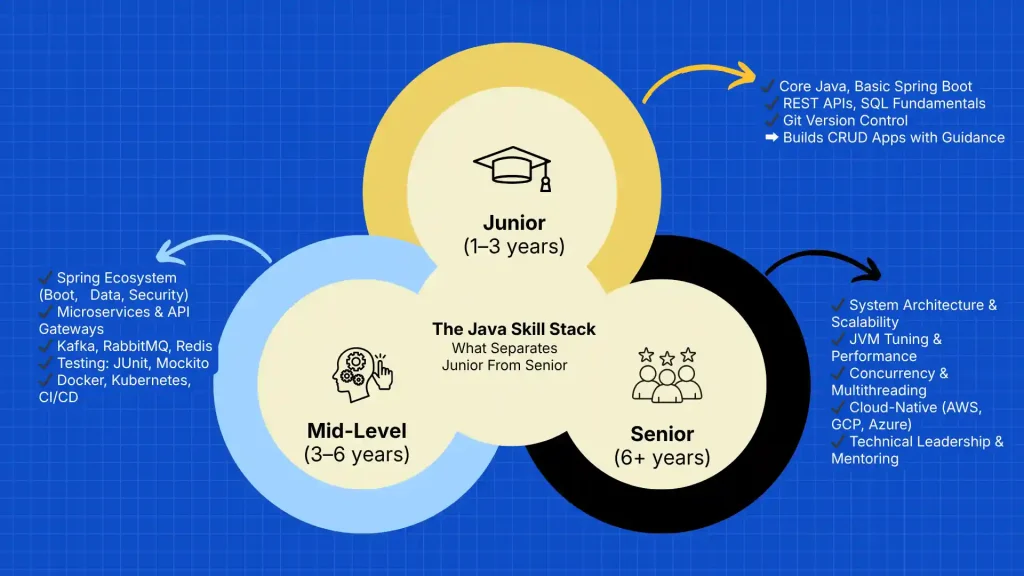
Junior (1–3 years)
- Core Java, basic Spring Boot, simple REST APIs, SQL fundamentals, Git
- Can build straightforward CRUD applications with guidance
Mid-Level (3–6 years)
- Spring ecosystem depth (Boot, Data, Security, Cloud)
- Microservices patterns: service discovery, circuit breakers, API gateways
- Message queues (Kafka, RabbitMQ), caching (Redis)
- JUnit + Mockito testing, integration tests
- Docker, basic Kubernetes, CI/CD pipelines
Senior (6+ years)
- System architecture: decomposing monoliths, designing for scale
- JVM internals: garbage collection tuning, memory management, profiling
- Multi-threading and concurrency (Java’s concurrent package, reactive programming)
- Cloud-native patterns on AWS/GCP/Azure
- Technical leadership: code review culture, mentoring, architectural decisions
Browse available Java talent on our offshore backend developer page. For the full technical hiring category, see hire engineering.
How Much Does a Java Backend Developer Cost?
| Level | U.S. Salary | Offshore Monthly | Key Differentiator |
|---|---|---|---|
| Junior | $70K–$95K | $1,000–$1,800 | Can build simple services with guidance |
| Mid-Level | $95K–$130K | $1,800–$3,000 | Owns features end-to-end, microservices capable |
| Senior | $130K–$160K+ | $3,000–$4,500 | Architects systems, leads technical decisions |
| Architect | $160K–$200K+ | $4,000–$6,000 | Defines system-wide technical direction |
Pakistan have the deepest Java talent pools globally, driven by decades of enterprise IT outsourcing. Eastern Europe (Poland, Romania, Ukraine) also produces strong Java developers. For companies comparing hiring channels, our software engineer recruitment agencies guide covers the landscape.
The Screening Problem: Framework-Locked Java Developers
After screening 100+ technical candidates, here’s the failure pattern specific to Java backend hiring: developers who are deeply proficient in Spring Boot but can’t adapt when the project requires broader ecosystem knowledge.
A candidate who’s built 10 Spring Boot microservices may freeze when asked about Kafka event streaming, Kubernetes deployment, or reactive programming with WebFlux. They’re not bad developers. They’re framework-locked. Their skills are deep but narrow.
This matters because modern Java backend work rarely stays within a single framework. A production microservices architecture involves Spring Boot AND Kafka AND Redis AND Docker AND Kubernetes AND a cloud provider. A developer who only knows the first piece can’t own the full backend.
How to Vet a Java Backend Developer
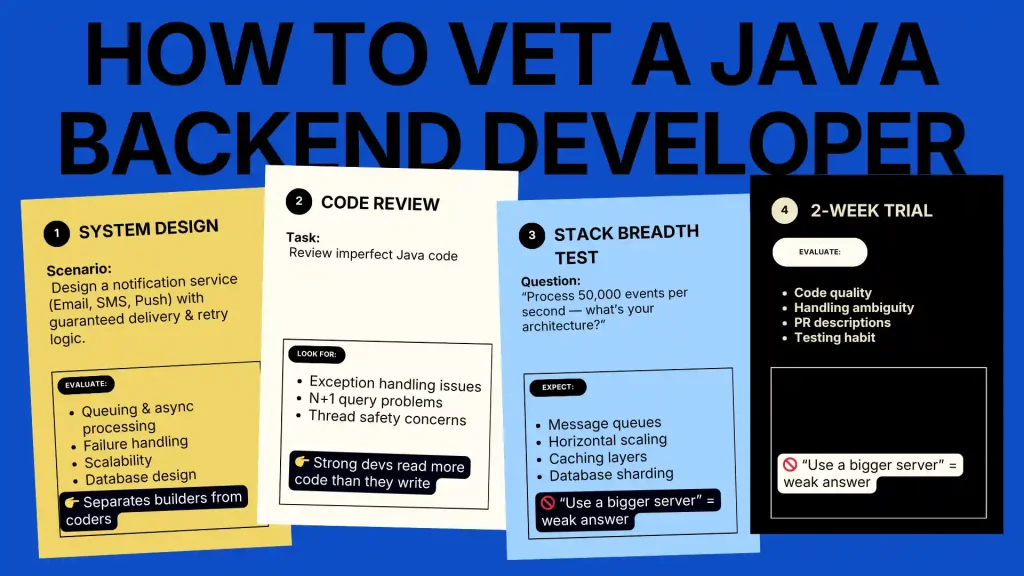
Step 1: System design question. Describe a real scenario: “Design a notification service that sends emails, SMS, and push notifications with guaranteed delivery and retry logic.” Evaluate: Do they think about queuing? Failure modes? Scalability? Database design? This question separates builders from coders.
Step 2: Code review exercise. Give them a piece of intentionally imperfect Java code (poor exception handling, N+1 query problem, thread-safety issue). Ask them to identify problems and suggest fixes. This tests reading ability, not just writing ability. The best backend developers spend more time reading code than writing it.
Step 3: Stack breadth test. Ask: “Your service needs to process 50,000 events per second. Walk me through your architecture.” Good answers involve message queues, horizontal scaling, caching layers, and database sharding. Candidates who only think in terms of “bigger server” are stuck in a monolithic mindset.
Step 4: 2-week trial on real work. Evaluate: code quality, how they handle ambiguity, PR descriptions, testing habits. For structuring technical evaluations, our interview questions for offshore candidates guide includes backend-specific prompts.
One of our clients, Tenant Planet, needed A-player technical talent placed offshore. We matched them with professionals who delivered strong results. Read the Tenant Planet case study for how we structured the screening and placement.
Why Java Backend Is Ideal for Offshore Hiring
- Massive global talent pool. Java is the #1 enterprise language taught in computer science programs worldwide. Pakistan, Eastern Europe, and LATAM all produce strong Java developers at every seniority level.
- Work is measurable. Backend work produces testable, deployable artifacts. Code quality is objectively evaluable through PRs, test coverage, and system performance metrics. No ambiguity about whether the work is good.
- Async-compatible. Backend development doesn’t require real-time pair programming. A developer can pick up a ticket, build the feature, write tests, push a PR, and it’s reviewable regardless of time zone.
- Retention advantage. A $3,000/month salary for a senior Java developer in Pakistan is premium compensation. Your offshore hire is well-paid by local standards, reducing the turnover risk that plagues U.S. companies trying to retain Java developers at below-market U.S. salaries.
For building complete technical teams with Java backend at the core, our hire an offshore development team guide covers team composition and management structures.
Frequently Asked Questions
What does a Java backend developer do?
Builds server-side systems using Java and its ecosystem (Spring Boot, Hibernate, Kafka, etc.). Core work: API development, microservices architecture, database integration, security implementation, performance optimization, and deployment automation. They build the infrastructure that web and mobile applications depend on.
How much does a Java backend developer cost?
U.S.: $70K–$200K+/year depending on seniority. Freelance: $50–$150/hour. Offshore: $1,000–$4,500/month. The cost gap is widest at the senior level where U.S. salaries are highest.
Java vs Python vs Node.js for backend?
Java: best for enterprise applications, financial systems, and high-throughput processing. Python: best for data-heavy applications, ML integration, and rapid prototyping. Node.js: best for real-time applications and when your frontend is also JavaScript. Choose based on your specific use case, existing codebase, and available talent.
What’s the difference between a Java developer and a Java backend developer?
A Java developer is a general title that could mean backend, Android mobile, desktop (JavaFX), or full stack. A Java backend developer specifically builds server-side systems: APIs, microservices, data processing, and backend infrastructure. If you need someone working on server-side logic, specify “backend” in the title.
Can I hire a Java backend developer from another country?
Yes. Java backend development is one of the most commonly offshored technical roles globally. Pakistan has the largest Java developer population. Eastern Europe produce strong mid-to-senior talent. For building remote technical teams, see our offshore dedicated team guide.
How do I test Java backend skills?
Three tests: (1) system design question to evaluate architecture thinking, (2) code review exercise to test reading and debugging ability, (3) stack breadth test to check ecosystem knowledge beyond Spring Boot. Always pay for a 2-week trial before committing.
Java Isn’t Going Anywhere. Neither Is the Talent Shortage.
Java backend developers are in sustained high demand because enterprise systems built on Java don’t get rewritten overnight. The talent shortage in the U.S. pushes salaries higher every year. For SMBs, the math is simple: hire offshore, vet properly, and get senior Java talent at mid-level U.S. prices. The framework hasn’t changed. The hiring model has.
Hire Java Backend Developers Through Pavago
Spring Boot, microservices, Kafka, cloud-native specialists. Screened for ecosystem breadth, not just Spring Boot proficiency. 100+ backend developers vetted.
Mid-level from $1,800/mo | Senior from $3,000 | Free replacements