
A case study on protecting senior expertise and increasing execution capacity
About Sudberry Southern
Sudberry Southern is a Tennessee-based architectural millwork company with a long history of producing high-quality custom woodwork. Their work spans detailed architectural components, custom fabrication, and execution-heavy projects where accuracy and coordination matter.
This is not conceptual design work. Mistakes downstream are expensive. Senior judgment is critical.
The business relies heavily on experienced principals and senior staff to guide projects from design through production.
The Constraint
As project volume increased, a predictable problem surfaced.
Senior staff were spending a growing amount of time on:
- drafting support
- drawing updates
- documentation revisions
- coordination details
This work is necessary, but it is not where senior architectural value is created.
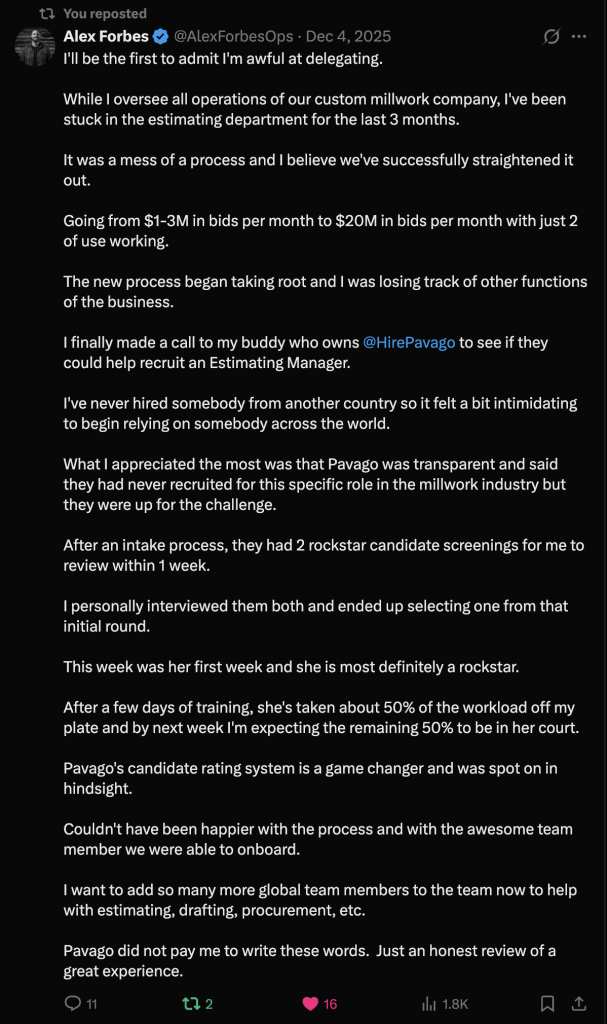
As Alex Forbes pointed out publicly, the issue was not capability. It was leverage.
Highly experienced people were doing work that did not require their level of judgment, simply because there was no dedicated support in place.
That slowed everything down.
What They Needed
Sudberry Southern did not need another senior architect.
They needed an Architectural Assistant who could:
- handle drafting and documentation accurately
- support ongoing product design work
- Take responsibility for foundational design tasks
- reduce the load on principals and senior designers
The goal was simple: keep senior people focused on the work only they can do.
The Hiring Decision
Sudberry Southern hired an Architectural Assistant through Pavago.
The role was clearly defined.
This was not an assistant in name only. The hire was expected to own architectural support work, so senior staff were no longer pulled into routine drafting and revisions by default.
What Changed
The impact was practical and immediate.
Drafting and documentation work flowed to the Architectural Assistant first. Senior staff stepped in for review and decision-making, not execution.
That shift:
- Reduced interruptions to senior staff
- improved turnaround on drawings
- removed a recurring bottleneck in project flow
- increased overall throughput without adding senior headcount
Projects moved forward more smoothly because the right work was being done by the right people.
ROI in Practical Terms
The return did not come from saving money. It came from where time was reallocated.
By adding an Architectural Assistant:
- Principals spent less time on drafting and revisions
- Senior staff stayed focused on design leadership and coordination
- More projects could move forward in parallel
execution speed improved without sacrificing quality
This is the point Alex made in the tweet.
The hire did not replace expertise.
They protected it.
One role unlocked hours of senior-level time every week. That leverage compounds across projects.
That is the ROI.
Why This Worked
This worked because the role was hired and scoped correctly.
The Architectural Assistant:
- had a clear responsibility
- worked inside existing processes
- was trusted with real work
- Reduced dependency on senior staff
Geography was irrelevant; fit and capability were not.
Pavago’s Role
Pavago did not produce architectural drawings for Sudberry Southern.
Our role was to:
- Identify candidates capable of real architectural support work
- vet for reliability, accuracy, and integration ability
- support the hiring process so expectations were clear from day one
The value was not speed; it was alignment.
The Takeaway
Sudberry Southern did not hire offshore to decrease recruitment cost.
They hired offshore to remove a structural bottleneck.
By adding the right support at the right level, they protected senior expertise, improved execution flow, and made the business easier to scale without burning out the people who matter most.
That is what good hiring actually looks like.
Remove Bottlenecks Without Burning Senior Talent