Most founders who hire content marketing professionals end up with the same realization: the writing looks good, the deadlines are met, your blog fills with articles… but revenue doesn’t move.
Traffic doesn’t budge.
Rankings remain flat.
Your sales team never references content in their conversations.
No pipeline.
No measurable ROI.
It’s not that the marketer you hired isn’t talented. The problem is that the skill set required for writing is completely different from the skill set required to drive results.
And this is where most content hiring goes wrong.
After evaluating more than 150 offshore content marketing professionals this year alone, we discovered a simple but hard-to-identify truth: Most content marketers can create content, but only a small percentage can create outcomes – especially in this age of AI.
This article breaks down:
- Why most content hiring doesn’t work
- How to identify content A-players
- What offshore markets uniquely offer
- and how to evaluate content talent the same way we do after 150+ screens
By the end, you’ll know exactly where strong content talent lives, and how to hire for outcomes, not output.
Writing Is No Longer a Scarce Skill (Thanks to AI)
A few years ago, strong writing alone could differentiate a content marketer.
That’s no longer true.
AI has flattened the writing curve. Clear grammar, decent structure, and on-brand tone are now easily achievable with the right tools. As a result, writing samples have lost most of their predictive value.
A good sample shows that someone can produce clean copy. It doesn’t show whether they can:
- interpret search intent correctly
- Choose topics that align with buyer readiness
- structure content to rank and convert
- understand ICP nuance
- Create differentiation in a crowded SERP
- turn content into a durable acquisition asset
This is where most hiring decisions go wrong. Founders assume they’re evaluating content performance potential when they’re really just evaluating presentation quality.

The Gap Between Producing Content and Producing Results
Across our interviews for content marketing professionals this year, one pattern repeated consistently: most candidates could write, but very few could explain why content succeeds or fails.
The gap wasn’t talent. It was judgment.
Most offshore writers struggled to differentiate between top, middle-, and bottom-of-funnel content. They wrote everything in the same tone, with the same level of detail, and the same assumptions about reader readiness – whether the goal was awareness, evaluation, or conversion.
Many couldn’t adjust their writing based on where the content lived. A blog post, a landing page, a comparison article, and a thought-leadership piece were treated as interchangeable formats, despite serving entirely different purposes. Tone, structure, depth, and calls to action were rarely adapted to the medium.
ICP understanding was another weak point. Candidates often wrote for a “general audience” rather than a specific buyer. When asked who the content was for, answers stayed vague – roles, pain points, objections, and buying context were often missing or assumed.
Content that actually moves the needle requires more than clean writing. It demands:
- the ability to map content to funnel stages
- clarity on who the buyer is and what they care about
- intentional tone and structure based on format and distribution
- an understanding of search intent and buyer psychology
- and increasingly, awareness of how content is interpreted by both search engines and AI systems
Without these, content becomes activity without direction – output without leverage.
The Four Levels of Content Talent We See Over and Over Again
Most founders don’t struggle to find people who can write. They struggle to hire a content writer whose content actually moves the business forward.
On the surface, many candidates look like A-players: strong portfolios, clean execution, and familiarity with the right tools. But once hired, the gap between expectations and outcomes becomes obvious very quickly.
Over time, we realized the problem wasn’t talent scarcity; it was misclassification. People usually evaluate candidates by how they wrote, not how they thought.
When we started classifying content marketing professionals by their underlying decision-making, a clear pattern emerged. Nearly every candidate we see falls into one of four levels.
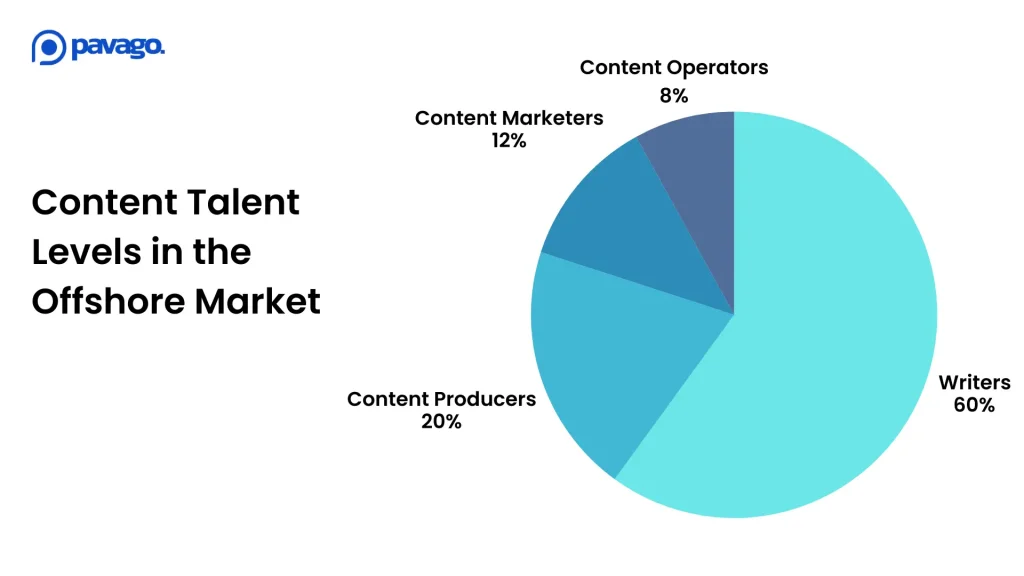
Level 1: Writers (≈50–60%)
This is the largest group by a wide margin. Writers have strong fundamentals and produce clean, readable work. Their mechanics are solid, their sentences flow, and their tone is generally appropriate.
What they typically lack is strategic context. Most writers have little understanding of:
- ICP behavior
- funnel dynamics
- search intent
- conversion triggers
- competitive positioning
They can execute well when given direction, but they aren’t equipped to decide what should be written or why it matters.
Writers are useful for execution, but they are not responsible for outcomes. When content works at this level, it’s almost always because someone else did the thinking.
Level 2: Content Producers (≈15–20%)
Content Producers are more dependable operators. They bring consistency and structure, which already makes them more valuable than most candidates. They reduce friction inside teams and keep output predictable.
They can reliably:
- follow briefs
- deliver on time
- handle volume
- adapt voice
Their value is leverage. They reduce workload and keep production moving, but they still depend heavily on the quality of the strategy they’re given.
At this level, results are strategy-dependent.
Strong direction produces solid output.
Weak direction gets amplified just as efficiently.
Level 3: Content Marketers (≈10–12%)
This is where strategic awareness starts to show.
Content Marketers understand that content exists within a broader system, not in isolation. They bring early signs of strategic thinking and typically have experience with:
- basic SEO
- topical relevance
- simple SERP analysis
- elementary ICP targeting
Because they connect more dots, they often outperform expectations. They understand how content earns visibility and relevance, not just how it’s written.
That said, many content marketing professionals at this level still struggle to consistently translate content performance into revenue impact. The gap at this level is usually downstream thinking — buyer psychology, sales alignment, and decision-making across the funnel.
Level 4: Content Operators (≈8–10%)
This is what the group’s founders think they’re hiring, but actually aren’t. Content Operators don’t just produce content. They design systems.
They:
- Align content with business goals
- reverse-engineer search intent
- map topics to buyer stages
- research deeply and independently
- structure narratives intentionally
- differentiate messaging
- collaborate with sales and leadership
- Use AI to increase depth and speed without losing clarity
These are the people who build acquisition engines, not blogs. They don’t rely on constant briefs because they operate from first principles. And they are far rarer than most teams realize.
We hired someone from this tier earlier this year, and they helped us increase our landing page conversion rate drastically in a small amount of time. Read more about it here.
Why This Distinction Matters
Most content hiring failures don’t come from bad candidates. They come from misaligned expectations. Founders hire Level 1 or Level 2 talent while expecting Level 4 outcomes, then blame content when results don’t materialize.
Content rarely fails because of writing quality. It fails because the thinking behind it is shallow. Understanding these four levels makes it easier to hire correctly, structure teams realistically, and align content with actual business outcomes.
At Pavago, we help our clients hire offshore content writers, producers, marketers, and even operators, but we set expectations at the very beginning so you know what you’re signing up for.
Where to Find Content Marketing Professionals Who Actually Deliver Results
Finding strong content marketing professionals isn’t about posting jobs everywhere. It’s about knowing where serious operators tend to work – and understanding the limitations of each option.
Below are the five most common places teams look, starting with the one that consistently delivers the best outcomes.
1. Vetted Offshore Talent Networks (e.g., Pavago)
Some of the strongest content marketing professionals operate offshore. These markets are highly competitive, and the best candidates are used to working with global companies, tight expectations, and real performance pressure.
Platforms like Pavago focus on how candidates think, not just what they’ve produced. We screen for strategy, commercial awareness, communication, and ownership before anyone is introduced to a company.
Why this works: access to high-caliber talent that’s been evaluated properly.
Downside: requires a mindset shift if you’re used to hiring locally.
2. LinkedIn
LinkedIn is still one of the easiest places to discover experienced content marketing professionals. You can see their background, how they communicate, and where they’ve worked.
Why it works: large talent pool and easy outreach.
Downside: hard to separate people who talk about content from people who deliver results.
3. Specialized Slack Communities and Private Groups
Private communities often attract content marketers who are actively working on real problems. Discussions tend to be more honest and technical than public platforms.
Why it works: high signal-to-noise ratio.
Downside: limited reach and inconsistent availability of candidates.
4. Niche Job Boards
Job boards focused on content or growth roles are better than general marketplaces. Candidates applying here usually understand the role and expectations better.
Why it works: more relevant applicants than general job boards.
Downside: still heavily optimized for availability, not performance.
5. Agency and Consultancy Alumni
Agency-trained content marketers often have strong execution skills and experience across multiple industries.
Why it works: exposure to fast-paced environments and real client constraints.
Downside: many struggle to transition from execution to long-term ownership.
What’s the Best Option for You?
Every option can work. Most fail because the evaluation is weak, not because the source is wrong.
The advantage of vetted offshore platforms like Pavago is that they combine access with filtering, so companies don’t have to guess who’s an A-player and who just looks like one.
Why Offshore A-Player Content Talent Delivers Better ROI for SMBs
This is not about “offshore is cheaper.” It’s about offshore that gives SMBs access to the exact talent profile that produces disproportionate outcomes.
Here’s what we consistently saw across interviews:
1. Offshore A-players have multi-industry exposure.
Writers in Pakistan, LATAM, Eastern Europe, and the Philippines often come from agency environments where they handle:
- multiple industries
- multiple ICPs
- multiple brand voices
This strengthens:
- intent understanding
- research accuracy
- messaging adaptability
2. Their research discipline is stronger than many local candidates.
Across 150+ screenings:
- 24% of offshore A-player candidates excelled at deep research
- Only ~18% of the local writers we compared to demonstrated the same rigor
Research quality is the #1 predictor of content performance.
3. They treat writing like a strategic function, not art.
Offshore content marketers write with intention:
- decision-stage clarity
- narrative flow
- structured arguments
- outcome-oriented messaging
4. They use AI as leverage, not a shortcut.
The strongest content marketing professionals didn’t avoid AI. They used it deliberately. What separated them wasn’t tool usage, but judgment.
They understood:
- what AI is good at (synthesis, iteration, pattern recognition)
- what it’s bad at (context, nuance, strategic trade-offs)
- How to guide it instead of outsourcing thinking to it
More importantly, they understood that content today has two audiences: Human buyers and large language models (LLMs).
Content that isn’t clearly structured, well-defined, and referenceable doesn’t just fail to convert; it often fails to surface at all in AI-driven discovery.
This is an emerging skill set, and most candidates haven’t developed it yet.
5. Their “output-to-cost” ratio is unbeatable for SMBs.
Local content marketing professionals are excellent, but the economics often don’t make sense for smaller companies.
Offshore A-players often deliver:
- equal or higher quality
- higher research depth
- higher content velocity
- stronger alignment to business outcomes
- dramatically better ROI
Offshore isn’t a “budget option.”
It’s a talent arbitrage that lets SMBs access senior-level operators normally priced far beyond reach.
How to Identify A-Players in Remote Roles: The 5-Step Evaluation Model
Most hiring mistakes don’t come from a lack of candidates. They come from evaluating the wrong things. CVs, portfolios, and past job titles are easy to scan, but they reveal very little about how someone thinks when faced with ambiguity.
Over time, we found that high performers – across all roles – consistently surface through their decision-making, not their deliverables. To capture that, we use a six-signal evaluation model focused on how candidates reason, prioritize, and take ownership of outcomes.
This framework is especially effective for remote and offshore roles, but it applies just as well to in-house or agency hires.
1. Strategy-First Screening
Instead of starting with samples or credentials, we ask candidates to think through a realistic problem related to the role. Not to execute it, but to outline how they would approach it.
Strong candidates naturally clarify objectives, constraints, and trade-offs before jumping into action. Weaker ones rush straight to tasks. This step quickly reveals whether someone thinks in terms of systems or instructions.
2. Interpretation Over Description
We present candidates with real inputs – data, workflows, documentation, or market context – and ask them to talk through what they see.
Lower-level candidates describe what’s in front of them. A-players interpret it. They explain why things are structured a certain way, what signals matter, and what implications those signals have. The ability to interpret rather than narrate is a strong indicator of seniority.
3. Structural Thinking Assessment
Most roles require organizing complexity into something usable. Here, we evaluate whether candidates can structure information logically and persuasively.
A-player candidates impose order. They break problems into parts, sequence decisions, and explain their reasoning clearly. B-players list facts without cohesion or rely on ad-hoc thinking.
4. Commercial and Outcome Awareness
A-players naturally think about impact. We listen for comments like:
- “This won’t move the needle.”
- “The effort doesn’t justify the return.”
- “This is useful, but not at this stage.”
These signals show an understanding that work exists to drive outcomes, not just activity. Candidates who think this way tend to make far better long-term hires across any role.
6. Communication and Ownership Signals
Finally, we pay close attention to how candidates communicate. A-players speak like teammates, not task-takers. They ask clarifying questions, flag risks early, and take responsibility for results rather than just deliverables.
In remote environments, especially, this signal is non-negotiable. Clear communication and ownership often matter more than raw skill.
Why This Model Works
Together, these six signals eliminate the majority of mismatched hires. They shift evaluation away from surface-level credentials and toward how someone actually operates day-to-day.
Skills can be trained. Judgment, ownership, and learning speed are much harder to teach. This model is designed to identify those traits – regardless of role, function, or geography.
Wrapping It Up
Content rarely fails because of execution quality. It fails because the thinking behind it is shallow.
AI has made writing fast, cheap, and accessible. What it hasn’t replaced is judgment – the ability to choose the right topics, interpret intent correctly, structure narratives with purpose, and align content with business outcomes. That gap is where most content hiring breaks down.
The difference between content that fills a blog and content that moves revenue isn’t talent – it’s classification and evaluation. When founders hire writers or producers but expect A-player content marketing professionals, disappointment is inevitable.
Offshore markets give SMBs access to elite content marketing talent at a level of ROI that’s simply unrealistic in local hiring markets, but only if the evaluation process is rigorous. After all, geography doesn’t create A-players – selection does.
If you want help finding and evaluating offshore content marketing A-players, that’s exactly what we do at Pavago.
We screen for strategic thinking, commercial awareness, and ownership, so you don’t have to guess who can actually drive results.
Talk to our hiring advisor to see what A-player offshore content talent looks like in practice.