If you searched “Google Ads expert offshore,” you’re probably not looking for marketing inspiration — you’re looking for relief, because you’ve hit that point where Google Ads is expensive enough that you can’t keep “figuring it out,” but messy enough that you don’t trust whoever’s touching it.
And the worst part isn’t even the money.
It’s the feeling that you’re renting competence, because every time performance dips, you’re back in a loop you’ve lived before: another audit, another “strategy,” another set of changes that may or may not matter, another month where the dashboard looks active while your sales team complains the leads don’t feel real.
So you look offshore because you want what you should’ve had all along: a dedicated owner, someone who wakes up thinking about your account, your conversion signals, and your lead quality like it’s their job (because it is), instead of someone who drops in once a week, flips a few levers, and calls it management.
Here’s the uncomfortable truth: most founders only learn after writing a few checks:
Offshore isn’t the solution. A system is the solution
Offshore is just a hiring market, and the best Offshore recruitment agencies are the ones that enforce the system, not hype the geography.
If your hiring and onboarding system is weak, you can hire offshore or local, and you’ll still get a bad hire. The only difference is that local bad hires cost more, and offshore bad hires burn more slowly because people tolerate ambiguity longer when the person is remote.
This post is a founder-grade system to hire an offshore Google Ads Expert who can actually own outcomes, including the pieces “Google Ads people” love to avoid (offline conversions, Smart Bidding reality, lead quality feedback loops), because that’s where real performance comes from.
Step 1: Stop hiring “a Google Ads person” and define the actual job
Most founders hire Google Ads talent the way they hire a designer: “take it off my plate.”
That framing works for design because you can judge outputs.
It fails for Google Ads because Google Ads is a feedback system, and if the inputs are incorrect, then the outputs will be wrong, while still appearing “busy” in the dashboard.
So before you even write a job post, define the job like an operator; most offshore hiring problems start right here, not in the talent pool.
Pick the job-to-be-done:
- Stop wasting: spending is leaking, and you don’t trust what you’re buying.
- Fix lead quality: leads exist, but sales says they’re junk.
- Create predictability: you want a consistent, qualified pipeline, not spikes.
- Scale responsibly: something works, and you don’t want to break it.
Write the job down in one sentence. Because if you don’t, you’ll hire someone who optimizes to the easiest measurable thing (usually form fills), and then you’ll be angry at them for doing exactly what the platform rewards.
Step 2: Filter for signal integrity first (because Smart Bidding only learns from what you feed it)
This is the fastest way to separate real experts from interface operators:
A real Google Ads expert starts by asking, “What are we optimizing toward, and is that signal trustworthy?” A fake Google Ads expert starts by talking about match types, bid modifiers, and “quick wins.”
In B2B, the signal problem is brutal, because the conversion you can measure easily (lead form, booked call) often isn’t the conversion you care about (qualified opportunity, closed revenue).
That’s why offline conversions matter, and why enhanced conversions for leads have become the cleanest “grown-up” way to do it, because Google positions it as an upgraded offline conversion import with benefits like more durable and more accurate reporting — and explicitly recommends upgrading if you’re already using offline conversion imports.
So if you want an offshore Google Ads expert who can actually own outcomes, you need them to be comfortable with this idea:
“We’re not optimizing for leads. We’re optimizing to the right leads, using offline signals.”
The 6-question screen (use this in the first call)
Ask these exactly, and if they can’t answer clearly, end the process early:
- “What conversion actions should exist in this account, and which ones should be primary vs secondary?”
- “How do you verify conversions aren’t duplicated or firing on junk events?”
- “If we’re B2B, what’s your plan for offline conversions (SQL, opp created, closed-won)?”
- “If lead quality is bad, how do you diagnose whether it’s ads, landing page, or sales follow-up?”
- “What do you need from our CRM/sales team to make Google Ads learn faster?”
- “What would you refuse to scale until measurement is clean?”
This is not “advanced PPC trivia.” This is what separates “I run campaigns” from “I run acquisition.”
Step 3: Treat offshore like any other expert: same standards, clearer system
Founders do something weird with offshore hiring.
They lower standards because they assume the market is cheaper, while also expecting senior ownership, and those two beliefs can’t coexist without disappointment.
The right mental model is simpler: Geography changes the cost base. It should not change the quality bar.
In fact, offshore requires more structure, because the feedback loop is weaker when the hire isn’t sitting near you, hearing sales calls, and absorbing context by accident, and that’s what the real challenge of managing remote employees is.
So don’t pitch the role like “please manage our ads.” Pitch it like an ownership role with clear rules:
- You own your weekly performance and learnings.
- You do not touch spend until measurement is sane.
- You run a weekly update cadence.
- You collaborate with landing pages and sales feedback.
- You document changes so nothing becomes “mystery performance.”
That’s how you get an offshore Google Ads Expert who behaves like an internal operator, not a remote freelancer, which is the whole point of hiring Offshore Talent.
Step 4: Use one “Google Ads reality” question to expose surface-level candidates
Ask this in the interview
“We’re on Smart Bidding. What bid adjustments (bid modifiers) actually work, and what gets ignored?”
Here’s why this is such a clean filter:
In Google’s own documentation for Target ROAS, it states that existing bid adjustments aren’t used, with one explicit exception: you can still set device bid adjustments of -100%.
In the Target CPA documentation, it notes that non-device bid adjustments are ignored on Search and Display, and explains that device adjustments modify the CPA target (plus you can set mobile to -100% to exclude).
A real operator answers by explaining what levers they use instead:
- signal quality (offline conversions / enhanced conversions for leads)
- conversion value rules / value-based optimization, where applicable
- query intent control (search terms + negatives)
- landing page clarity and offer alignment
- controlled experiments, not random tweaks
A surface-level candidate answers with “we’ll add bid modifiers” as if it’s still 2017.
This single question saves founders from hiring people who look experienced but haven’t actually operated under modern Smart Bidding constraints.
Step 5: Use a scorecard (because confidence is not competence)
If you don’t score candidates, you will hire the best communicator, and performance marketing is full of people who can talk for an hour while saying nothing.
Here’s a scorecard that’s built for the actual job.
Pass/fail gates (non-negotiable)
They must be able to:
- start with measurement + conversion signals (including offline conversions for B2B)
- explain how they eliminate waste (search terms report + negatives + intent control)
- explain Smart Bidding bid adjustment reality (Target CPA/ROAS nuance)
- share a founder-friendly weekly update format (decisions, tests, next steps)
Weighted scorecard (100 points)
- Signal integrity + measurement plan (25)
- B2B intent strategy (20)
- Waste control (search terms + negatives + match discipline) (15)
- Ad messaging tied to objections (10)
- Landing page collaboration + CRO instinct (10)
- Operating cadence + communication clarity (10)
- Proof + learning depth (10)
If they score well, you keep going. If they don’t, you stop, because “we’ll see after 60 days” is how budgets get quietly burned.
Step 6: Run a paid test project (48–72 hours) that forces real thinking to show up
This is the step founders skip, and it’s why they get burned. You cannot interview your way into certainty with a Google Ads Expert.
So don’t hire off conversation. Hire off a small, paid, time-boxed project that mirrors the work.
Paid test brief (copy/paste)
Goal: Show me how you think.
You’ll get:
– Read-only access OR exports/screenshots
– Last 90 days’ performance summary
– Our ICP + offer + target geos
– A rough definition of “good lead” from sales
Deliver in 48–72 hours:
1) Signal integrity check: what’s broken/missing/untrusted (and how you’d validate it)
2) Offline conversion plan (B2B): what event you’d import (SQL/opp/etc) and why
3) Waste map: top spend leaks + negative keyword plan
4) Intent restructure: how you’d reorganize for cleaner learning + better lead quality
5) Ad messaging: 5 angles tied to objections + intent
6) Landing page notes: 5 high-impact tests (no redesign fantasies)
7) 30-day plan: 3 experiments, success metric, stop rule, weekly cadence
How to score the test (what “good” looks like)
- They start with signal integrity, not creativity.
- They identify waste using actual search term intent, not generic advice.
- Their 30-day plan is specific enough to execute immediately.
- They ask for lead quality feedback loops (because they know ads don’t exist in isolation).
- They don’t overpromise; they prioritize.
When a candidate is real, you feel calmer after reading their plan, because the account stops being a mystery and starts being a system.
Step 7: Onboard with a 30-day operating system (or your “expert” becomes a freelancer)
Offshore hires don’t fail because they’re offshore. They fail because founders onboard them like contractors, then expect ownership, the same mistake people make with virtual assistant onboarding.
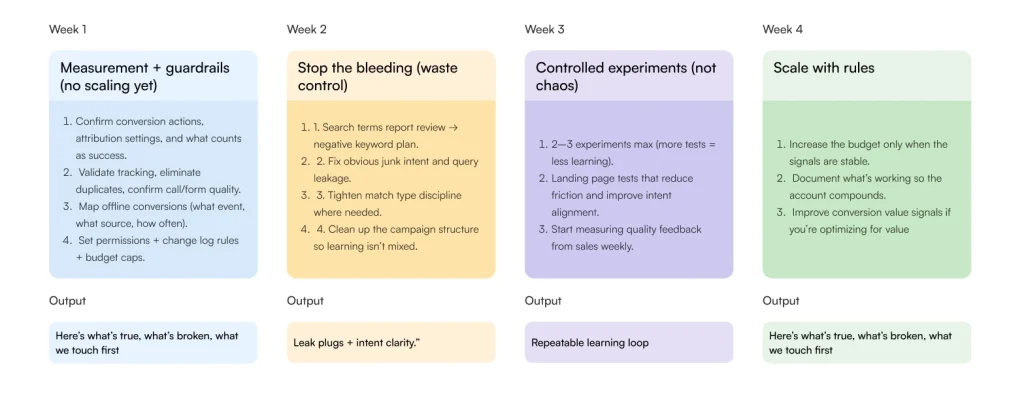
Here’s the onboarding plan that prevents chaos.
Weekly update template (force this cadence)
WEEKLY UPDATE (5-minute read)
| S.No | What changed (and why) | What we learned | Next week (tests) | Founder’s decisions needed |
|---|---|---|---|---|
| 1 | Change: | Winner: | 1- (hypothesis, metric, stop rule) | Decision: |
| 2 | Reason: | Loser: | 2- (hypothesis, metric, stop rule) | Options: |
| 3 | Expected outcome: | Why: | Recommendation: |
This format does two things: it makes performance legible, and it prevents “mystery optimizations” that nobody can explain later.
What does it cost to hire a Google Ads expert offshore?
From our experience, after placing Google Ads Experts across dozens of Small-Medium Businesses and B2B teams, here’s what the market looks like when you’re hiring properly (meaning: full-time, dedicated, accountable, not juggling five clients).
Pakistan
This is where we consistently find some of the strongest performance marketers relative to cost, especially for search-heavy, intent-driven Google Ads accounts.
Typical range: $1,200 – $2,500 / month
Best fit when you want:
- Strong technical execution
- Comfort with Bidding, search terms, negatives, and conversion setup
- willingness to work US hours or overlap meaningfully
Many of our most reliable Google Ads hires come from Pakistan because the market has deep exposure to performance marketing work for US companies, but local salary expectations are still grounded.
South Africa
South Africa tends to produce Google Ads experts who are very strong communicators and operate more like in-house team members, especially in service businesses and lead-gen models.
Typical range: $1,800 – $2,800 / month
- Best fit when you want:
- high English fluency and client-facing communication
- strong strategic thinking and reporting
- Less hand-holding from a management perspective
You usually pay more than Pakistan, but you’re buying polish, clarity, and ownership, not just execution.
Latin America (LATAM)
LATAM is a solid middle ground, particularly for founders who care about time-zone overlap and tight collaboration with sales or product teams.
Typical range: $2,000 – $3,000 / month
- Best fit when you want:
- real-time collaboration with US teams
- someone who feels very “internal” from day one
LATAM talent is not cheap, but the overlap and cultural alignment often justify the premium.
The part most founders miss
Here’s the part that actually matters, regardless of region: A bad system produces bad hires everywhere.
If you don’t have:
- a definition of what a “good lead” actually is,
- a weekly decision cadence,
- and clear guardrails around spend and changes,
Then hiring locally won’t save you, and hiring offshore won’t break you — you’ll just keep getting the same outcome at different price points.
We’ve seen founders pay $1,500/month for an offshore Google Ads expert who outperformed a $5,000/month agency, and we’ve seen founders burn money with cheap hires because nobody owned signal quality or lead feedback.
The cost of the hire is rarely the real risk.
The risk is wasted spending.
That’s why, at Pavago, we don’t consider offshore Google Ads hiring as “cheap labor.” We consider it as a way to get full-time ownership at a fair, market-appropriate cost, without paying US salary overhead for a role that doesn’t require US geography to be effective.
Real examples from Pavago (so this isn’t just theory)
We see a lot of founders approach offshore hiring like it’s a cost trick, and then they get burned because they hire the wrong profile, onboard them with no system, and hope the geography does the work for them.
The wins look different.
The wins happen when you hire offshore like you’d hire locally: same standards, clear expectations, real ownership, and a feedback loop that makes performance measurable beyond surface-level leads.
Here are two real examples we’ve worked through.
Celebrate Dental: replacing agencies with full-time offshore specialists (ownership, not “more tactics”)
Celebrate Dental is a growing dental group with seven locations across Texas, so marketing isn’t a “nice to have” for them; it directly impacts bookings, staffing, and how fast new locations ramp.
They started the way most multi-location businesses start: agencies for SEO and paid ads, monthly reports, and constant back-and-forth whenever anything needed to change. Over time, the real friction wasn’t strategy; it was that nothing felt owned inside the business, and every bit of context had to be re-explained whenever priorities shifted or people rotated.
So we helped them hire two full-time offshore marketing specialists, one for paid ads and one for SEO, and these weren’t freelancers or shared resources. They worked only on Celebrate Dental, joined meetings, were treated like internal team members, and were accountable for outcomes.
The CEO feedback is the part we pay attention to, because it’s the ownership signal founders actually want: “The PPC expert is a superstar. Leadership potential. Takes initiative.”
Financially, they were coming from typical monthly agency costs of $7,000–$13,000 across SEO and paid ads (not counting internal vendor-management time), and after shifting to dedicated full-time specialists, they estimated 40–60% lower fixed marketing overhead, one of the clearest ways to reduce marketing costs without losing ownership while gaining dedicated focus instead of shared attention. They also estimated freeing up 10–15 hours/month of leadership/operator time because communication became direct and execution stopped waiting for agency cycles.
What changed first wasn’t a dashboard metric. It was speed, initiative, and the feeling that marketing finally lived inside the company instead of inside a vendor relationship.
Zen Dental Studio: replacing Google Ads agencies with one accountable offshore hire
Zen Dental Studio operates two dental clinics in the Bay Area, where Google Ads directly affects patient acquisition. If ads underperform, chairs sit empty, so “marketing” is basically lead flow.
Before working with Pavago, Zen Dental relied on agencies for Google Ads and experienced the usual pattern: monthly retainers, inconsistent performance, slow changes, and constant context re-explaining. Their conclusion was simple: the problem wasn’t Google Ads, the problem was ownership. They wanted one person whose job was to care about performance every single day.
Through Pavago, Zen Dental hired a full-time Google Ads Expert in Pakistan with five years of hands-on experience at $1,400/month. This wasn’t a freelancer; it was a dedicated hire treated like an internal team member.
Before that hire, Google Ads agency fees were typically $3,000–$5,000/month. After switching to the full-time offshore specialist at $1,400/month, Zen Dental reduced Google Ads management costs by roughly 60–70% while gaining full-time ownership instead of partial agency attention.
Operationally, the biggest shift was speed: instead of tickets, delays, and monthly-report pacing, changes happened immediately, issues were flagged proactively, and testing became continuous rather than occasional, because someone was in the account daily.
And importantly, our role wasn’t “we run your ads.” Our role was: help them hire the right person, structure the hire so risk stayed low, and support the ramp when needed.
The takeaway (what these wins have in common)
- Offshore worked because standards stayed high, geography reduced cost, but it didn’t reduce expectations.
- The ROI came from ownership: someone inside the business caring daily, not vendors caring occasionally.
- The cost savings were real, but the bigger win was control: faster iteration, less founder time spent managing vendors, and knowledge staying inside the company.
If you want to hire an offshore Google Ads Expert without spending weeks screening people
Book a consult with Pavago, and we’ll show you three pre-vetted Google Ads specialists offshore live on the call, walk you through how we’d score them using the same criteria in this post, and help you pick the best fit for yoursituation (stop waste, fix lead quality, or scale responsibly).
See 3 vetted Google Ads experts on your call
FAQs
1) What’s the safest way to hire a Google Ads Expert offshore?
We don’t start with resumes, because resumes don’t tell you who can protect your budget; we start with a system that forces competence to show up fast: a scorecard, a paid 48–72 hour audit test, and a 30-day onboarding plan with weekly decision cadence. Offshore is just a hiring market; your process is what determines whether you get an owner or a button-pusher.
2) How much does it cost to hire an offshore Google Ads Expert through us?
Most founders should think in monthly “dedicated owner” cost, not hourly freelancer rates, because the real win is ownership and compounding learning. In our experience, the typical monthly ranges look like this: Pakistan: $1.2k–$2k/month, South Africa: $1.8k–$2.8k/month, LATAM: $2k–$3k/month, and the exact number depends on seniority, communication strength, and how much US-hours overlap you want.
3) Does hiring offshore reduce the risk of a bad Google Ads hire?
No!. and we’re very direct about this with founders. If your hiring system is weak (no test project, no definition of a good lead, no weekly accountability), you can hire locally and still get the wrong person; you’ll just pay more to learn the same lesson.
4) What interview questions actually expose a real Google Ads expert?
We ask questions that force someone to think like an owner, not a task-doer:
- “What do you check in the first 60 minutes of a new account?” (They should start with tracking + conversion actions)
- “If lead quality is bad, how do you prove whether it’s ads vs landing page vs sales follow-up?”
- “How do you stop wasted spend fast?” (search terms + negatives + intent control)
- “How would you set up offline conversions so Google optimizes toward SQL/opportunities, not just form fills?”
5) I’m B2B, how do we stop Google Ads from optimizing toward low-quality leads?
You stop rewarding Google for shallow conversions, because the system will optimize toward whatever you call a “win.” In practice, that means tightening intent (so you’re not buying curiosity clicks), fixing landing page clarity (so the right people convert), and feeding back better signals via offline conversions (SQL / opportunity stages) so the account learns what “good” actually looks like.
6) Do bid modifiers/bid adjustments still matter with Smart Bidding?
Sometimes, but they’re not the magic lever people think they are once you’re running Target CPA/ROAS at scale. A real operator knows when bid adjustments matter, when they’re effectively ignored, and what levers to use instead, usually conversion signal quality, query intent control (search terms + negatives), structure that helps learning, and landing page alignment, not constant bid tweaking.
7) What should an offshore Google Ads expert deliver in the first 30 days?
We expect a clean sequence that protects spend while building a foundation for scale:
- Week 1: measurement sanity + guardrails (no cowboy changes)
- Week 2: waste removal (search terms, negatives, intent cleanup)
- Week 3: controlled experiments (2–3 max, with stop rules)
- Week 4: scale rules + documentation so wins compound
8) If we want to shortcut hiring, what’s the fastest path with Pavago?
If you don’t want to screen 10–20 candidates just to find out most of them can’t talk about offline conversions, lead quality loops, or Smart Bidding reality, we keep it simple: you book a consult and we show you three vetted offshore Google Ads Consultants live on the call, then we help you compare them side-by-side using a scorecard so you can pick the best fit for your situation (stop waste, fix lead quality, or scale responsibly).