Why “Business System Analyst” Gets the Hire Wrong
The job market treats these three titles as interchangeable. They’re not.
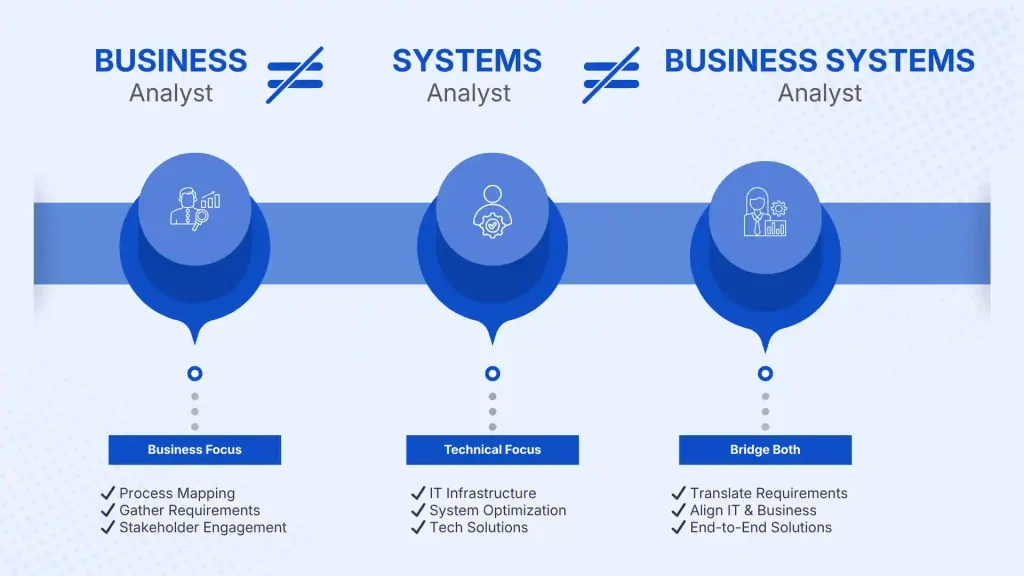
A business analyst maps processes and gathers requirements from stakeholders. A systems analyst evaluates IT infrastructure and recommends technical solutions. A business systems analyst does both: they translate business needs into system specifications and ensure technology aligns with business objectives.
Hire a business analyst when you need a systems analyst: you get a requirements document with no technical recommendations. Hire a systems analyst when you need someone who can talk to your sales team about their workflow: you get a technically brilliant person who can’t translate business language. The most common hiring mistake we see at Pavago: SMBs cycling through freelancers on Upwork for “analyst” work without defining which of these three roles they need.
The Three Roles (And What Each Actually Does)
| Business Analyst (BA) | Systems Analyst (SA) | Business Systems Analyst (BSA) | |
|---|---|---|---|
| Primary focus | Business processes, requirements, stakeholder management | IT systems, technical architecture, system performance | Bridge: translating business needs into system solutions |
| Key deliverables | Requirements docs (BRDs), process maps, user stories, gap analyses | System specs, technical assessments, architecture diagrams, integration plans | Both: BRDs + technical specs + implementation roadmaps |
| Who they talk to | Business stakeholders, product owners, end users | IT teams, developers, database admins, vendors | Both: they’re the translator between business and tech |
| Tools | JIRA, Confluence, Visio, Excel, Lucidchart | SQL, ERP systems, cloud platforms, monitoring tools | All of the above |
| Best for | Companies that know WHAT they want but need someone to document it clearly | Companies that have IT systems that need evaluation, optimization, or migration | Companies where business processes and IT systems are tightly coupled and someone needs to own both |
| U.S. salary | $70K–$100K | $75K–$110K | $80K–$120K |
| Offshore monthly | $1,200–$2,500 | $1,500–$3,000 | $1,500–$3,500 |
Which Do You Actually Need?
“Our team wastes time because our processes are messy and undocumented.” → Business Analyst. They’ll map current workflows, identify bottlenecks, gather requirements for improvement, and document everything so your team stops reinventing processes.
“Our ERP/CRM/internal systems are slow, fragmented, or don’t talk to each other.” → Systems Analyst. They’ll evaluate your current tech stack, identify integration gaps, and recommend solutions. Pavago’s offshore system analyst page shows the type of professionals available for this work.
“We’re implementing a new system (ERP, CRM, HRIS) and need someone to manage the gap between what the business needs and what the software does.” → Business Systems Analyst. This is the role most companies searching for “business system analyst” actually need. They own the implementation from requirements through go-live.
The Screening Problem: Framework-Locked Candidates
After screening 100+ technical candidates, the failure pattern we see most with analyst roles is different from what you’d expect. It’s not lack of technical skills. It’s candidates who are strong in one system or framework but can’t adapt to the client’s stack.
A BSA who’s spent 5 years in SAP may be lost when your company runs NetSuite. An analyst fluent in Salesforce may struggle with HubSpot. The technical knowledge is transferable in theory, but candidates who’ve only worked in one ecosystem often can’t make the jump without significant ramp-up time.
This is why we screen for adaptability, not just proficiency. Our AI-vetted screening process evaluates whether candidates can learn new systems quickly, not just whether they’ve used your specific tools before. For more on how we evaluate adaptability, see our interview questions for offshore candidates guide.
Where to Find Business System Analysts
For project-based needs: Upwork and Toptal have BSA talent, but quality varies. The analyst role requires deep business context that’s hard to evaluate from a profile.
For U.S. placements: Robert Half and Insight Global place analysts regularly, but at enterprise pricing ($80K–$120K+ with agency markup).
For dedicated offshore hires: Pakistan, and the Philippines produce strong analyst talent, particularly professionals with ERP implementation experience (SAP, Oracle, NetSuite). The hire engineering category at Pavago includes system analyst professionals.
One of our clients, FLLR Consulting, needed to scale operations without adding U.S.-level overhead. We placed dedicated professionals who helped them build scalable systems. Read the full FLLR Consulting case study for how the engagement was structured.
Cost Comparison
| U.S. Full-Time | Freelance | Offshore Dedicated | |
|---|---|---|---|
| Business Analyst | $70K–$100K/yr | $50–$100/hr | $1,200–$2,500/mo |
| Systems Analyst | $75K–$110K/yr | $60–$120/hr | $1,500–$3,000/mo |
| Business Systems Analyst | $80K–$120K/yr | $65–$150/hr | $1,500–$3,500/mo |
For SMBs building remote operations, the offshore model delivers the same analytical rigor at 60–75% lower cost. For how to structure a remote technical team, see our build a successful remote first company guide.
How to Vet a Business System Analyst
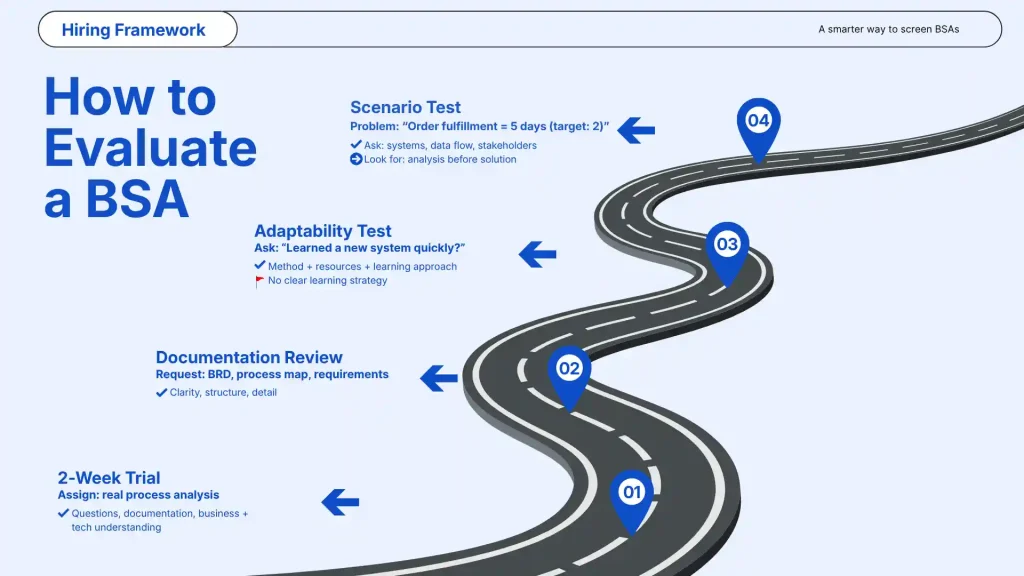
Step 1: Scenario test. Describe a real business problem (e.g., “Our order fulfillment takes 5 days when it should take 2”). Ask them to walk through their analysis approach. Good BSAs ask clarifying questions about systems, data flows, and stakeholders before proposing solutions.
Step 2: System adaptability test. Ask about a time they had to learn a new system quickly. How did they approach it? What resources did they use? Candidates who’ve only ever worked in one ecosystem and can’t articulate a learning methodology are likely to struggle in your environment.
Step 3: Documentation review. Ask for a sample BRD, process map, or requirements document from a previous role. The quality of their documentation tells you more than any interview about how they think and communicate.
Step 4: 2-week trial. Give them a real business process to analyze. Evaluate: do they ask the right questions? Can they produce clear documentation? Do they understand both the business and technical dimensions? For structuring the trial, our offshore dedicated team guide covers onboarding frameworks for technical hires.
Frequently Asked Questions
What does a business system analyst do?
A business systems analyst bridges business operations and IT systems. They gather requirements from stakeholders, evaluate current systems, recommend improvements, and ensure technology implementations align with business goals. Day-to-day work includes creating requirements documents, facilitating meetings between business and tech teams, managing system implementations, and conducting gap analyses.
How much does a business system analyst cost?
U.S.: $80,000–$120,000/year. Freelance: $65–$150/hour. Offshore dedicated: $1,500–$3,500/month through platforms like Pavago.
What’s the difference between a business analyst and a business systems analyst?
A business analyst focuses on business processes, requirements gathering, and stakeholder management. A business systems analyst adds the technical dimension: they understand IT systems, can write technical specifications, and can manage system implementations. If your project involves technology changes, you need the BSA. If it’s purely process improvement, a BA suffices.
What certifications should a BSA have?
CBAP (Certified Business Analysis Professional) is the gold standard. PMI-PBA (Professional in Business Analysis) is valued for project-heavy roles. For systems-focused BSAs, certifications in specific platforms (Salesforce Administrator, SAP certification, Oracle) demonstrate depth. ITIL certification shows IT service management knowledge.
Can I hire a business system analyst from another country?
Yes. BSA work is requirements-driven, documentation-heavy, and increasingly remote. Cloud-based tools (JIRA, Confluence, Lucidchart) work globally. The key is vetting for communication quality and business process understanding. Pakistan, and the Philippines have strong BSA talent pools. Our guide on how to hire offshore software developers covers the vetting process for technical offshore hires.
Do I need a full-time BSA or a consultant?
System implementations and major process overhauls need a dedicated BSA for 6–12+ months. One-time audits or requirements gathering for a specific project can use a consultant. The breakeven: if you need analyst support for 20+ hours/week ongoing, a dedicated hire is cheaper and produces better institutional knowledge.
Name the Role. Then Name the Hire.
“Business system analyst” covers three different jobs. The companies that hire well identify which type they need before writing the job description. Business process problem? BA. IT system problem? SA. Need someone to bridge both? BSA. The title determines the talent pool, the vetting criteria, and the outcome.
Hire Business System Analysts Through Pavago
We place dedicated BAs, systems analysts, and business systems analysts for SMBs. Every candidate screened for system adaptability, not just proficiency in one platform. 100+ technical candidates vetted in the last 18 months.
BSAs from $1,500/month | ERP/CRM specialists available | Free replacements