How Payroll Outsourcing Companies Actually Work
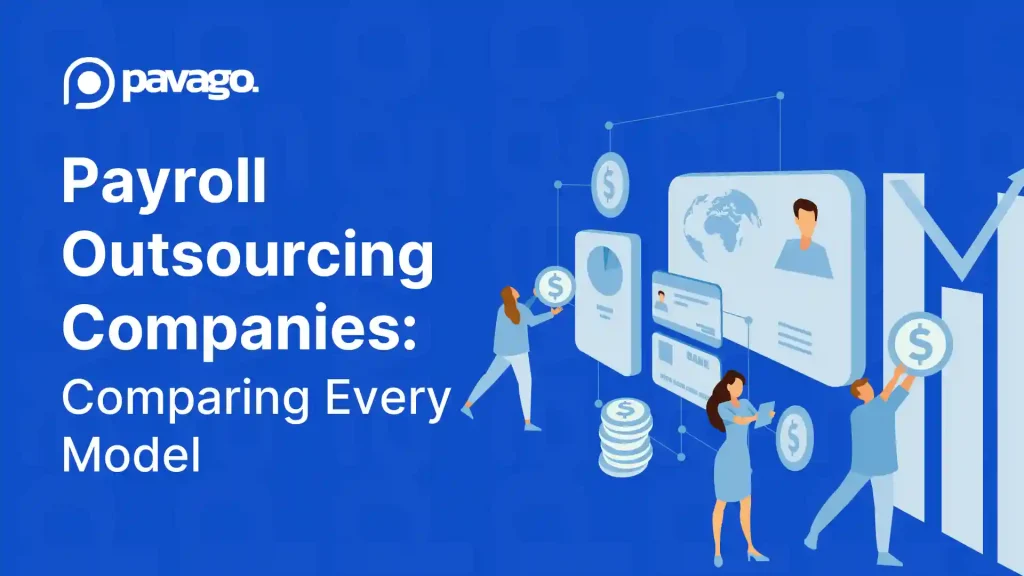
Payroll outsourcing companies provide a combination of software and service: they calculate pay, withhold and deposit taxes, file quarterly and annual returns, process direct deposits, and generate year-end tax forms. According to the American Payroll Association, payroll errors affect roughly 33% of employers annually, resulting in IRS penalties. (external, dofollow, new tab) That risk is the primary reason companies outsource payroll in the first place.
The 4 Payroll Models With Real Costs
| DIY Software | Payroll Company | Full-Service PEO | Dedicated Specialist | |
|---|---|---|---|---|
| Examples | Gusto, QuickBooks Payroll, Wave | ADP RUN, Paychex Flex, OnPay | Justworks, Trinet, ADP TotalSource | Pavago-placed payroll professional |
| How it works | You run payroll through software that automates calculations and tax filings. | Company processes payroll for you. You input hours/salaries, they handle the rest. | Co-employer model: PEO handles payroll + benefits + compliance + HR. | One full-time person who processes your payroll, handles bookkeeping, and manages financial reporting. |
| Base monthly fee | $40–$125 | $59–$149 | Varies (bundled) | $0 (you pay their salary) |
| Per employee | $6–$12 | $4–$14 | $100–$250 | $0 |
| Cost for 10 employees | $100–$245 | $99–$289 | $1,000–$2,500 | $1,000–$1,500 |
| Cost for 25 employees | $190–$425 | $159–$499 | $2,500–$6,250 | $1,000–$1,500 |
| Cost for 50 employees | $340–$725 | $259–$849 | $5,000–$12,500 | $1,000–$1,500 |
| What else is included | Nothing. Payroll only. | Tax filing, year-end forms. No bookkeeping. | Benefits admin, compliance, HR. No bookkeeping. | Payroll + bookkeeping + reconciliation + reporting. |
The inflection point: at 15–20 employees, the per-employee model (payroll companies and PEOs) costs as much as or more than a dedicated specialist whose cost stays flat. At 50 employees, a PEO can hit $12,500/month while a dedicated specialist stays at $1,500.
What Most Payroll Guides Won’t Tell You
Hidden cost 1: Year-end fees. Most payroll companies charge $50–$200 extra for W-2/1099 generation and distribution. That’s $200–$600 at year-end for a 25-person company.
Hidden cost 2: Off-cycle runs. Bonus payrolls, correction runs, and termination payrolls often cost $10–25 per additional run.
Hidden cost 3: State registration. If you have employees in multiple states, some payroll companies charge $20–50 per new state registration.
Hidden cost 4: Payroll companies don’t do bookkeeping. This is the big one. ADP processes your payroll but doesn’t reconcile your books. Gusto calculates taxes but doesn’t prepare your P&L. You still need an accountant or bookkeeper for everything else. A dedicated specialist handles BOTH payroll and bookkeeping in one role.
At Pavago, we place payroll specialists who use your software (Gusto, QuickBooks Payroll, ADP) and handle payroll processing alongside bookkeeping and financial reporting. Browse our payroll consultant page, or the full hire finance category for all finance roles.
When Each Model Makes Sense
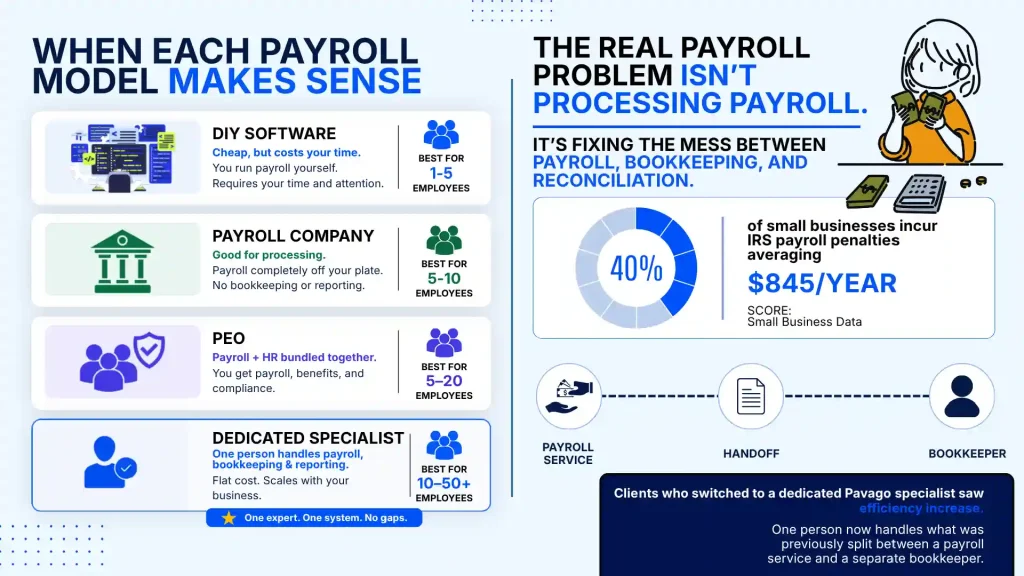
DIY software: You have 1–5 employees with simple pay structures and you’re comfortable running payroll yourself. Cheapest option. Requires your time and attention.
Payroll company: You have 10–50 employees and want payroll completely off your plate but don’t need bookkeeping or financial reporting. Works well as a pure payroll solution.
PEO: You have 5–20 employees and want payroll + benefits + compliance bundled. You’re okay with co-employment and 12-month lock-in. Best for companies that want zero HR involvement.
Dedicated specialist: You have 10–50+ employees and want one person who owns payroll AND bookkeeping AND reconciliation AND reporting. Cost stays flat regardless of headcount. Most cost-effective at 15+ employees.
Clients who switched from payroll outsourcing companies to dedicated Pavago specialists saw efficiency increase because one person now handles what was previously split between a payroll service and a separate bookkeeper. The consolidation eliminates the reconciliation gap between the two.
According to SCORE small business data, 40% of small businesses incur an average IRS payroll penalty of $845 per year. (external, dofollow, new tab) A dedicated specialist eliminates this by owning the entire process end to end.
For how we’ve helped companies build scalable finance operations, see the FLLR Consulting case study. For the broader payroll outsourcing process, our outsource payroll guide covers the step-by-step. And for general cost comparisons, our offshore hiring pros and cons guide covers the economics.
Frequently Asked Questions
How much do payroll outsourcing companies charge?
Software: $100–$425/month for 10–25 employees. Payroll companies: $99–$499/month. PEOs: $1,000–$6,250/month. Dedicated specialist: $1,000–$1,500/month flat regardless of headcount.
What’s the best payroll outsourcing company for small businesses?
Gusto is the most user-friendly for small teams (under 25). ADP and Paychex have more features for mid-size. But the “best” depends on whether you need pure payroll software or a dedicated person. For most SMBs above 15 employees, a dedicated specialist delivers more value.
Should I use Gusto or hire a payroll person?
Use Gusto alone if payroll is your only need and you have time to manage it. Hire a dedicated specialist if you also need bookkeeping, reconciliation, and financial reporting. The specialist uses Gusto as the tool but handles everything the software doesn’t.
Can I outsource payroll to another country?
Yes. The specialist uses your U.S. payroll software and follows U.S. tax rules. Cloud-based tools make location irrelevant. The math, the deadlines, and the compliance requirements are the same regardless of where the person processing them sits.
What payroll software do offshore specialists use?
Gusto, QuickBooks Payroll, ADP RUN, Paychex Flex, Rippling, and Xero. All cloud-based, all globally accessible. The specialist works in YOUR system.
When should I switch from a payroll company to a dedicated specialist?
When you’re paying $300+/month for payroll processing AND separately paying for bookkeeping. A dedicated specialist at $1,000–$1,500/month consolidates both and adds financial reporting. For more, our virtual assistant companies guide compares outsourcing models across all admin functions.
The Best Payroll Outsourcing Company Might Not Be a Company at All
Payroll outsourcing companies solve one problem: payroll processing. A dedicated specialist solves three: payroll + bookkeeping + financial reporting. For SMBs where payroll is just one piece of the finance puzzle, the specialist model delivers more value at comparable cost. The companies getting the most from their payroll spend in 2026 aren’t the ones paying ADP the most. They’re the ones who consolidated payroll and bookkeeping into a single dedicated hire.
Hire a Payroll Specialist Through Pavago
Gusto, QuickBooks, ADP proficient. Handles payroll + bookkeeping + reconciliation + reporting. One person. One cost. No per-employee fees.
Payroll specialists from $1,000/month | Fixed cost | Free replacements