
Why Payroll Outsourcing Cost Is So Confusing
Google “payroll outsourcing cost” and you’ll find 20 articles that each give a different number. Gusto says $49/month. ADP says, “contact us.” A PEO says $80–$150/employee. A freelance bookkeeper on Upwork says $25/hour. They’re all technically correct because they’re all describing different models that include different things.
The confusion comes from comparing models as if they’re the same product at different prices. They’re not. A payroll software subscription, a payroll company service, a PEO co-employment arrangement, and a dedicated payroll specialist are four fundamentally different products. Comparing their monthly price tags without understanding what each includes is how SMBs end up overpaying for payroll for years without realizing it.
Payroll Outsourcing Cost by Model (Real Numbers)
| Model | Examples | Base Monthly Fee | Per Employee/Month | 10 Employees/Month | 25 Employees/Month | 50 Employees/Month |
|---|---|---|---|---|---|---|
| DIY payroll software | Gusto, QuickBooks Payroll, Wave, OnPay | $40–$125 | $6–$12 | $100–$245 | $190–$425 | $340–$725 |
| Payroll company | ADP RUN, Paychex Flex, SurePayroll | $59–$149 | $4–$14 | $99–$289 | $159–$499 | $259–$849 |
| Full-service PEO | Justworks, Trinet, ADP TotalSource, Insperity | Bundled | $80–$150 | $800–$1,500 | $2,000–$3,750 | $4,000–$7,500 |
| Dedicated specialist | Payroll + bookkeeping professional hired through Pavago | $0 (flat salary) | $0 | $1,000–$1,500 | $1,000–$1,500 | $1,000–$1,500 |
The pattern nobody points out: software and payroll companies get cheaper as you scale (per-employee costs stay flat while base fees amortize). PEOs get MORE expensive as you scale (per-employee costs multiply). And the dedicated specialist stays perfectly flat regardless of headcount. At 15–20 employees, the specialist matches payroll company pricing. At 25+, the specialist is dramatically cheaper. At 50, it’s not even close.
An IRS study cited by Thomson Reuters found that 33% of employers make payroll errors each year, resulting in costly amendments and penalties. Accurate payroll isn’t optional. The question is which model delivers accuracy at the right cost for your company’s size.
What Each Model Actually Includes (And What It Doesn’t)
This is where the real comparison happens. Price means nothing without scope.
DIY Payroll Software (Gusto, QuickBooks Payroll)
Includes: Automated pay calculations, tax withholding, direct deposit processing, quarterly and annual tax filings, W-2/1099 generation, employee self-service portal for pay stubs and tax forms.
Does NOT include: Bookkeeping. Reconciliation. AP/AR. Financial reporting. CPA coordination. Anything beyond processing pay runs and filing payroll taxes.
Your time required: 2–5 hours per pay period to input hours, verify calculations, approve runs, and handle exceptions. This is the hidden cost. At $100/hour of your time, that’s $200–$500 per pay period in founder time.
Payroll Company (ADP RUN, Paychex Flex)
Includes: Everything the software does, but the company processes it for you. You input hours and salary changes; they handle calculations, deposits, filings, and year-end forms.
Does NOT include: Bookkeeping. Reconciliation. Financial reporting. The payroll company handles payroll and ONLY payroll. Everything else in your finance function is still your problem.
Your time required: 30 minutes–1 hour per pay period to input data and approve. Significantly less than DIY, but you still need a separate bookkeeper.
Full-Service PEO (Justworks, Trinet)
Includes: Payroll + benefits administration + compliance support + HR admin + workers’ comp. The most comprehensive package. Also, the most expensive, and you become a co-employee (the PEO is the legal employer of record for tax purposes).
Does NOT include: Bookkeeping. Financial reporting. CPA coordination. PEOs handle the employment relationship, not the accounting function.
Your control: Limited. Co-employment means the PEO has a say in employment decisions. Switching off a PEO means migrating payroll, benefits, compliance, and all associated infrastructure. Budget $2K–$5K and 2–4 weeks of disruption for the transition.
Dedicated Specialist (Pavago Model)
Includes: Payroll processing using YOUR software (Gusto, QuickBooks, ADP) + bookkeeping + bank reconciliation + AP/AR management + financial reporting + CPA coordination + month-end close. One person owns the entire finance operations layer.
Does NOT include: Benefits administration (use a benefits broker). Tax strategy (use a CPA). Audit support (senior accountant or CPA).
Your control: Full. The specialist works directly for you. No co-employment. No lock-in. No per-employee scaling.
Pavago is a self-serve hiring marketplace where you search vetted payroll specialists yourself: people who use your existing software and handle payroll alongside the full bookkeeping function. Browse the payroll consultant page, or the full hire finance category for all finance roles. You get matched in under a minute, watch video intros and hire directly, with no sales call and no recruiter in the middle.
The Hidden Costs Nobody Puts on the Pricing Page
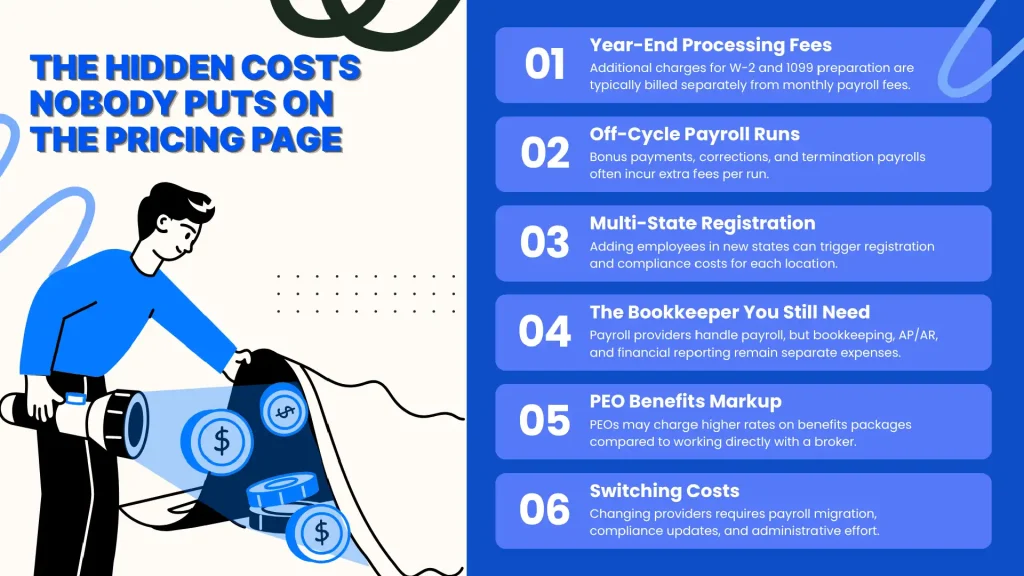
Every payroll outsourcing model has costs that don’t appear on the monthly invoice. Here’s what you’re actually paying:
- Year-end processing fees: $50–$200 extra for W-2/1099 generation and distribution. Many payroll companies charge this on top of regular monthly fees, though some, such as Gusto and Justworks, include it. For a company with 25 employees, that’s $200–$500 every January.
- Off-cycle payroll runs: $10–25 per additional payroll with providers that charge for them (Gusto and Justworks include unlimited runs). Bonuses, correction runs, termination payrolls, commission payrolls. If you run 4 off-cycle payrolls per year, that’s $40–$100 extra.
- Multi-state registration: $20–50 per new state. Remote employees in 3 states = $60–$150 in state registration fees. As remote work grows, this cost grows with it.
- The bookkeeper you still need: This is the hidden cost that breaks the comparison. Payroll companies don’t do bookkeeping. You still need someone to reconcile your books, manage AP/AR, and produce financial reports. That’s $500–$2,000/month for a freelance bookkeeper or outsourced accounting service. Add that to your payroll company bill, and the real cost of “payroll outsourcing” doubles.
- PEO benefits markup: PEOs bundle health insurance and 401(k), but mark up 10–25% over what you’d pay going direct through a benefits broker. In a 25-person company, that’s $5,000–$15,000/year in hidden margin on benefits alone.
- Switching costs: Leaving a PEO means migrating payroll, benefits enrollment, tax accounts, and compliance documentation. Budget $2,000–$5,000 and 2–4 weeks of disruption. Leaving a payroll company is simpler but still requires moving tax registrations.
The Real Math: What Our Clients Were Paying Before and After
This isn’t hypothetical. Here’s the actual before-and-after for clients who switched to a dedicated Pavago specialist:
Before Pavago (Typical Client Setup): Payroll company (ADP/Paychex): $300/month, Separate freelance bookkeeper: $1,500/month, CPA quarterly review: $400/month, Year-end processing fee: $200/year = $17/month, Off-cycle payroll runs (4/year): $80/year = $7/monthTotal: ~$2,224/month ($26,688/year)
After Pavago: Dedicated payroll + bookkeeping specialist: $1,000–$1,500/month. CPA for annual tax filing only: $250/month amortized. Hiring through Pavago is a one-time 3% of first-year salary ($360–$540 at $1,000–$1,500 a month), and messaging and interviews are free. Plane payroll is free for the first 60 days, then optional at $149/month per hire. Total: $1,250–$1,750/month ($15,000–$21,000/year), plus $360–$540 once in year one.
Annual savings: $5,688–$11,688 (about 21–44%), before the one-time $360–$540 placement fee in year one.
The savings grow when you’re paying $2,000+/month for a bookkeeper on top of your payroll service. Consolidating both into one dedicated hire at $1,000–$1,500 is what drives them. According to SCORE, roughly 40% of small businesses pay a payroll tax penalty each year, averaging $850 to $1,000 per incident. A dedicated specialist who owns the entire process end-to-end eliminates this risk because one person is accountable for accuracy, not a chain of disconnected tools and vendors.
When Each Model Makes Sense
DIY software (Gusto, QBO Payroll): 1–5 employees. Simple pay structures (all salaried, one state). You have the time and willingness to run payroll yourself. Budget: $50–$150/month.
Payroll company (ADP, Paychex): 10–50 employees. You ONLY need payroll processing and tax filing. You already have a bookkeeper or accountant handling everything else. Budget: $100–$500/month.
PEO (Justworks, Trinet): 5–20 employees. You want payroll + benefits + compliance + HR bundled into one vendor. You’re comfortable with co-employment and a 12-month lock-in. Budget: roughly $400–$2,500/month in PEO fees, plus benefits premiums.
Dedicated specialist (Pavago): 10–50+ employees. You need payroll, bookkeeping, reconciliation, and financial reporting. You want one person who owns the entire finance operations layer. Fixed cost regardless of headcount. Budget: $1,000–$1,500/month for everything.
For how we’ve helped companies build scalable finance operations from scratch, see the FLLR Consulting case study. For the full payroll outsourcing process, our outsource payroll guide covers step-by-step. For a broader cost context, our virtual assistant companies guide compares outsourcing models across functions.
Frequently Asked Questions
How much does payroll outsourcing cost per employee?
Software: $6–$12/employee/month. Payroll companies: $4–$14/employee/month. PEOs: $80–$150/employee/month, before health premiums. Dedicated specialist: $0/employee (flat monthly cost of $1,000–$1,500 regardless of how many employees you have).
Is Gusto or ADP cheaper?
Gusto is generally cheaper for small teams: its plans start at $49/month plus $6 per person. ADP doesn’t publish RUN pricing, and third-party estimates put its entry plan near $79/month plus about $4 per employee. Gusto has a more intuitive interface and transparent pricing. ADP has more enterprise features and integrations. For teams under 25, Gusto usually wins on both price and ease of use.
When should I switch from payroll software to a dedicated specialist?
When payroll admin takes 5+ hours per pay period, OR when you’re paying for a payroll service AND a separate bookkeeper. The consolidation is the value driver: one person handling payroll + bookkeeping + reporting at $1,000–$1,500/month costs less than a $300/month payroll company + a $1,500/month bookkeeper.
What payroll tools do Pavago specialists use?
Gusto, QuickBooks Payroll, ADP RUN, Paychex Flex, Rippling, Xero, and OnPay. All cloud-based, all globally accessible. The specialist works in YOUR system. They don’t bring their own software and ask you to switch.
Can I outsource payroll to another country?
Yes. The specialist uses U.S. payroll software, follows U.S. tax rules, and files U.S. tax forms. Cloud-based tools make the specialist’s physical location irrelevant. The math, the deadlines, and the compliance requirements are the same regardless of where the person processing them sits.
What’s the difference between payroll outsourcing and payroll software?
Payroll software automates calculations but you still manage the process (input data, verify, approve, handle exceptions). Payroll outsourcing means someone else handles the entire process. A dedicated specialist takes it one step further: they handle payroll AND all the finance functions the payroll company doesn’t touch.
How do I know if I’m overpaying for payroll?
Add up everything you spend on payroll-related costs: payroll company fee + year-end fees + off-cycle fees + state registration fees + your time managing the process + your bookkeeper’s fee for the finance tasks your payroll company doesn’t cover. If the total exceeds $1,500/month and you have 15+ employees, you’re almost certainly overpaying relative to the dedicated specialist model.
The Cheapest Payroll Option Depends on What You’re Actually Paying For
If you only need automated pay runs and tax filings, payroll software at $100–$400/month works. If you need payroll processed by someone else, a payroll company at $200–$500/month works. If you need payroll, bookkeeping, PLUS reconciliation PLUS financial reporting, a dedicated specialist at $1,000–$1,500/month costs less than the combination of vendors you’re currently using to cover those functions separately.
That’s where the savings come from. Not by cutting service. By consolidating three vendor relationships into one dedicated hire who costs less than any two of them combined.
Stop Overpaying for Payroll
Through Pavago, you can hire a payroll specialist who owns your entire finance operations layer: payroll + bookkeeping + reconciliation + reporting. One person. One cost. No per-employee fees. No year-end surprises.
- Payroll specialists from $1,000/month
- Gusto, QuickBooks, ADP, Paychex proficient
- Fixed cost regardless of headcount
- Free replacements if a hire doesn’t work out