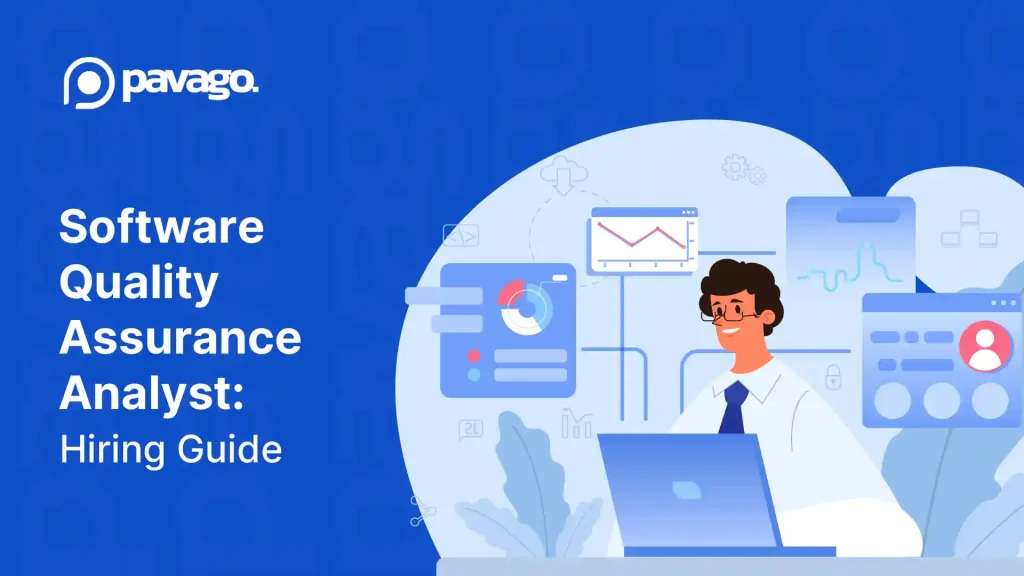
What a Software Quality Assurance Analyst Actually Does
The title sounds straightforward, but the role spans a wide range depending on the company:
| Function | What It Includes | Why It Matters |
|---|---|---|
| Test planning | Design test strategies, create test plans and cases aligned to requirements | Without a plan, testing is random. Structured testing finds more defects. |
| Manual testing | Execute exploratory, functional, regression, and user acceptance tests | Catches UX issues and edge cases that automation misses. |
| Automation testing | Build and maintain automated test suites (Selenium, Cypress, Playwright, Appium) | Scales testing across builds. Catches regressions instantly. |
| Defect management | Document bugs with reproduction steps, severity, and context in tracking systems (JIRA) | Clear defect reporting reduces developer debugging time by 50%+. |
| API testing | Test backend endpoints for correct responses, error handling, performance | Frontend can look perfect while backend returns wrong data. API testing catches this. |
| Performance testing | Load testing, stress testing, identifying bottlenecks (JMeter, k6, Gatling) | Prevents your app from crashing when traffic spikes. |
| CI/CD integration | Integrate automated tests into deployment pipelines | Catches bugs before code reaches production, not after. |
The key distinction most companies miss: there’s a massive difference between a QA analyst who follows scripts and one who thinks adversarially about how software fails. The script-follower catches known bugs. The adversarial thinker catches the bugs you didn’t anticipate. At Pavago, our screening process specifically tests for this adversarial thinking.
Our Process for Hiring QA Analysts
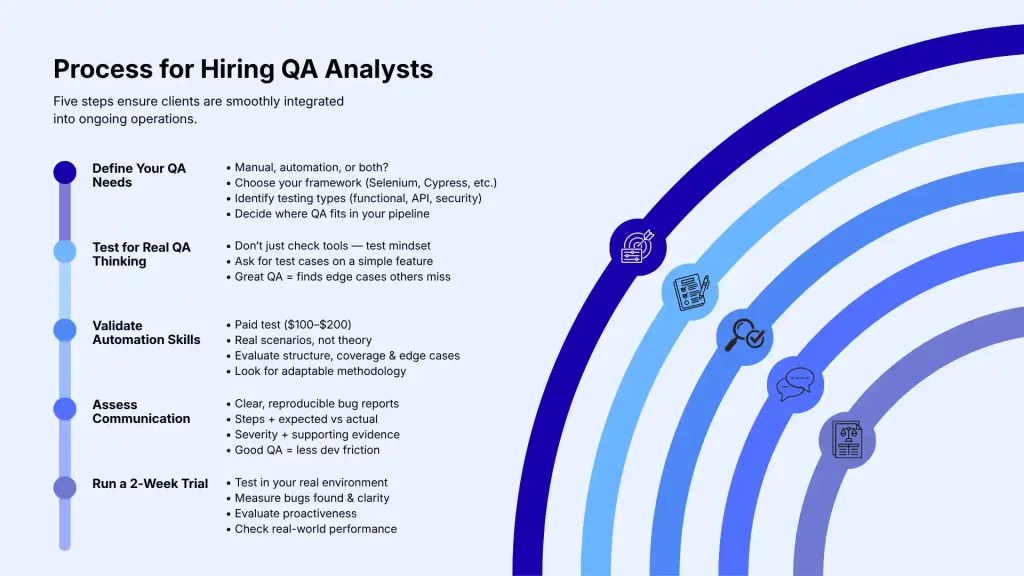
Step 1: Define Your QA Needs
Before screening candidates, answer:
- Manual, automation, or both? Early-stage startups may need manual + exploratory testers. Growing products need automation to scale.
- Which automation framework? Selenium? Cypress? Playwright? Appium for mobile? This determines who to screen.
- What types of testing? Functional? Performance? Security? API? Each requires different expertise.
- Where in the pipeline? Do you need someone writing tests during development (shift-left) or validating before release?
Browse Pavago’s offshore quality assurance page for available QA talent, or the broader hire engineering category.
Step 2: Screen for Adversarial Thinking, Not Just Tool Knowledge
The test that separates great QA from mediocre QA:
Show them a simple feature (e.g., a login form with email and password fields). Ask: “List every test case you would write for this feature.” The script-follower gives you 5–8 obvious cases (valid login, wrong password, empty fields). The adversarial thinker gives you 20+: SQL injection, XSS in email field, max character limits, password with special characters, concurrent logins, session timeout, password reset flow, email case sensitivity, rate limiting on failed attempts.
The depth of their test case list tells you more about their QA instincts than any certification on their resume.
Step 3: Test Automation Quality (If Applicable)
Give a paid automation challenge ($100–$200, 3–4 hours): Provide a simple web app (or a public one like TodoMVC). Ask them to write automated tests covering 5 scenarios of their choice. Evaluate: test structure, assertions quality, reusability, error handling, and whether they test happy paths AND edge cases.
The framework-lock problem applies strongly to QA. A candidate who’s spent 3 years writing Selenium tests in Java may freeze when your stack requires Cypress with TypeScript. We screen for testing methodology that transfers across tools, not just proficiency in one framework.
Step 4: Evaluate Communication and Documentation
QA analysts write bug reports that developers have to read and act on. Give them a sample bug to document. Evaluate: is the report clear enough for a developer who wasn’t in the room to reproduce the issue? Does it include steps, expected vs actual behavior, severity assessment, and screenshots/logs? Poor bug reports create friction between QA and development. For more on evaluating communication, our interview questions for offshore candidates guide includes QA-specific prompts.
Step 5: 2-Week Trial in Your Environment
Assign them real testing work on your actual product. Evaluate: how many real defects do they find? How clear are their reports? Do they suggest test improvements proactively? Can they navigate your codebase enough to write meaningful automation? For structuring the trial, our onboarding remote employees framework covers the first 30 days.
Our clients building offshore technical teams have seen strong results from dedicated QA placements. See the Eversite case study for how we structured a performance-focused offshore technical team.
What Does a Software QA Analyst Cost?
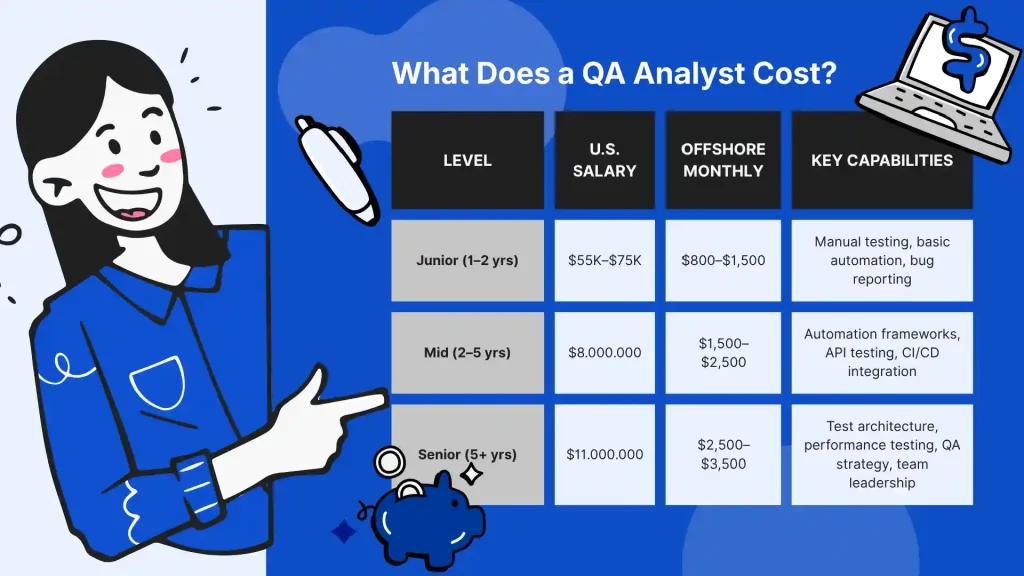
| Level | U.S. Salary | Offshore Monthly | Key Capabilities |
|---|---|---|---|
| Junior (1–2 yrs) | $55K–$75K | $800–$1,500 | Manual testing, basic automation, bug reporting |
| Mid (2–5 yrs) | $75K–$100K | $1,500–$2,500 | Automation frameworks, API testing, CI/CD integration |
| Senior (5+ yrs) | $100K–$130K+ | $2,500–$3,500 | Test architecture, performance testing, QA strategy, team leadership |
India, Pakistan, and Eastern Europe produce the strongest QA talent pools. The BLS projects 25% job growth for QA analysts through 2031, making it one of the fastest-growing tech roles. For companies evaluating offshore team models, our hire remote developers guide covers how QA fits into the development team structure.
Frequently Asked Questions
What does a software quality assurance analyst do?
Designs test plans, executes manual and automated tests, documents defects, and ensures software meets quality standards before release. They work within the development lifecycle to catch bugs early, validate fixes, and prevent regressions. Modern QA analysts also write automation scripts and integrate testing into CI/CD pipelines.
How much does a QA analyst cost?
U.S.: $55K–$130K+/year. Offshore dedicated: $800–$3,500/month depending on seniority and automation skills.
Manual testing vs automation testing: which do I need?
Both. Manual testing catches UX issues, edge cases, and exploratory findings that automation can’t anticipate. Automation catches regressions across builds at scale. Early-stage products lean manual. Mature products need heavy automation. Most companies need a QA analyst who can do both.
What certifications should a QA analyst have?
ISTQB Foundation Level is the most widely recognized baseline certification. ISTQB Advanced Level for senior roles. For automation, tool-specific certifications (Cypress, Selenium) carry weight. AWS Certified for cloud-based testing. Certifications matter less than demonstrated testing methodology and defect-finding ability.
Can I hire a QA analyst from another country?
Yes. QA is one of the most successfully offshored technical roles. Bug reports are written artifacts. Test automation is code that runs anywhere. Defects don’t care about time zones. Pakistan, India, Ukraine, and Poland all produce strong QA professionals. For the hiring process, see our how to hire offshore software developers guide.
QA analyst vs QA engineer: what’s the difference?
Overlapping titles, but typically: QA analysts focus more on test planning, manual testing, and defect management. QA engineers focus more on building automation frameworks, writing test code, and integrating tests into CI/CD. Senior QA professionals often combine both skill sets. The title matters less than the specific capabilities you need.
The Bugs Your QA Analyst Catches Are the Bugs Your Customers Don’t
Every bug that makes it to production costs 10–30x more to fix than one caught during development. A dedicated QA analyst doesn’t just find bugs. They prevent the customer support tickets, the negative reviews, the emergency hotfixes, and the trust erosion that comes from shipping broken software. At $1,500–$2,500/month offshore, that’s the highest-ROI quality investment most SMBs can make.
Hire Software QA Analysts Through Pavago
Manual testers, automation engineers, and full-lifecycle QA specialists. Screened for adversarial thinking, not just tool knowledge. Selenium, Cypress, Playwright, JMeter, API testing.
Mid-level QA from $1,500/mo | Automation specialists available | Free replacements