What Does a Senior Staff Accountant Actually Do?
The title gets used loosely. Some companies use it for a glorified bookkeeper. Others use it for someone doing controller-level work. Here’s what it should actually cover at an SMB:
| Function | What It Includes | Why It Matters |
|---|---|---|
| General ledger management | Closing entries, bank reconciliations, and trial balance | The GL is your single source of financial truth. Errors cascade into every report. |
| Month-end / year-end close | Maintain/reconcile GL accounts, post journal entries, and manage the chart of accounts | Timely close = timely decisions. |
| Financial reporting | P&L, balance sheet, cash flow, budget variance | Leadership needs accurate numbers for decisions. |
| Compliance & audit support | Review processes, approve payments, and manage aging reports | Non-compliance triggers penalties. |
| AP/AR oversight | A senior accountant multiplies the output below them. | Cash flow management is the #1 SMB survival skill. |
| Tax prep support | Supporting schedules, CPA coordination | Clean data = lower CPA bills. |
| Team oversight | Train and review junior staff/bookkeepers | A senior accountant multiplies output below them. |
The key distinction: a bookkeeper records transactions. A senior staff accountant owns the accuracy of the entire financial picture.
If your reports are late, reconciliations don’t balance, or your CPA spends hours cleaning up, you need a senior staff accountant. If you’re weighing whether to outsource bookkeeping or hire a full accountant, the answer depends on complexity and whether you need someone to own the function end-to-end.
What to Look for When Hiring
Non-Negotiable Skills
- GAAP knowledge. Not optional for any company that will be audited, seeks financing, or has investors.
- Full-cycle accounting experience. Journal entries through financial statement preparation. Not just one piece.
- Reconciliation accuracy. Bank recs, intercompany accounts, balance sheet accounts. The baseline competency.
- Software proficiency. QuickBooks, Xero, NetSuite, Sage. Productive from week one.
- Excel mastery. Pivot tables, VLOOKUP/INDEX-MATCH, and financial modeling. If they can’t build a reconciliation workbook from scratch, they’re not senior.
The Trait That Separates Good From Great
Technical skills get candidates through the door, but the ones who perform best treat accuracy as a personal standard, not just a job requirement. They double-check before anyone asks. They flag discrepancies proactively. They build systems that prevent errors rather than just catching them.
How Much Does a Senior Staff Accountant Cost?
At Pavago, we see this cost comparison play out daily:
| U.S. (Full-Time) | U.S. (Freelance) | Offshore (Dedicated) | |
|---|---|---|---|
| Annual cost | $65K–$95K + benefits | $40–$75/hr | $14,400–$30,000/yr ($1,200–$2,500/mo) |
| Total employer cost | $80K–$120K | Variable | $14,400–$30,000 (no benefits overhead) |
| Experience level | 5–10 yrs, CPA preferred | Variable | 5–10 yrs, ACCA/CA common |
| Replacement | 3–6 month search + fees | Start over | Free replacement through Pavago |
Clients who switch to offshore senior accountants typically reduce operational costs by up to 70%. Countries like Pakistan, the Philippines, and South Africa produce professionals trained in IFRS and GAAP. For a broader view, see our guide on finance and accounting outsourcing companies.
Why Cycling Through Freelance Accountants Costs You More
The most common mistake: posting bookkeeping jobs on Upwork, hiring at $20–$30/hr, discovering the books are a mess after 3 months, and repeating 2–3 times.
- Onboarding cost. 2–4 weeks of reduced productivity every time you switch.
- No ownership. Freelancers do tasks. Dedicated accountants own outcomes.
- Hidden hourly cost. A $25/hr freelancer who takes 3x longer than a skilled accountant costs $75/task.
- No continuity. Institutional knowledge leaves when they do.
For ongoing needs, a dedicated hire wins over any 6+ month horizon. Our guide on offshore employees vs outsourcing explains the structural economics.
How to Vet a Senior Staff Accountant
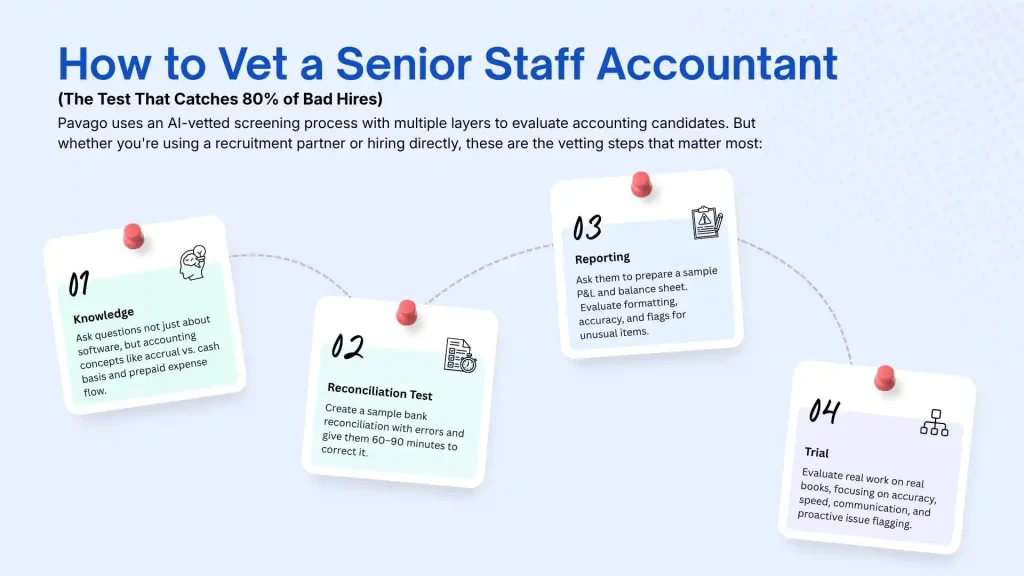
Pavago uses AI-vetted screening with multiple layers. Here are the steps that matter most:
Step 1: Verify accounting knowledge, not tool knowledge. Ask them to explain accrual vs cash basis. If they can’t explain the concepts behind the software, they’re a bookkeeper.
Step 2: Paid reconciliation test. Create a bank rec with 3–5 intentional errors. Give 60–90 minutes. This single test eliminates 80% of unqualified candidates.
Step 3: Test reporting. Ask them to prepare a P&L and balance sheet from a trial balance. Evaluate accuracy AND annotations. For more, our interview questions for offshore candidates guide includes accounting-specific prompts.
Step 4: 2-week trial. Real work on real books. Evaluate accuracy, speed, communication, and proactive issue-flagging.
Why Offshore Senior Accountants Work for U.S. Companies
- Standards are global. IFRS and GAAP are taught worldwide. Same cloud software (QuickBooks, Xero, NetSuite).
- Async-friendly work. Reconciliations and reports don’t require real-time interaction.
- Certifications transfer. ACCA is recognized in 180+ countries. CA certifications equivalent to CPA-level knowledge.
- Retention economics. $2,000/month is highly competitive in Pakistan or the Philippines. Lower turnover risk.
For broader offshore accounting operations, this guide covers team structure. For tax-specific needs, see hire offshore tax accountant.
One of our clients, QBM Services, needed executive-level financial support but couldn’t justify U.S. salaries. We placed dedicated professionals who integrated into their workflow within weeks. Read the full QBM Services case study for details.
Frequently Asked Questions
What’s the difference between a staff accountant and a senior staff accountant?
A staff accountant handles daily transactions. A senior owns the broader function: full-cycle close, financial statements, compliance, audit support, and team oversight. Requires 5+ years and deeper GAAP knowledge. U.S. salary: $45K–$65K for staff vs $65K–$95K for senior.
How much does a senior staff accountant make?
U.S.: $65K–$95K/year. Offshore: $1,200–$2,500/month. Explore our hire finance page for available staff accountant professionals.
What certifications should they have?
U.S.: CPA or CMA. Offshore: ACCA, CA, or equivalent national certifications. Certifications matter most for audit support and regulatory compliance roles.
Can I hire one from another country?
Yes. GAAP/IFRS are standardized globally. Cloud tools work everywhere. The key is vetting for both accounting knowledge and communication quality.
Full-time hire vs outsource to a firm?
Consistent needs = dedicated hire. Seasonal/tax-only needs = CPA firm. Most 10–50 employee SMBs benefit from a dedicated accountant for ongoing work plus a CPA for annual filings.
How long to hire?
U.S.: 4–8 weeks minimum. Through Pavago: candidates presented in 1–2 weeks, productive hire in 3–4 weeks total.
Your Books Can’t Wait. Your Budget Doesn’t Have To.
Hiring a senior staff accountant is one of the highest-ROI decisions an SMB can make. The question is whether you’ll pay $80K–$120K for a U.S. hire, cycle through freelancers, or get a dedicated professional at $1,200–$2,500/month who treats your books like their reputation depends on it.
Hire a Senior Staff Accountant Through Pavago
Pre-vetted from Pakistan, the Philippines, and LATAM. Multi-layer screening: AI-vetted profiles, accounting assessment, reconciliation test, and communication evaluation.
From $1,200/month | ACCA/CA-certified | Free replacements