
Why Pakistan for 3D Animation?
The typical search for 3D animation talent goes: check Upwork for freelancers in India or the Philippines, get 50 proposals, pick the cheapest, get mediocre work, repeat. The SERP for “hire 3D animation specialist from Pakistan” is all freelance platform listings. No editorial content. No guidance on the market, rates, or vetting.
Here’s what the freelance platforms don’t tell you about Pakistan’s 3D animation market:
- Architecture drives the talent pipeline. Pakistan has a large and growing pool of architecture graduates who learn 3D visualization as a core skill. Programs at NCA (National College of Arts), NUST, UET, and private institutions produce hundreds of 3D-trained graduates annually. Many specialize in architectural visualization from day one — not as a side skill.
- The tools are the same. Pakistani animators work with the same global tool stack: Autodesk 3ds Max, Maya, Cinema 4D, Blender, V-Ray, Lumion, D5 Render, Unreal Engine, and After Effects. No adaptation period for your software.
- English proficiency is strong. Pakistan’s education system is English-medium at the university level. Technical communication — project briefs, revision notes, client calls — is typically smooth.
- Time zone works. Pakistan (PKT/UTC+5) overlaps with U.S. Eastern time in the evening hours. A Pakistani animator starting their day at 1 PM PKT catches 4 hours of U.S. EST business overlap. Many work adjusted hours for U.S. clients.
At Pavago, we’ve placed 3D animation specialists for clients specifically needing architectural visualization work. The results have been strong because we’re matching a genuine regional strength to a specific client need, not just finding the cheapest warm body on a freelance platform.
What Types of 3D Animation Work Pakistan Excels At
Not all 3D animation is the same. Pakistan’s talent pool is strongest in specific categories:
| Type | Pakistan’s Strength | Monthly Rate Range | Tools Used |
|---|---|---|---|
| Architectural visualization | Very strong — architecture education pipeline | $1,000–$1,500 | 3ds Max, V-Ray, Lumion, D5 Render, Unreal Engine |
| Product visualization / e-commerce | Strong — growing with e-commerce demand | $1,000–$1,500 | Blender, Cinema 4D, KeyShot |
| Explainer / marketing animation | Moderate — 2D/motion graphics stronger than 3D | $800–$1,200 | After Effects, Cinema 4D, Blender |
| Character animation / gaming | Emerging — smaller pool, growing fast with gaming studios | $1,200–$2,000 | Maya, Blender, ZBrush, Unreal Engine |
If your primary need is architectural visualization — building renders, interior walkthroughs, real estate marketing animations — Pakistan is one of the strongest-value markets globally. For product visualization and marketing animation, it’s competitive. For character animation and gaming, India and the Philippines currently have deeper pools, though Pakistan’s gaming studio ecosystem is growing. Our offshore animation expert page shows available animation talent. Browse the hire product category for all creative roles.
Why a Dedicated Hire Beats Freelance Platforms for Animation
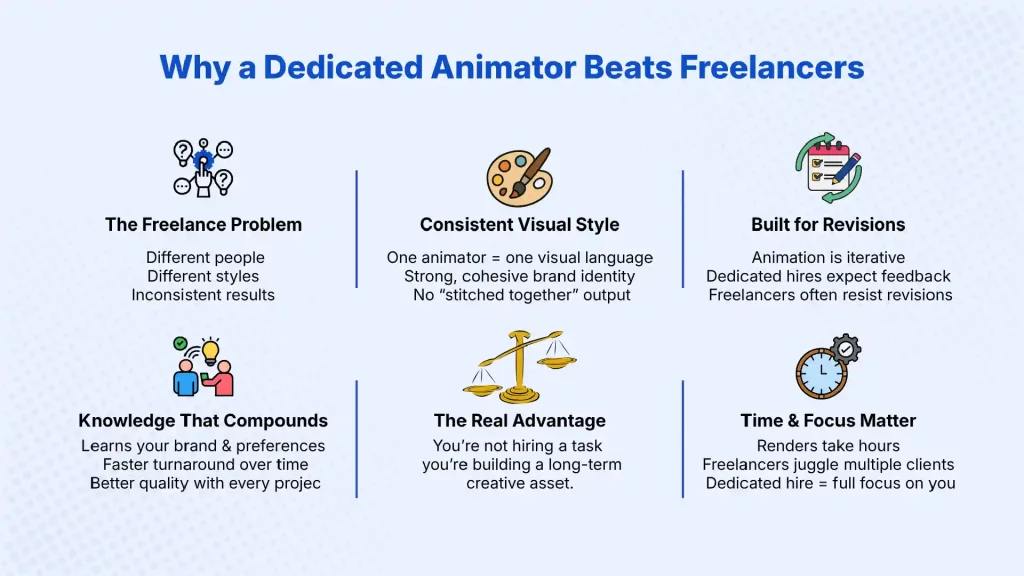
The freelancer cycling problem is especially bad in animation because:
- Animation requires style consistency. Every animator has a visual style. If you cycle through 3 freelancers on the same project, the output looks stitched together. A dedicated hire develops a consistent visual language for your brand.
- Revisions are the norm, not the exception. 3D animation is iterative. A freelancer doing one-off projects resists extensive revisions because it erodes their hourly rate. A dedicated hire works through revisions as part of the role.
- Render times create scheduling complexity. Complex 3D renders take hours. A freelancer juggling 5 clients can’t dedicate render time to your project. A dedicated hire’s machine and time are yours.
- Institutional knowledge compounds. After 3 months, your dedicated animator knows your brand guidelines, your preferred camera angles, your material library, and your client’s aesthetic preferences. That knowledge makes every subsequent project faster and better.
For how freelance vs dedicated hire economics compare across roles, our freelancers vs remote employees guide breaks down the math.
How to Vet a 3D Animation Specialist
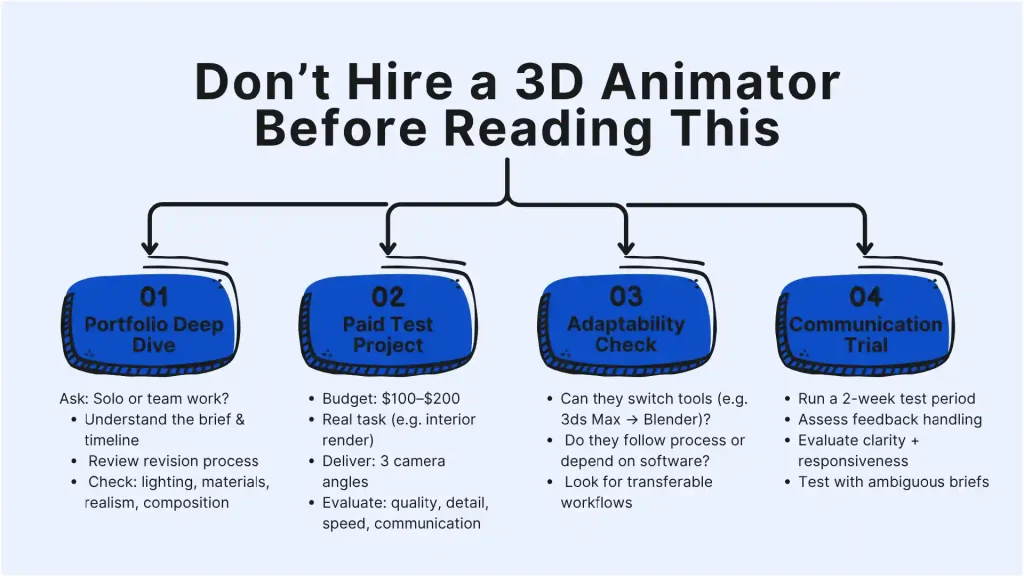
Step 1: Portfolio review with specificity. Don’t just look at the reel. Ask: which projects were solo work vs team? What was the brief? How long did it take? What was the revision process? For architectural visualization specifically, evaluate: lighting realism, material accuracy, camera composition, and whether the renders look like photographs or obvious CG.
Step 2: Paid test project ($100–$200). Give them a real brief: “Render a single room interior from this reference image. Include natural lighting, specific materials (wood, marble, fabric), and deliver 3 camera angles.” Evaluate: technical quality, attention to brief details, turnaround time, and communication during the process.
Step 3: Framework adaptability check. If they’ve only worked in 3ds Max but your pipeline uses Blender, ask how they’d approach the transition. The screening failure we see most: candidates locked into one tool who can’t adapt to the client’s workflow. Strong animators have a methodology that transfers across tools.
Step 4: Communication trial. 2 weeks. Evaluate how they handle creative feedback, revision requests, and ambiguous briefs. For structuring the evaluation, our interview questions for offshore candidates guide applies to creative roles too.
For a real example of how Pavago placed global design talent that delivered strong results, see our OneNine case study on global design talent.
Cost Comparison: Pakistan vs Other Markets
| Pakistan | India | Philippines | Eastern Europe | U.S. | |
|---|---|---|---|---|---|
| Dedicated monthly rate | $1,000–$1,500 | $1,200–$2,000 | $1,000–$1,800 | $2,000–$3,500 | $5,000–$8,000+ |
| Freelance hourly | $15–$30 | $15–$35 | $12–$30 | $25–$50 | $50–$150 |
| Arch viz strength | Very strong | Strong | Moderate | Strong | Very strong |
| English proficiency | Strong | Variable | Strong | Variable | Native |
| U.S. time zone overlap | 4–6 hrs (evening) | 3–5 hrs (evening) | Minimal | 6–8 hrs (morning) | Full |
At $1,000–$1,500/month, Pakistan offers the best value for architectural visualization specifically, combining strong technical skill with strong English and competitive pricing. For companies building broader creative operations in Pakistan, our hire professionals in Pakistan guide covers the talent landscape across all roles.
Frequently Asked Questions
How much does it cost to hire a 3D animation specialist from Pakistan?
Dedicated full-time: $1,000–$1,500/month through a recruitment platform like Pavago. Freelance: $15–$30/hour on platforms like Upwork. The dedicated model is more cost-effective for ongoing work and produces more consistent output due to style continuity and institutional knowledge.
What software do Pakistani 3D animators use?
The global standard stack: Autodesk 3ds Max, Maya, Cinema 4D, Blender for modeling and animation. V-Ray, Lumion, D5 Render, and Unreal Engine for rendering. After Effects for compositing and motion graphics. ZBrush for sculpting. The tools are identical to what U.S. studios use.
Is Pakistan good for architectural visualization?
Excellent. Pakistan’s architecture education pipeline produces graduates trained specifically in 3D visualization. Major cities (Lahore, Karachi, Islamabad) have established architectural visualization studios serving international clients. The combination of technical training, English proficiency, and competitive pricing makes Pakistan one of the best-value markets for arch viz globally.
How do I manage a remote 3D animator?
Project management tools (Asana, Monday, Trello) for task tracking. Cloud storage (Google Drive, Dropbox) for file sharing. Screen recording tools for feedback on renders. Weekly video calls for creative alignment. For the full remote management framework, our managing remote employees guide covers strategies for creative roles.
Can I hire a 3D animator for part-time work?
Yes, but the economics favor full-time for ongoing animation needs. At $1,000–$1,500/month full-time, the per-hour cost is roughly $6–$9. Freelancers charge $15–30/hour. For any work volume above 15–20 hours/month, a dedicated hire is cheaper and produces better-quality output.
What’s the difference between a 3D animator and a 3D visualizer?
A 3D animator creates movement: character animation, product animation, walkthrough sequences. A 3D visualizer creates still images: photorealistic renders of buildings, interiors, products. Many professionals do both, but the skill emphases differ. For architectural work, you’re typically hiring a visualizer who also does animation for walkthroughs. Our offshore video editor page covers related creative roles if you also need post-production support.
Pakistan’s 3D Talent Is Underpriced. That Won’t Last.
The Pakistani 3D animation market is where the broader offshore development market was 10 years ago: exceptional talent at prices that don’t reflect the quality. As more international clients discover this market, rates will rise. Companies that build relationships with strong Pakistani animators now lock in both quality and favorable economics before the market corrects.
Hire 3D Animation Specialists From Pakistan Through Pavago
Architectural visualization, product rendering, and marketing animation specialists. Pre-vetted for technical quality, creative reasoning, and communication. Dedicated full-time professionals, not freelancers.
From $1,000/month | Arch viz specialists available | Free replacements