Why AI Changes Everything in Cybersecurity
Two years ago, the average phishing email had spelling errors and suspicious formatting. Today, AI-generated phishing emails achieve click rates over 50%, compared to roughly 12% for traditional attacks. The skill barrier for cybercrime has effectively been removed.
On the defense side, AI-powered security tools can now detect and contain breaches in seconds instead of days. IBM reports that organizations using AI security tools identify breaches faster and at lower cost than those relying on manual processes. The gap between companies that deploy AI-augmented security and those that don’t is widening every quarter.
For SMBs, this creates a paradox: the threats are more sophisticated than ever, but the talent to fight them is priced for enterprises. At Pavago,we’re seeing surging demand for cybersecurity professionals from SMB clients who can’t justify $150K salaries but can’t afford to ignore the threat landscape either.
What AI Powered Cyber Security Actually Looks Like in Practice
Strip away the vendor marketing and here’s what AI actually does in cybersecurity today:
| AI Capability | What It Does | Why It Matters for SMBs |
|---|---|---|
| Behavioral analytics | Learns normal patterns for users and systems, flags anomalies in real time | Catches insider threats and compromised accounts that signature-based tools miss. |
| Autonomous response | Automatically isolates infected endpoints, blocks suspicious IPs, contains breaches | Reduces response time from hours to seconds. Critical when you don’t have a 24/7 SOC. |
| Predictive threat modeling | Analyzes attack patterns to predict likely attack vectors before they’re exploited | Lets small security teams focus on the highest-probability threats. |
| AI-enhanced phishing detection | Analyzes email content, sender behavior, and link patterns using NLP | Blocks the sophisticated AI-generated phishing that basic email filters miss. |
| Automated vulnerability scanning | Continuously scans code, infrastructure, and configurations for exploitable weaknesses | Finds vulnerabilities before attackers do, without manual audits. |
| AI SOC augmentation | Triages alerts, reduces false positives, prioritizes incidents for human review | Solves the alert fatigue problem that burns out small security teams. |
The Cybersecurity Talent Problem for SMBs
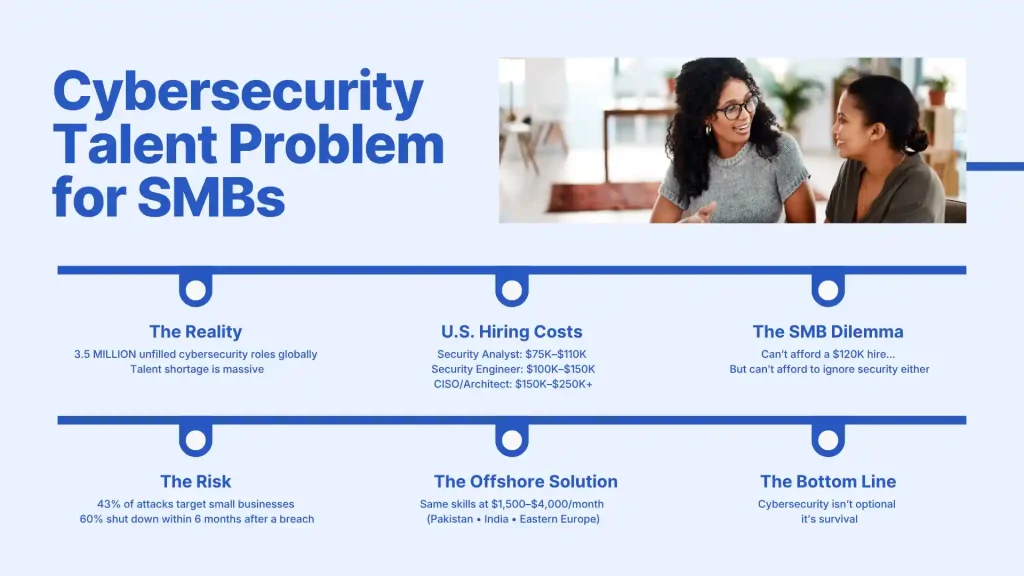
The global cybersecurity workforce gap is approximately 3.5 million unfilled positions. U.S. cybersecurity professionals earn:
- Security analyst: $75K–$110K
- Security engineer: $100K–$150K
- CISO/security architect: $150K–$250K+
Most SMBs with 10–50 employees can’t justify a $120K security hire. But they can’t ignore cybersecurity either. 43% of cyberattacks target small businesses, and 60% of small businesses that suffer a cyberattack go out of business within six months. The math is existential.
The offshore solution: dedicated cybersecurity professionals from Pakistan, India, and Eastern Europe cost $1,500–$4,000/month for the same skill sets. Pavago’s offshore cybersecurity expert page shows available talent in the hire engineering category.
What to Look for When Hiring AI-Literate Cybersecurity Talent
Must-Have Skills
- SIEM proficiency. Splunk, Microsoft Sentinel, or equivalent. They need to configure, tune, and interpret AI-driven security information and event management platforms.
- Cloud security. AWS Security Hub, Azure Defender, GCP Security Command Center. Most SMB infrastructure is cloud-based now.
- Incident response. Structured approach to detecting, containing, eradicating, and recovering from security incidents.
- AI tool proficiency. Experience with AI-powered security tools (CrowdStrike Falcon, SentinelOne, Darktrace). They don’t need to build the AI. They need to deploy and tune it.
- Compliance frameworks. SOC 2, HIPAA, PCI-DSS, GDPR — whichever applies to your industry.
The Screening Challenge
After screening 100+ technical candidates, the failure pattern with cybersecurity hires mirrors what we see across all technical roles: candidates strong in one framework but can’t adapt to the client’s stack. A professional who’s spent 5 years in Splunk may struggle to configure Microsoft Sentinel. Someone certified in AWS security may not understand Azure’s security model. We screen for adaptability across platforms, not just depth in one.
How to Structure Cybersecurity for an SMB
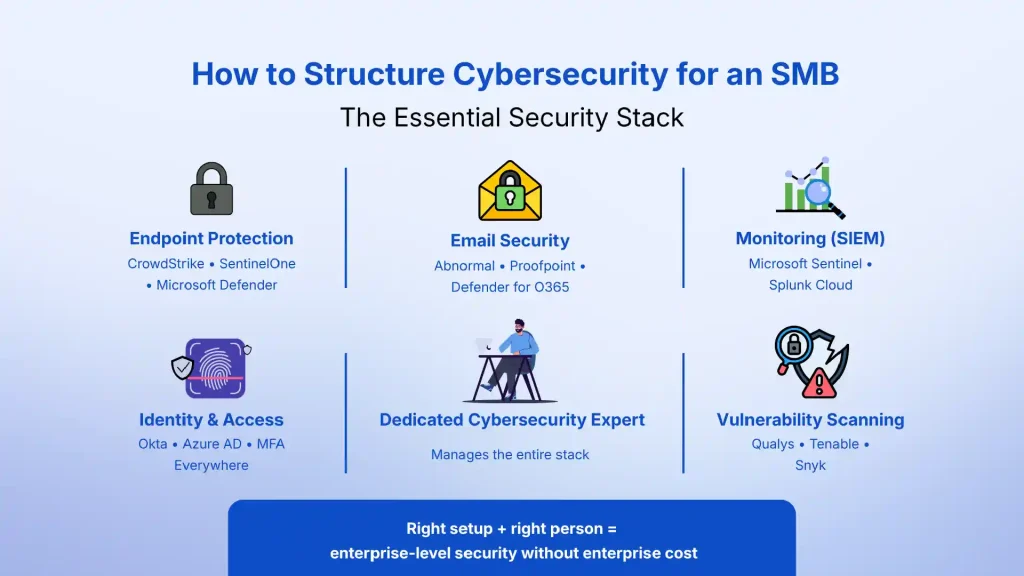
Most SMBs don’t need a full security team. They need the right combination of tools and one dedicated person who knows how to use them.
The SMB cybersecurity stack:
- Endpoint protection: CrowdStrike, SentinelOne, or Microsoft Defender for Endpoint (AI-powered)
- Email security: Abnormal Security, Proofpoint, or Microsoft Defender for Office 365
- SIEM/monitoring: Microsoft Sentinel (cost-effective for SMBs) or Splunk Cloud
- Vulnerability scanning: Qualys, Tenable, or Snyk for code-level scanning
- Identity & access: Okta, Azure AD with conditional access, MFA everywhere
One dedicated offshore cybersecurity professional at $2,000–$3,500/month can manage this entire stack for an SMB. Compare that to the $10K–$15K/month cost of a U.S. security engineer. For companies evaluating remote technical team structures, our hire remote engineering team guide covers how cybersecurity fits into the broader engineering function.
We’ve placed cybersecurity professionals for clients building secure offshore operations. For an example of how we structure technical team placements, see our Press Advantage case study on building in-house technical teams offshore.
Frequently Asked Questions
What is AI powered cyber security?
AI powered cybersecurity uses machine learning, behavioral analytics, and natural language processing to detect, analyze, and respond to security threats in real time. AI augments human security teams by automating threat detection, reducing false positives, and enabling faster incident response. It’s used for both offensive and defensive purposes, making it essential for modern security operations.
How much does a cybersecurity professional cost?
U.S.: $75K–$180K+/year depending on role. Offshore dedicated: $1,500–$4,000/month for equivalent skill levels. The gap is widest at the senior/architect level.
Do SMBs really need AI cybersecurity?
Yes. 43% of cyberattacks target small businesses. AI-powered attacks (sophisticated phishing, automated vulnerability exploitation) don’t discriminate by company size. The tools are affordable (many have SMB pricing tiers). The talent is available offshore. The risk of not investing is existential.
What certifications should cybersecurity hires have?
CompTIA Security+ (baseline), CEH (ethical hacking), CISSP (senior/architect level), AWS/Azure security specializations (cloud-specific). For offshore hires, also look for ISO 27001 Lead Auditor and OSCP (offensive security).
Can I hire cybersecurity talent from another country?
Yes. Cybersecurity is one of the fastest-growing offshore technical specializations. The tools are cloud-based, the work is systems-based, and threats don’t operate in business hours. India, Pakistan, and Eastern Europe have strong cybersecurity talent. For the broader hiring process, see our how to hire offshore software developers guide.
How does AI change the cybersecurity hiring process?
AI raises the bar for cybersecurity professionals. They need to understand how AI tools work, how to tune them, and how AI-powered attacks differ from traditional ones. The old model of purely reactive, signature-based security is dead. Every cybersecurity hire in 2026 needs to be AI-literate. Our interview questions for offshore candidates guide includes technical evaluation approaches.
AI Cybersecurity Isn’t Optional. The Pricing Is Negotiable.
The threat landscape doesn’t care about your company size. AI-powered attacks hit SMBs harder because SMBs are less defended. The good news: AI-powered defense tools are more accessible than ever, and the talent to deploy them is available offshore at SMB-friendly prices. The companies that survive the next wave of AI-driven cybercrime won’t be the biggest. They’ll be the ones that hired a competent security professional before the breach, not after.
Hire Cybersecurity Professionals Through Pavago
Dedicated security analysts, engineers, and AI-literate cybersecurity specialists. SIEM, cloud security, incident response, compliance. Growing demand from SMB clients.
From $1,500/month | CompTIA/CEH/CISSP-certified | Free replacements