Why Real Estate Bookkeeping Breaks Generic Bookkeepers
A generic bookkeeper records income, categorizes expenses, reconciles the bank account, and produces a P&L. For a consulting firm or a retail store, that’s the whole job. For a property management company or a real estate investment portfolio, it’s about 30% of the job.
Real estate adds layers that don’t exist in other industries:
- Trust accounts. In most states, security deposits and owner funds MUST be held in a separate trust account, legally distinct from the company’s operating account. Commingling is illegal. A generic bookkeeper who’s never managed a trust account will commingle funds or fail to reconcile them, creating legal exposure.
- Property-level accounting. Every property needs its own P&L, balance sheet, and cash flow tracking. An owner managing 50 properties needs 50 individual financial statements, not one consolidated report. Generic bookkeepers produce one company-wide P&L and call it done.
- Owner distributions. Income collected from tenants is distributed to property owners after deducting management fees, maintenance costs, reserves, and mortgage payments. The timing, calculation, and documentation of these distributions are unique to property management.
- Security deposit accounting. Every deposit received must be tracked per tenant, per unit, per property. At move-out, the bookkeeper produces a disposition statement showing deductions for damages and the refund amount. Getting this wrong triggers tenant lawsuits in many states.
- 1099 processing for contractors. Property management companies use dozens of contractors (plumbers, electricians, landscapers, handymen). Each contractor paid $600+ in a year needs a 1099-NEC. Missing one triggers IRS penalties.
What Real Estate Bookkeeping Actually Involves
Function | What It Involves | Why It’s Different From Regular Bookkeeping | |
|---|---|---|---|
| Function | What It Involves | Why It’s Different From Regular Bookkeeping | PM Software/Tools |
| Trust account management | Separate bank account for tenant deposits and owner funds. Daily/weekly reconciliation. State compliance reporting. Never commingled with operating funds. | Regular bookkeeping has one bank account. Real estate has two or more properties with strict legal separation requirements. | AppFolio, Buildium, Rent Manager, Yardi, QuickBooks (separate company file) |
| Property-level P&L | Revenue, expenses, NOI, and cash flow tracked per property. Allocate shared costs (management fee, software, office) across properties. | Generic bookkeeping produces one company P&L. Property managers need 10–200 individual property financials. | AppFolio, Buildium (built-in property reporting), QuickBooks (class/location tracking) |
| Rent collection and processing | Record rent received by tenant, unit, and property. Track partial payments, late fees, prepayments. Apply payments to correct ledger. | Regular A/R is by customer. Real estate A/R is by tenant-unit-property, a 3-level hierarchy. | AppFolio, Buildium, Rent Manager tenant ledger |
| Owner distributions | Calculate net income per property. Deduct management fee, maintenance reserves, mortgage payments. Issue distribution to owner with supporting statement. | No equivalent in generic bookkeeping. This is unique to property management and real estate investment. | PM software distribution module, QuickBooks, owner portals |
| Security deposit accounting | Track deposits received per tenant. Record interest accrual (required in some states). Produce disposition statement at move-out with itemized deductions. | Generic bookkeeping doesn’t track individual liability balances with this granularity. | PM software deposit tracking, trust account reconciliation |
| Maintenance and repair tracking | Record expenses by property, unit, vendor, and category (repair vs capital improvement vs preventive). Track against budgets. | Regular expense tracking doesn’t need property/unit/vendor/category multi-dimensional coding. | PM software maintenance module, QuickBooks job costing |
| CAM reconciliation | For commercial properties: calculate Common Area Maintenance charges, reconcile estimates vs actuals, bill tenants for their share. | Unique to commercial real estate. No equivalent in other industries. | Yardi, MRI Software, QuickBooks with custom tracking |
| Year-end tax prep | 1099-NEC for all contractors. Property-level income/expense reports for owner tax filings. Depreciation schedules. Cost segregation support. | Regular year-end is one set of financials. Real estate is one per property per owner, plus contractor 1099s. | QuickBooks, PM software year-end reporting |
At Pavago, we’ve placed bookkeepers for both property management companies and real estate agents/brokerages. They work across all major PM and accounting platforms. Browse our hire finance category for available talent, or see our offshore bookkeeper page.
Real Estate Accounting Software Your Bookkeeper Needs to Know
AppFolio
Full property management + accounting platform. Built-in trust accounting, owner portals, property-level reporting, and 1099 processing. The accounting module is integrated, meaning the bookkeeper works within AppFolio for both operations and financials. Learning curve: 2–4 weeks for accounting functions.
Buildium
Strong accounting for small to mid-size PM companies. Intuitive trust account management, automated owner statements, and built-in bank reconciliation. Simpler than AppFolio. Learning curve: 1–3 weeks.
Rent Manager
Most customizable PM accounting. Powerful reporting engine. Popular with mid-to-large companies. Steeper learning curve: 3–4 weeks for full accounting proficiency.
QuickBooks + PM Software Hybrid
Some PM companies use their PM software for operations and QuickBooks for accounting. The bookkeeper syncs data between systems or enters transactions in both. This hybrid model requires proficiency in both platforms and understanding of how data flows between them. More complex, but it gives greater accounting flexibility.
Yardi
Enterprise-level. Full accounting suite built for large portfolios (500+ units). Complex. If your company uses Yardi, screen for prior Yardi experience specifically.
Key insight: Like ecommerce bookkeeping, the tool is trainable, but the real estate accounting knowledge is not. A bookkeeper who understands trust accounts, property-level reporting, and owner distributions can learn any PM software in 2–4 weeks. A bookkeeper who knows AppFolio but doesn’t understand trust account compliance is a liability.
How to Vet a Real Estate Bookkeeper
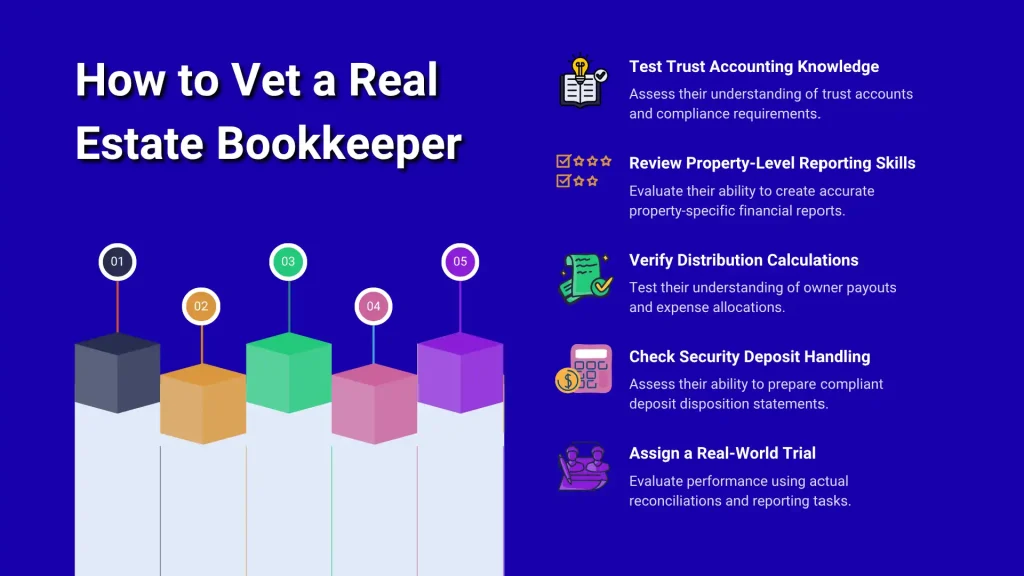
Step 1: Trust account knowledge test. Ask: “What is a trust account and why can’t you commingle it with operating funds?” Then: “What happens if a property manager commingles trust funds?” Expected: legal penalties, license revocation in many states, and tenant lawsuits. If they can’t explain trust account compliance, they’re not a real estate bookkeeper.
Step 2: Property-level reporting exercise. Give them a dataset: 5 properties, each with rental income, management fees, maintenance expenses, and mortgage payments. Ask them to produce a property-level P&L for each. A generic bookkeeper will produce one combined P&L. A real estate bookkeeper will produce five individual P&Ls with allocated shared costs.
Step 3: Owner distribution calculation. Provide: $8,500 rent collected, 10% management fee ($850), $1,200 in maintenance, $3,500 mortgage payment, $200 reserve hold. Ask them to calculate the owner distribution. Expected: $8,500 – $850 – $1,200 – $3,500 – $200 = $2,750 distribution. Simple math, but the exercise reveals whether they understand the components and the logic.
Step 4: Security deposit disposition. Give them a move-out scenario: tenant paid a $2,000 deposit, unit needs $450 in cleaning, $200 in paint touch-up, and $125 in carpet repair. Ask them to prepare a disposition statement. Evaluate: Is the format compliant? Did they deduct correctly? Did they calculate the refund ($1,225) accurately?
Step 5: 2-week trial on real books. Assign them trust account reconciliation, 3 owner distribution calculations, and bank reconciliation for both operating and trust accounts. Evaluate accuracy and whether they flag discrepancies proactively. According to Buildium’s Property Management Industry Report, property managers who invest in financial management technology and talent retain owners significantly longer because reporting quality directly impacts owner confidence. (external, dofollow, new tab)
We placed a VA for Rovira Property Management, who handles their full operational and financial workflow. Read the Rovira Property Management case study. For broader bookkeeping outsourcing, our outsource bookkeeping guide covers all models. And for property management admin (non-accounting tasks), our property management virtual assistant guide covers the full operational scope.
What Real Estate Bookkeeping Costs
| U.S. Real Estate Bookkeeper | CPA Firm (RE Specialty) | Freelance | Dedicated Offshore (Pavago) | |
|---|---|---|---|---|
| Monthly cost | $4,000–$6,000 + benefits | $1,500–$3,500 | $1,000–$2,500 variable | $800–$1,500 |
| Annual cost | $55K–$85K all-in | $18K–$42K | $12K–$30K (inconsistent) | $10K–$18K |
| Trust account proficiency | Varies (must screen for it) | Usually strong | Rarely | Screened for RE accounting knowledge |
| Property-level reporting | If trained | Yes | Rarely | Screened during vetting |
| Dedicated? | Yes | No (1 of many clients) | No (juggling clients) | Yes, 100% |
The cost comparison is dramatic at the PM company level. A 100-unit management company generating $10,000/month in management fees can’t justify a $5,000/month bookkeeper. That’s 50% of gross revenue going to one admin function. At $1,200/month offshore, it’s 12%. The math makes the case. For full accounting outsourcing cost details, our cost of outsourcing accounting services guide has the breakdown.
Who Needs a Dedicated Real Estate Bookkeeper
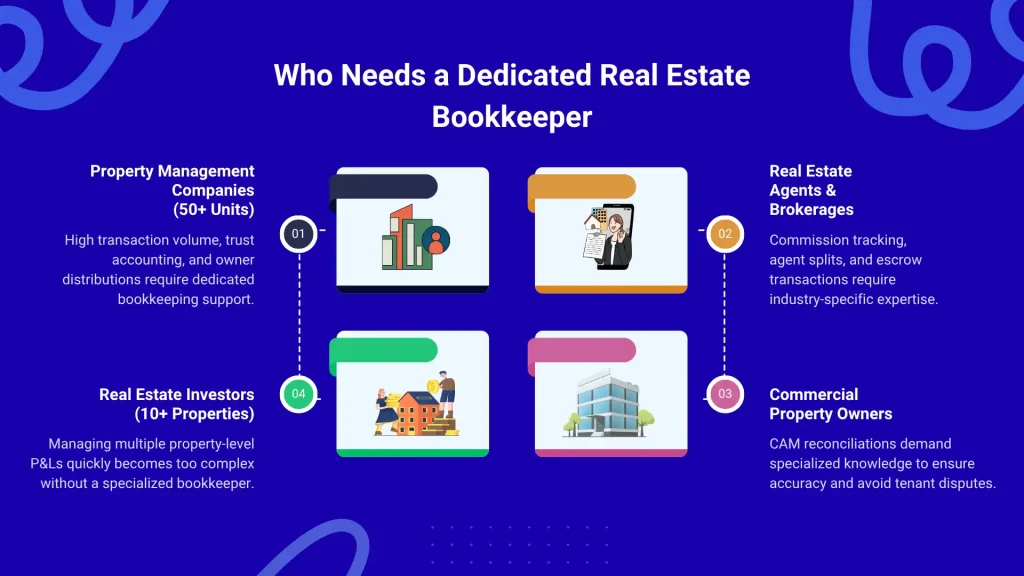
Property management companies (50+ units): The volume of trust account transactions, owner distributions, and maintenance coding requires dedicated bookkeeping. This isn’t something the property manager should be doing alongside leasing and maintenance coordination.
Real estate investors with 10+ properties: Each property is effectively its own small business with its own P&L. At 10+ properties, the bookkeeping complexity exceeds what generic accounting software handles without dedicated attention.
Real estate agents/brokerages with commission splits: Tracking agent commissions, broker splits, transaction fees, and escrow disbursements requires industry-specific bookkeeping. Generic bookkeepers constantly miscategorize commission income and expenses.
Commercial property owners with CAM: Common Area Maintenance reconciliation is a specialized calculation that most bookkeepers have never performed. Getting CAM wrong leads to tenant disputes and potential legal action.
For real estate companies also needing admin support (tenant communication, listing management, showing coordination), our hire a real estate virtual assistant guide covers the operations side. And for general accounting outsourcing options, our accounting outsourcing companies in USA guide compares providers.
Frequently Asked Questions
What is real estate bookkeeping?
Real estate bookkeeping is the financial record-keeping for property management companies, real estate investors, agents, and brokerages. It includes trust account management, property-level P&L reporting, owner distributions, security deposit accounting, rent collection processing, maintenance expense tracking, and year-end tax preparation (1099s, property-level reports for owner filings).
How much does a real estate bookkeeper cost?
U.S.: $4,000–$6,000/month + benefits. CPA firm: $1,500–$3,500/month. Offshore dedicated through Pavago: $800–$1,500/month.
Can a regular bookkeeper handle real estate books?
Usually not. Real estate bookkeeping requires trust account compliance, property-level reporting, owner distribution calculations, and security deposit accounting. These are specialized functions that don’t exist in generic bookkeeping. A bookkeeper who’s managed books for a service business will struggle with all four.
What software do real estate bookkeepers use?
AppFolio, Buildium, Rent Manager, Yardi, and Propertyware for property management. QuickBooks or Xero for accounting (sometimes alongside PM software). The bookkeeper needs to work in YOUR system, whether that’s a standalone PM platform or a PM + QuickBooks hybrid.
What about trust account compliance?
Trust accounts are legally required in most states for holding tenant security deposits and owner funds. The bookkeeper must keep trust funds strictly separate from operating funds, reconcile the trust account regularly (monthly minimum, weekly preferred), and produce trust account reports for state audits. Commingling is illegal and can result in fines, license revocation, and lawsuits.
How is real estate bookkeeping different from regular bookkeeping?
Five key differences: (1) trust accounts with legal separation requirements, (2) property-level P&L instead of company-wide, (3) owner distributions instead of standard revenue recognition, (4) security deposit tracking with per-tenant liability accounting, (5) 1099 processing for dozens of maintenance contractors. None of these exist in standard business bookkeeping.
Can I outsource real estate bookkeeping to another country?
Yes. All real estate accounting is digital: PM software is cloud-based, bank feeds are electronic, and reporting is generated from the system. The bookkeeper’s location is irrelevant as long as they understand real estate accounting principles. Pavago screens specifically for trust account knowledge, property-level reporting, and owner distribution proficiency. For the broader outsourcing case, our offshore accounting guide covers country-specific capabilities.
Real Estate Bookkeeping Isn’t Bookkeeping. It’s Property-Level Financial Management.
The word “bookkeeping” makes it sound simple. Record income, track expenses, and reconcile the bank. For a coffee shop, that IS the job. For a property management company, the “bookkeeping” includes trust account compliance that carries legal penalties if done wrong, 50–200 individual property financials that owners expect monthly, distribution calculations that determine whether owners stay or leave, and security deposit accounting that triggers lawsuits if the disposition is wrong.
The real estate companies with the cleanest books and the happiest owners aren’t the ones spending $6,000/month on a U.S. bookkeeper. They’re the ones who hired a dedicated real estate bookkeeper who understands the industry, paired them with the right PM software, and got property-level financial reporting that actually builds owner confidence. At $800–$1,500/month, that’s the most undervalued hire in property management.
Hire a Real Estate Bookkeeper Through Pavago
Placed for property management companies, real estate investors, and agents/brokerages. Trust account management, property-level P&L, owner distributions, security deposit accounting, and 1099 processing. AppFolio, Buildium, Rent Manager, QuickBooks.
- Real estate bookkeepers from $800/month
- Trust account compliance screened | Property-level reporting
- Free replacements | Candidates in 1–2 weeks