
Why Python Developers Are the Hardest to Screen
The Python talent pool is massive. It’s the most popular programming language globally. Which means every developer on Upwork lists “Python” on their profile. The problem: Python is used for everything from simple scripting to building Netflix’s recommendation engine. A developer who can write a Python script to rename files is not the same person who can design a Django REST API that handles 10,000 concurrent users.
According to Stack Overflow’s 2024 Developer Survey, Python is the third most commonly used programming language globally and the most wanted language among developers. (external, dofollow, new tab) That popularity is great for the talent pool and terrible for screening. Most Python “developers” on freelance platforms are entry-level or self-taught without production experience.
Python Specializations: Know What You’re Hiring For
| Specialization | What They Build | Key Frameworks/Tools | Monthly Rate (Pavago) | Who Needs This |
|---|---|---|---|---|
| Web backend | REST APIs, server-side logic, authentication, database models, admin panels | Django, FastAPI, Flask, SQLAlchemy, PostgreSQL, Redis | $1,800–$2,500 | SaaS companies, web apps, marketplaces |
| Data engineering | ETL pipelines, data warehouses, data processing, batch and streaming jobs | Pandas, PySpark, Airflow, dbt, Snowflake, BigQuery | $2,000–$3,000 | Data-heavy companies, analytics platforms, fintech |
| Machine learning / AI | ML models, NLP, computer vision, recommendation systems, predictive analytics | TensorFlow, PyTorch, scikit-learn, Hugging Face, OpenAI APIs | $2,500–$4,000 | AI products, research teams, ML-powered features |
| Automation / scripting | Process automation, web scraping, report generation, system integration, DevOps scripting | Selenium, BeautifulSoup, Celery, boto3 (AWS), REST API integrations | $1,500–$2,000 | Operations teams, marketing automation, data collection |
| Full-stack (Python + frontend) | Complete web applications with frontend and backend | Django + React, FastAPI + Next.js, Flask + Vue | $2,000–$3,000 | Startups, MVPs, small dev teams that need one person covering both layers |
At Pavago, we place Python developers across all of these specializations. Browse our hire engineering category for available talent. For full-stack roles, see our offshore full stack developer page.
Cost Comparison: What Remote Python Developers Cost
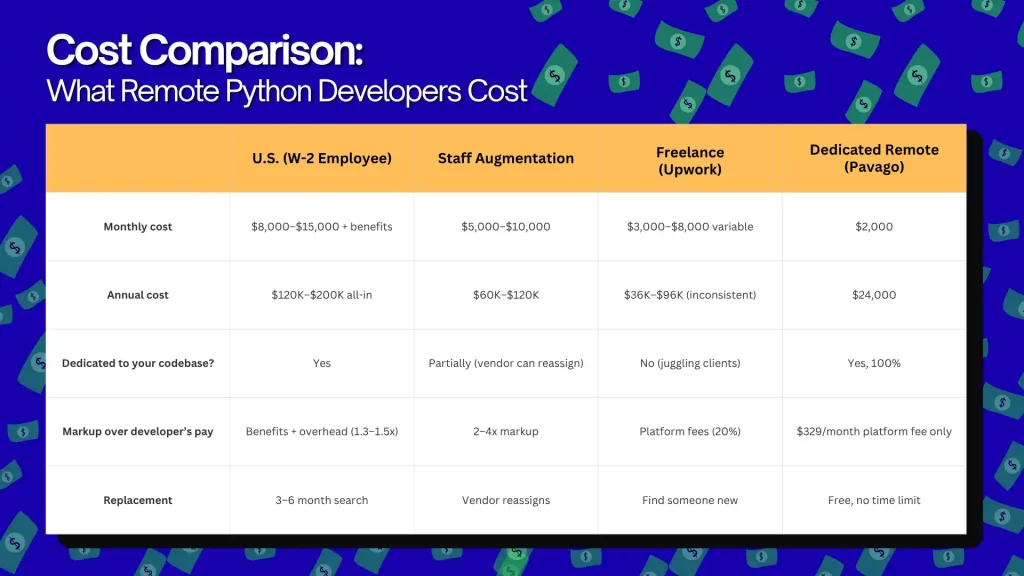
At $24K/year vs $120K–$200K, the Pavago model delivers the same Python proficiency at 80–85% lower cost. The developers use the same tools, write the same code, and push to the same Git repos. The cost difference is geography and overhead, not skill.
How to Vet Remote Python Developers (5 Steps)
Step 1: Specialization Fit
Before any technical test, confirm the candidate’s specialization matches your needs. A Django web developer and a PySpark data engineer are both “Python developers,” but they’re completely different roles. Interviewing a data engineer for a web backend role wastes everyone’s time.
Step 2: Practical Coding Challenge (Not LeetCode)
Give them a real-world task in your domain:
- For web backend: “Build a REST API with Django/FastAPI that has user authentication, CRUD operations for a resource, and pagination.” Evaluate: code structure, ORM usage, error handling, test coverage.
- For data engineering: “Write an ETL pipeline that reads from a CSV, transforms the data (cleaning, aggregation), and loads into a database.” Evaluate: code clarity, error handling, logging, and idempotency.
- For ML: “Train a classification model on this dataset, evaluate performance, and explain your feature engineering choices.” Evaluate: methodology, feature selection reasoning, model evaluation metrics.
Step 3: Architecture Conversation
This separates junior from senior. Describe a system and ask how they’d design it:
Example: “We need an API that processes 5,000 requests/minute, with a PostgreSQL database, Redis caching, and background job processing for email notifications. How would you structure this?”
Good answers include: API framework choice with reasoning (FastAPI for async performance), database indexing strategy, caching layer design, background worker architecture (Celery + Redis), and deployment considerations. Bad answers: “I’d use Django” with no elaboration on architecture decisions.
Step 4: Code Review
Review their GitHub or past code. Evaluate: naming conventions, docstrings, test coverage, commit history (small focused commits vs large monolithic ones), and code organization. Code style reveals how they think and how maintainable their code will be for the next developer. According to GitHub’s Octoverse report, Python remains among the top 3 languages on GitHub by both number of contributors and repository count. (external, dofollow, new tab) The talent pool is vast, but code quality varies enormously.
Step 5: 2-Week Trial on Your Codebase
Give them access to your actual repo (sandboxed). Assign a real feature or bug fix. Evaluate: can they navigate an unfamiliar codebase? Do they read existing code before writing new code? Do they write tests? Do they submit clean PRs with clear descriptions? This is the final filter and the most important one.
We’ve built offshore engineering teams for multiple clients. See the Press Advantage case study on building an in-house technical team, and the Eversite case study on assembling a performance engineering team. For broader engineering hiring, our hire remote developers guide covers all stacks, and our how to hire offshore software developers guide covers the full process.
Frequently Asked Questions
How much does it cost to hire a remote Python developer?
U.S.: $120K–$200K/year. Staff augmentation: $60K–$120K/year. Dedicated offshore through Pavago: $24,000/year ($2,000/month).
Django or FastAPI: which should my developer know?
Django for full-featured web applications with admin panels, ORM, and built-in auth. FastAPI for high-performance APIs, microservices, and async workloads. Most senior Python developers know both.
Can I hire a Python developer for data engineering and web development?
Possible but rare at the senior level. These are different specializations with different toolsets. For a startup needing both, hire a full-stack Python developer who can cover basic data work alongside the web backend. For serious data engineering, hire a specialist.
Which countries have the strongest Python talent?
Pakistan and Eastern Europe (Ukraine, Poland) have deep Python talent pools, especially for web backend and data engineering. The Philippines is growing but stronger in other areas. LATAM provides time zone alignment with strong mid-level talent. Pavago sources from all of these except India.
How long to hire?
Through Pavago: qualified candidates in 1–2 weeks. With a 2-week trial, the total time to a productive developer is 3–4 weeks.
Junior vs senior: what’s the real difference?
Junior: can write Python code that works. Senior: can design systems, make architecture decisions, mentor other developers, and write code that’s maintainable by the next person. The architecture conversation (Step 3) is the best filter. For more on engineering team structure, our engineering search firms guide covers how to think about technical hiring.
The Python Developer Who Can Write Code Is Easy to Find. The One Who Can Architect Systems Is Not.
Python is everywhere. Python developers are everywhere. But the developer who understands when to use FastAPI vs Django, how to structure a codebase for scale, when to add caching, and how to write code that the NEXT developer can maintain is rare. That’s the developer worth $2,000/month. That’s the developer the 5-step vetting process finds.
Hire Remote Python Developers Through Pavago
Django, FastAPI, Flask, data engineering, ML/AI, automation. Every developer is screened with practical coding challenges and architecture conversations. Direct hire, no markup.
Python developers from $2,000/month | All specializations | Free replacements