Why Ecommerce Bookkeeping Breaks Generic Bookkeepers
A traditional bookkeeper reconciles bank deposits against invoices. The money in equals the money recorded. Clean.
An ecommerce bookkeeper reconciles a Shopify payout of $4,847.23 against 127 orders totaling $5,391.40 in gross sales, minus $198.12 in refunds, minus $157.84 in Shopify processing fees, minus $94.21 in transaction fees, minus $94.00 in subscription charges, and arrives at the $4,847.23 that actually hit the bank. Every. Single. Payout. Across every channel.
When clients come to Pavago for ecommerce bookkeeping help, the challenge isn’t one specific function. It’s everything. Their books are a mess because generic bookkeepers treated Shopify payouts as revenue, didn’t separate marketplace fees, didn’t track inventory costs properly, and filed sales tax incorrectly in half their nexus states. According to Zamp’s ecommerce sales tax compliance research, the U.S. has over 13,000 distinct tax jurisdictions, and the ecommerce sector is projected to reach $3.89 trillion in revenue in 2026. (external, dofollow, new tab) Every dollar of that revenue needs to be booked correctly.
What Ecommerce Bookkeeping Actually Involves
Here’s the full scope, broken down by function. If your current bookkeeper isn’t handling all of these, your books aren’t clean.
| Function | What It Involves | Why It’s Harder in E-Commerce | Tools |
|---|---|---|---|
| Revenue recognition | Recording gross sales, separating refunds, returns, chargebacks, and discounts from net revenue | Marketplace payouts bundle everything. A $5,000 payout includes sales, minus fees, minus refunds. You can’t just book the payout as revenue. | Shopify, Amazon Seller Central, WooCommerce, A2X, Webgility |
| Marketplace fee tracking | Separating platform commission, processing fees, FBA fees, referral fees, advertising costs from revenue | Amazon alone charges 8–15 fee types per transaction. If your bookkeeper books the payout as revenue, your margin is wrong. | A2X, Webgility, Link My Books, Synder |
| Cost of goods sold (COGS) | Tracking product cost, inbound freight, customs duties, 3PL receiving fees, packaging costs per SKU | Physical stores buy and sell from one location. E-commerce sellers ship from 3PLs, FBA warehouses, and suppliers globally. Costs are distributed. | QuickBooks, Xero, DEAR Inventory, Cin7, TradeGecko |
| Inventory valuation | Maintaining accurate inventory counts, calculating average cost or FIFO per SKU, writing off dead/damaged stock | Multi-warehouse inventory across FBA, 3PL, and self-fulfilled creates constant valuation discrepancies. | Shopify Inventory, DEAR, Cin7, ShipBob, SKULabs |
| Sales tax compliance | Calculating, collecting, and remitting sales tax across every nexus state. Tracking economic nexus thresholds. | The Wayfair decision means you collect tax in every state where you exceed $100K in sales. That could be 20–40 states. | TaxJar, Avalara, Shopify Tax, QuickBooks Sales Tax |
| Bank and payment reconciliation | Matching Shopify/Amazon/PayPal payouts to bank deposits, resolving timing differences, reconciling payment processor statements | Payouts arrive 2–7 days after sales. A sale on May 28 might not hit the bank until June 3. Month-end cutoffs create mismatches. | QuickBooks, Xero, bank feeds, A2X |
| Multi-channel consolidation | Combining financial data from Shopify, Amazon, wholesale, brick-and-mortar, and direct sales into one chart of accounts | Each channel has different fee structures, payout schedules, and reporting formats. Consolidation is a reconciliation nightmare without automation. | Webgility, A2X, Synder, QuickBooks |
At Pavago, we place bookkeepers who handle this full ecommerce-specific scope. They work across Shopify, Amazon, WooCommerce, and multi-channel operations. Browse our hire finance category for available talent, or see our offshore bookkeeper page specifically.
Why a Generic Bookkeeper Can’t Handle Ecommerce Books
A bookkeeper who’s managed books for a law firm, a dental practice, or a consulting company is not equipped for ecommerce. Here’s why:
Failure 1: They book Shopify payouts as revenue. A Shopify payout is NOT revenue. It’s revenue minus refunds minus fees minus discounts. If your bookkeeper records the payout as a single revenue line item, your gross revenue is understated, your expenses are understated, and your margin is meaningless.
Failure 2: They don’t track COGS per SKU. In traditional bookkeeping, COGS is a single line item. In ecommerce, COGS includes product cost + inbound freight + customs + receiving fees + packaging. Each of these varies by SKU, by supplier, and by shipment. A generic bookkeeper who enters one COGS number per month is masking your true product-level profitability.
Failure 3: They don’t understand sales tax nexus. After the 2018 Wayfair decision, ecommerce sellers must collect sales tax in every state where they have economic nexus (typically $100K in sales). A generic bookkeeper who’s only managed local businesses has no framework for multi-state sales tax compliance.
Failure 4: They can’t reconcile multi-channel. An ecommerce brand selling on Shopify + Amazon + wholesale has three revenue streams with three fee structures and three payout schedules. Consolidating these into one accurate P&L requires ecommerce-specific tools (A2X, Webgility) and the knowledge to use them. Generic bookkeepers don’t have either.
According to Webgility’s ecommerce accounting guide, AI reconciliation and automated inventory syncs can reduce reconciliation time by up to 30%, but the bookkeeper still needs to understand the underlying accounting logic. (external, dofollow, new tab) Automation helps. It doesn’t replace knowledge.
The Ecommerce Bookkeeping Tool Stack
Accounting Software
- QuickBooks Online: Most common for ecommerce businesses under $10M revenue. Strong Shopify and Amazon integrations via A2X or Webgility.
- Xero: Growing alternative. Better multi-currency handling. Stronger for international ecommerce.
- NetSuite: For larger operations ($5M+ revenue). Built-in inventory and multi-entity support.
Ecommerce-to-Accounting Connectors
- A2X: The gold standard for Shopify and Amazon to QuickBooks/Xero reconciliation. Breaks down marketplace payouts into gross sales, fees, refunds, and tax automatically.
- Webgility: Broader connector supporting more platforms. Automates data sync from marketplaces to accounting software.
- Synder: Popular with smaller sellers. Connects Shopify, Amazon, Stripe, and PayPal to QuickBooks/Xero.
- Link My Books: Amazon-focused. Detailed Amazon fee categorization and settlement reconciliation.
Sales Tax Automation
- TaxJar: Calculates, collects, and files sales tax across all nexus states. Integrates with Shopify, Amazon, and WooCommerce.
- Avalara: Enterprise-grade. Handles complex scenarios: marketplace facilitator rules, exemption certificates, international VAT/GST.
Inventory Management
- DEAR Inventory / Cin7: Full inventory management with COGS tracking, multi-warehouse, and purchase order management.
- ShipBob / ShipStation: Fulfillment-focused with inventory visibility across warehouses.
- Shopify Inventory: Basic. Works for single-warehouse Shopify-only sellers. Outgrown quickly by multi-channel brands.
Your bookkeeper needs to work across this tool stack. If they’ve only used QuickBooks for a local service business, the learning curve for A2X + TaxJar + DEAR is significant.
How to Vet an Ecommerce Bookkeeper
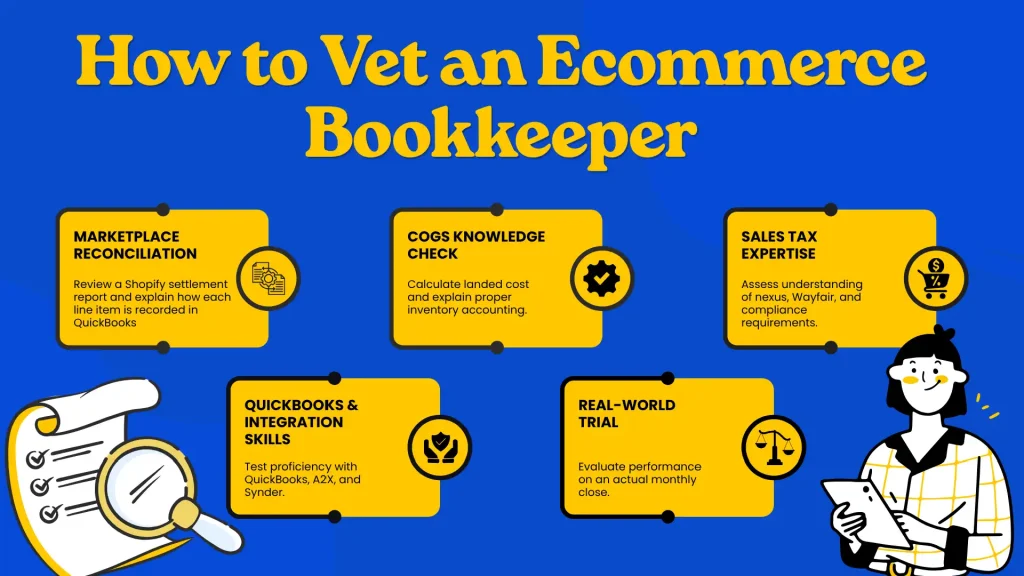
Step 1: Ask about marketplace reconciliation. Give them a sample Shopify settlement report. Ask them to explain what each line item means and how they’d record it in QuickBooks. If they try to book the payout as a single line item, they’re not an ecommerce bookkeeper.
Step 2: Ask about COGS tracking. “How would you calculate COGS for a product that costs $8 from the supplier, $2 in ocean freight, $0.50 in customs duty, $0.30 in 3PL receiving, and $0.40 in packaging?” Expected answer: $11.20 per unit, capitalized to inventory and expensed when sold. Not expensed when purchased.
Step 3: Ask about sales tax. “What is an economic nexus, and how do you determine which states I need to collect in?” If they can’t explain Wayfair, nexus thresholds, and marketplace facilitator rules, they’ll create compliance risk.
Step 4: Tool proficiency test. Give them access to a sandbox QuickBooks account connected to A2X or Synder. Can they navigate the integration? Can they troubleshoot a reconciliation discrepancy? This test separates ecommerce bookkeepers from generalists.
Step 5: 2-week trial on real books. Assign them your actual monthly close: revenue recognition, fee reconciliation, COGS posting, sales tax verification, and bank reconciliation. Evaluate accuracy, speed, and whether they proactively flag discrepancies or just process what they see.
We placed financial professionals for QBM Services who integrated seamlessly into their accounting workflow. Read the QBM Services case study. For more on outsourcing bookkeeping, our outsource bookkeeping guide covers the broader landscape, and our hire offshore tax accountant covers tax-specific accounting roles.
What Ecommerce Bookkeeping Costs
| U.S. Ecommerce Bookkeeper | CPA Firm (Ecommerce Specialty) | Freelance (Upwork) | Dedicated Offshore (Pavago) | |
|---|---|---|---|---|
| Monthly cost | $4,000–$6,000 + benefits | $1,500–$4,000 | $1,000–$3,000 variable | $800–$1,500 |
| Annual cost | $55K–$85K all-in | $18K–$48K | $12K–$36K (inconsistent) | $10K–$18K |
| Ecommerce-specific knowledge | Varies (not guaranteed) | Usually strong | Varies widely | Screened for ecommerce reconciliation |
| Tools | QuickBooks + ecommerce connectors | Their tools (may not match yours) | Whatever they know | YOUR tools (QuickBooks, A2X, Shopify, TaxJar) |
| Dedicated? | Yes | No (1 of many clients) | No (juggling clients) | Yes, 100% |
Clients who switched from domestic bookkeeping to a dedicated Pavago ecommerce bookkeeper saw up to 75% cost reduction on accounting operations. The savings come from replacing a $6,000/month domestic setup with a $1,500/month dedicated hire who handles the same functions. For the full cost breakdown across accounting models, our cost of outsourcing accounting services guide has the real numbers.
Frequently Asked Questions
What is ecommerce bookkeeping?
Ecommerce bookkeeping is the process of recording, reconciling, and reporting financial transactions for online businesses. It includes revenue recognition from marketplace payouts, fee tracking, COGS calculation, inventory valuation, sales tax compliance, and multi-channel consolidation. It’s more complex than traditional bookkeeping because of marketplace fee structures, multi-state sales tax, and inventory accounting across multiple fulfillment locations.
How much does ecommerce bookkeeping cost?
U.S. bookkeeper: $4,000–$6,000/month. CPA firm: $1,500–$4,000/month. Offshore dedicated through Pavago: $800–$1,500/month. The offshore model delivers the same reconciliation quality at 60–75% lower cost.
Can a regular bookkeeper handle ecommerce books?
Usually not. Ecommerce bookkeeping requires understanding marketplace payout structures, COGS capitalization with landed costs, multi-state sales tax, and ecommerce connector tools (A2X, Webgility, TaxJar). A bookkeeper who’s only managed service businesses will struggle with all four.
What tools do ecommerce bookkeepers need?
Accounting: QuickBooks Online or Xero. Ecommerce connectors: A2X, Webgility, or Synder. Sales tax: TaxJar or Avalara. Inventory: DEAR, Cin7, or Shopify native. Your bookkeeper needs proficiency across the full stack.
How do I reconcile Shopify payouts?
Shopify payouts bundle gross sales minus refunds, fees, and adjustments into a single bank deposit. You need to break that deposit into its components: gross revenue, refunds, processing fees, transaction fees, and subscription charges. Tools like A2X automate this. Without them, you’re manually matching each payout to individual orders.
What about Amazon FBA accounting?
Amazon FBA adds complexity: referral fees (8–15%), FBA fulfillment fees, storage fees, advertising spend, and settlement periods that create timing differences. A2X and Link My Books are built specifically to break down Amazon settlements for clean QuickBooks/Xero posting. For broader accounting outsourcing options, our accounting outsourcing companies in USA guide compares providers.
Do I need a CPA or a bookkeeper for ecommerce?
Both, but for different things. A bookkeeper handles daily transaction recording, reconciliation, and reporting. A CPA handles tax strategy, annual filing, and audit support. The most cost-effective setup: an offshore ecommerce bookkeeper ($800–$1,500/month) preparing clean, audit-ready books, and a CPA ($2,000–$5,000/year) doing annual tax filing from that clean data.
Ecommerce Bookkeeping Isn’t Bookkeeping. It’s Financial Operations for Online Businesses.
The word “bookkeeping” undersells what this function actually requires. An ecommerce bookkeeper is reconciling multi-channel marketplace payouts, tracking landed costs across global supply chains, managing sales tax compliance across 20–40 states, and producing financial reports that actually reflect the health of your business. Calling it “bookkeeping” is like calling a cardiac surgeon a “doctor.” Technically true. Practically misleading.
The ecommerce brands with the cleanest books and the best financial visibility in 2026 aren’t the ones with the biggest accounting budgets. They’re the ones who hired a bookkeeper who actually understands ecommerce and paired them with the right tools. At $800–$1,500/month, that’s the most underpriced hire in the ecommerce stack.
Hire an Ecommerce Bookkeeper Through Pavago
Placed for Shopify, Amazon, WooCommerce, and multi-channel e-commerce brands. Revenue reconciliation, marketplace fee tracking, COGS calculation, sales tax compliance, and multi-channel consolidation. QuickBooks, Xero, A2X, Webgility, and TaxJar proficient.
- Ecommerce bookkeepers from $800/month
- Multi-channel reconciliation: Shopify + Amazon + wholesale
- Free replacements | Candidates in 1–2 weeks