
The B-Player Problem Nobody Talks About
When SMB owners hire a marketing VA on their own (Upwork, OnlineJobs.ph, a Facebook group recommendation), they typically get someone who:
- Can schedule social media posts using a tool you set up, but can’t create original content that actually engages your audience.
- Can run a Google Ads campaign you’ve already built, but can’t optimize it when performance drops or identify why CTR is declining.
- Can write blog posts that technically cover the topic, but read like generic filler that nobody shares or links to.
- Can send emails through Mailchimp or Klaviyo, but can’t write subject lines that get above a 20% open rate or segment the list for better targeting.
These are B-players. They execute instructions. They don’t create a strategy. They don’t think about what’s working and why. They don’t proactively suggest improvements. They do what you tell them and stop.
The result: the SMB owner ends up spending 5–10 hours per week managing the VA’s work, reviewing mediocre output, and creating the content strategy themselves. That’s not delegation. That’s supervision. And it defeats the purpose of hiring. At Pavago, we screen specifically for A-player marketing talent. The difference: A-players produce work you’d publish without editing. B-players produce work that needs your revision before it goes anywhere.
What a Marketing Virtual Assistant Actually Handles
A marketing VA is not a social media scheduler. That’s one task within one channel. A real marketing VA can own multiple channels:
| Channel | Tasks Included | Tools Used | A-Player Signal |
|---|---|---|---|
| SEO and content | Keyword research, blog writing, on-page optimization, internal linking, competitor content analysis, and content calendar management | Ahrefs, SEMrush, Surfer SEO, Google Search Console, WordPress | They suggest keywords based on competitive gaps, not just search volume. They understand search intent. |
| Social media | Content creation (captions + graphics), scheduling, community engagement, analytics interpretation, trend adaptation | Canva, Buffer, Later, Meta Business Suite, Instagram, LinkedIn, X | They create content that feels native to each platform. Their posts drive engagement, not just fill a calendar. |
| Paid ads | Campaign setup, ad copy writing, audience building, bid management, A/B testing, reporting | Google Ads, Meta Ads Manager, Google Analytics, UTM tracking | They can diagnose why a campaign is underperforming and propose fixes, not just report the numbers. |
| Email marketing | List segmentation, campaign creation, automation workflows, A/B testing subject lines, deliverability monitoring | Klaviyo, Mailchimp, ActiveCampaign, ConvertKit, HubSpot | They understand segmentation and automation logic. They write subject lines that get opened. |
| Content creation | Blog posts, landing page copy, email sequences, case studies, social copy, ad copy | Google Docs, WordPress, Notion, Grammarly | They produce first drafts that need minimal editing. Not filler content that requires complete rewrites. |
| Analytics and reporting | Google Analytics, platform-specific analytics, UTM tracking, conversion tracking, monthly reporting | Google Analytics 4, Looker Studio, platform dashboards | They interpret data and recommend actions. Not just screenshot dashboards. |
Pavago places marketing VAs who handle all of these functions, depending on client needs. Some clients need a VA who covers 2–3 channels at once. Others need a specialist for one channel. Browse our hire marketing category for available talent. For social media specifically, see our social media manager page. For SEO, see our seo content writer.
The 4 Models for Getting Marketing Done
Model 1: Marketing Agency
Cost: $2,000–$8,000+/month retainer. $15,000–$50,000+ for project work.
What you get: A team of specialists managed by an account manager. Multi-channel execution. Creative director oversight.
What you don’t get: Dedication. You’re one of 15–20 clients. A junior at the agency does your work while you pay senior rates. The account manager reviews it for 15 minutes. 30–50% of your budget goes to agency overhead, not actual marketing output.
Model 2: Freelance Marketers
Cost: $25–75/hour. $500–$3,000/month depending on scope.
What you get: Channel-specific expertise from an individual. Good for specific projects (a website rewrite, a Google Ads launch).
What you don’t get: Continuity. Freelancers juggle 3–7 clients. Availability drops. Quality fluctuates. They leave when they get a bigger client. You start over every 4–6 months.
Model 3: U.S. Marketing Coordinator
Cost: $3,500–$5,500/month + benefits ($50K–$80K/year all-in).
What you get: A dedicated team member in your time zone with full attention.
What you don’t get: Budget efficiency. For the price of one U.S. coordinator, you can hire 2–3 dedicated offshore marketing VAs covering more channels with more output.
Model 4: Dedicated Offshore Marketing VA (Pavago)
Cost: $1,000–$1,500/month. Full-time. Dedicated to your business.
What you get: One person who learns your brand, covers 2–3 marketing channels, creates original content, and produces 40+ hours/month of marketing output. Same tools as any U.S. marketer. Direct management (Slack, Zoom, Asana).
What you don’t get: In-person presence and native U.S. cultural context. For most SMB marketing needs (SEO, social, email, ads), this doesn’t matter. For PR, media relations, or event marketing, in-house or U.S.-based is better.
Cost Comparison: What Each Model Actually Delivers Per Dollar
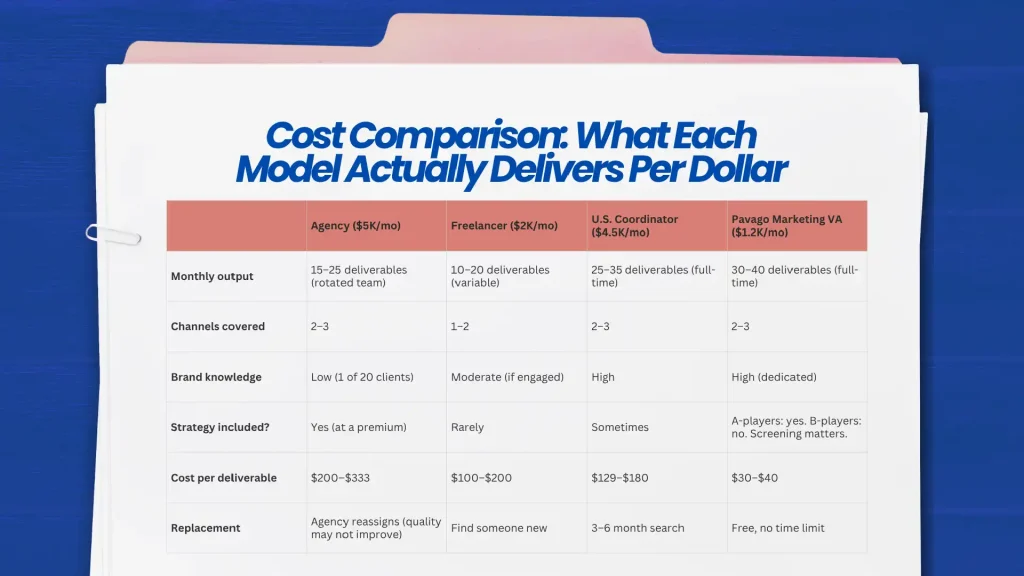
According to There Is Talent’s virtual assistant statistics, companies report a 35% increase in efficiency when routine tasks are managed by VAs, and businesses save up to 78% on operational expenses by hiring VAs instead of full-time in-house staff. (external, dofollow, new tab) For marketing specifically, the savings are even more dramatic because you’re replacing high-cost agency retainers, not just salaries.
How to Vet a Marketing VA (5-Step A-Player Screening)
This process is specifically designed to filter out B and C players. Each step tests for something that separates task-followers from strategic thinkers.
Step 1: Portfolio Review With the Right Questions
Don’t just look at deliverables. Ask: Which campaigns drove measurable results? What was the strategy behind this social campaign? What would you do differently? B-players show you pretty graphics. A-players show you pretty graphics AND explain why those graphics converted.
Step 2: Content Creation Test (Paid, $100–$200)
Give them your brand guidelines, your target audience, and ask them to create: 3 social media posts, 1 email subject line with preview text, and 1 blog post outline with 5 H2s. Evaluate: Does the content feel on-brand? Is the blog outline focused on search intent, not just keyword stuffing? Are the social posts native to the platform? B-players produce generic output. A-players produce output tailored to your specific audience.
Step 3: Channel-Specific Assessment
For SEO: Give them a keyword and ask them to outline a blog post that would rank. Do they consider search intent? Competitor content gaps? Internal linking? Or do they just write “10 Tips About [Keyword]”?
For Paid Ads: Show them a Google Ads account with declining CTR. Ask what they’d investigate and change. Do they look at ad copy? Audience targeting? Landing page alignment? Or do they just suggest “increase budget”?
For Email: Ask them to write 3 subject lines for a product launch email. Evaluate: Do the subject lines create curiosity, urgency, or specificity? Or are they generic (“Check out our new product!”)?
Step 4: Analytics Interpretation
Show them a Google Analytics dashboard with 3 months of traffic data. Ask: What’s the trend? Which channels are driving the most conversions? What would you prioritize next month? A-players identify patterns and recommend actions. B-players describe what they see without interpretation. According to HubSpot’s State of Marketing research, 36% of marketers say proving ROI is their biggest challenge. (external, dofollow, new tab) An A-player marketing VA helps solve this because they connect activities to outcomes.
Step 5: 2-Week Trial on Live Channels
Give them access to your actual marketing channels. Assign real tasks: create and schedule a week’s worth of social content, write one blog post, set up one email campaign. Evaluate: output quality without templates, speed, brand consistency, and proactive suggestions. A-players start pitching ideas by week 2. B-players wait to be told what to do next.
We built an offshore marketing team for Celebrate Dental that included social media, SEO, and paid ads specialists. The team drove consistent growth across channels. Read the Celebrate Dental case study. For related marketing roles, our marketing automation specialist guide covers the automation layer, and our seo writers guide covers content-specific hiring.
When Each Model Makes Sense
Agency: You have $3,000+/month and want a multi-channel team with a creative director. You don’t want to manage individual marketers. You value strategic direction more than volume of output.
Freelancer: You need a specific project done: a website redesign, a Google Ads launch, a content strategy document. Defined scope, defined timeline.
U.S. coordinator: You need someone in your time zone for real-time collaboration on brand-sensitive or event-based marketing. Budget allows $4,500+/month.
Dedicated marketing VA (Pavago): You need 30–40+ hours/month of marketing output across 2–3 channels at $1,000–$1,500/month. You can provide direction and feedback. You want one person who learns your brand deeply and gets better every month.
For companies evaluating how to reduce marketing costs specifically, our how to reduce marketing costs for small businesses guide covers the structural approach. And for the broader outsourcing comparison, our benefits of outsourcing digital marketing for SMBs covers the case.
Frequently Asked Questions
How much does a marketing virtual assistant cost?
Agency: $2,000–$8,000+/month. Freelance: $25–75/hour. U.S. coordinator: $3,500–$5,500/month. Dedicated offshore through Pavago: $1,000–$1,500/month full-time.
What marketing channels can a VA handle?
SEO and content, social media management, paid ads (Google and Meta), email marketing, analytics, and reporting. Most marketing VAs specialize in 2–3 channels. Some cover all at a generalist level.
Should I hire a specialist or a generalist?
Generalist if you need coverage across channels and you’re early-stage (pre-product-market-fit or under $1M revenue). Specialist, if you know which channel drives your growth and need depth (e.g., SEO is your growth engine and you need a dedicated SEO VA).
What’s the biggest risk of hiring a marketing VA?
Getting a B-player who can execute but can’t think. The 5-step screening process above is designed to prevent this. The content creation test (Step 2) and analytics interpretation test (Step 4) are the two best B-player filters.
Can a marketing VA replace an agency?
For most SMBs under $2M revenue: yes. A $1,200/month marketing VA produces more output, more consistently, with deeper brand knowledge than a $5,000/month agency retainer. The trade-off: you provide the strategic direction instead of a creative director. If you know your ICP, your channels, and your goals, the VA executes at 3–5x the output per dollar.
What tools should a marketing VA know?
Content: WordPress, Google Docs, Grammarly. Social: Canva, Buffer/Later, Meta Business Suite. SEO: Ahrefs/SEMrush, Google Search Console, Surfer SEO. Paid ads: Google Ads, Meta Ads Manager. Email: Klaviyo, Mailchimp, and ActiveCampaign. Analytics: Google Analytics 4, Looker Studio.
How do I know if my marketing VA is working?
Track: website traffic growth, social media engagement rate, email open/click rates, ad ROAS, and leads generated. An A-player marketing VA should show measurable improvement within 60–90 days. Our facebook ads expert guide covers paid-specific performance tracking.
The A-Player Difference Is Everything
A B-player marketing VA costs you $1,000/month and produces output you have to redo. An A-player marketing VA costs the same $1,000/month and produces output that drives results. The price is identical. The outcome is 10x different. The only difference is how you screen.
The 5-step process works because each step tests for what separates A-players from B-players: portfolio quality with strategic reasoning, original content creation without heavy direction, channel-specific diagnostic thinking, data interpretation with actionable recommendations, and live-channel performance without templates. Skip any step, and you’re rolling the dice on quality. Follow all five, and you hire a marketing VA who actually moves the needle.
Hire an A-Player Marketing Virtual Assistant Through Pavago
SEO, social media, paid ads, email marketing, content creation, and analytics. Every candidate screened with our 5-step A-player process. $1,000–$1,500/month for full-time dedicated marketing execution.
- Marketing VAs from $1,000/month
- Multi-channel: SEO + social + ads + email
- Free replacements | Candidates in 1–2 weeks