The Hidden Cost of “Good Enough” Data Entry
Here’s a number nobody talks about when they hire cheap data entry help: a 2% error rate across 5,000 records per month means 100 records you can’t trust. Those 100 bad records don’t just sit there. They cascade.
A wrong phone number in your CRM means a lost sales opportunity. A misclassified expense in QuickBooks means a wrong financial report, which means a wrong business decision. A product listing with the wrong price on Shopify means a customer dispute, a refund, and a negative review. A patient record with the wrong insurance code means a denied claim and a billing delay.
According to Gartner research, poor data quality costs organizations an average of $12.9 million per year. (external, dofollow, new tab) For SMBs, the dollar amount is proportionally smaller, but the impact per error is proportionally larger. When you have 500 customers instead of 50,000, every wrong record matters more.
This is why hiring the cheapest data entry person you can find on Fiverr is a trap. The $3/hour person who produces a 5% error rate costs more than the $6/hour person who produces a 0.5% error rate, because you spend more time fixing their work than they saved you doing it.
What a Data Entry Virtual Assistant Actually Handles
Data entry VA is a broad title. Here’s what it covers across the industries Pavago serves:
| Industry | Data Entry Tasks | Primary Tools | Volume (1 FTE/Month) |
|---|---|---|---|
| Sales/CRM | New lead record creation, contact info updates, deal pipeline tracking, activity logging, duplicate merging, list imports from events and campaigns | HubSpot, Salesforce, Pipedrive, Zoho CRM, Monday CRM | 2,000–5,000 records |
| E-commerce | Product listing creation (titles, descriptions, pricing, images, categories, variants), SKU management, inventory updates, product migration between platforms | Shopify, WooCommerce, BigCommerce, Magento, Amazon Seller Central | 500–1,500 products |
| Finance/Accounting | Invoice processing, receipt digitization, expense categorization, bank transaction entry, vendor record management, payroll data input | QuickBooks, Xero, FreshBooks, Wave, Excel | 1,000–3,000 transactions |
| Medical/Insurance | Patient demographics entry, insurance eligibility verification, CPT/ICD coding support, claims data entry, appointment scheduling data, referral tracking | Epic, Cerner, Athenahealth, eClinicalWorks, custom EHR | Varies by practice size |
| Real estate | Listing data entry to MLS and marketing platforms, tenant record management, lease data input, property detail updates, comparative market analysis data | AppFolio, Buildium, MLS portals, Zillow, Apartments.com | 200–500 listings/records |
| Research/Operations | Survey response compilation, competitive intelligence gathering, market data tabulation, document digitization (paper/PDF to structured data), inventory auditing | Excel, Google Sheets, Airtable, Qualtrics, OCR tools | Project-dependent |
At Pavago, we place data entry VAs across all of these industries. The VA doesn’t need to be a CRM expert or an e-commerce specialist. They need to be accurate, fast, and trainable in your specific system. Browse our hire admin category for available talent. For roles that combine data entry with broader admin support, see our administrative assistant page.
The 5-Step Process for Hiring a Data Entry VA Who Actually Maintains Accuracy
Step 1: The Accuracy Test (Non-Negotiable)
Before anything else. Before portfolio review. Before interviews. Before discussing rates. Give them 50 records to enter into a spreadsheet with specific formatting requirements:
- Name format: Last, First (not First Last)
- Phone format: (XXX) XXX-XXXX (not XXX-XXX-XXXX or XXXXXXXXXX)
- Date format: MM/DD/YYYY (not DD/MM/YYYY or spelled out)
- Category codes: use specific codes from a reference table you provide
- Include 3 intentionally tricky records: misspelled source data, ambiguous categories, incomplete fields
Scoring: 49–50 correct = excellent (98–100%). Pass. 47–48 = acceptable (94–96%). Borderline. Below 47 = disqualify. Don’t rationalize. Accuracy at 50 records predicts accuracy at 5,000. If they’re making 3+ errors in 50 records, they’ll make 300+ in 5,000.
Step 2: The Speed Test
Accuracy without speed is too expensive. Speed without accuracy is dangerous. You need both.
Using the same 50-record set, track time. Benchmarks for trained data entry professionals:
- 50 simple records (name, phone, email, category): 30–45 minutes
- 50 complex records (multiple fields, reference table lookups, formatting rules): 45–75 minutes
If they’re taking 2+ hours for 50 records, their productivity at scale won’t justify the cost.
Step 3: Tool Proficiency Check
Give them access to your actual system (sandbox or test environment). Ask them to complete 3 tasks:
- Create 5 new records from the provided source data
- Find and update 3 existing records
- Run a basic filter/sort to find records matching specific criteria
A proficient data entry VA navigates any CRM, spreadsheet, or ERP within 15–20 minutes. If they need step-by-step instructions to create a record in HubSpot, expect a steep onboarding curve.
Step 4: Consistency Test (The Hidden Dimension)
Most accuracy tests check a single batch. But data entry quality degrades over time if the person isn’t disciplined. Give them a second batch of 50 records, 3 days after the first test, without warning. Compare the accuracy between batch 1 and batch 2. If accuracy drops more than 2% between batches, they’re not consistent. Consistency matters more than peak accuracy because your data comes in every day, not just on test days.
According to MIT Sloan research, companies that invest in data quality see 15–20% increases in revenue from better decision-making. (external, dofollow, new tab) That investment starts with the person entering the data.
Step 5: 1-Week Paid Trial on Live Data
Assign real work from your actual backlog. Track three metrics daily:
- Error rate: Spot-check 10% of records entered each day. Calculate errors per 100 records. Target: under 1%.
- Throughput: Records completed per hour. Should match or exceed test performance.
- Self-correction: Do they catch and fix their own mistakes, or do you find them? A VA who self-corrects is worth 2x one who doesn’t.
We provided administrative support for Sudberry Southern that included data-intensive work. Read the Sudberry Southern case study for how we structured the placement. For adjacent outsourcing topics, our pros and cons of offshore medical billing covers data-intensive medical roles, and our 3 reasons to outsource admin tasks covers the broader case for admin outsourcing.
Data Entry VA vs “Outsource Data Entry”: Different Search, Different Need
If you’re reading this, you searched for a PERSON. “Data entry virtual assistant.” That’s different from “outsource data entry,” which is about the FUNCTION. Here’s why the distinction matters:
| “Data Entry Virtual Assistant” | “Outsource Data Entry” | |
|---|---|---|
| You’re looking for | A dedicated person who handles your data entry ongoing | A solution for getting data entered (could be a person, a team, or a service) |
| Best model | Dedicated VA working full-time in your systems | Could be freelance project, BPO team, or dedicated hire depending on volume |
| Volume | 10–40+ hours/week of recurring data entry | Could be one-time or ongoing |
| Relationship | Direct employment, institutional knowledge, brand familiarity | Vendor relationship, potentially rotating workers |
| When to choose | You need consistent, daily data entry in YOUR systems by someone who learns your processes | You need data entered but don’t care who does it or whether they know your business |
Both are valid. But if you’re hiring a VA, you want the dedicated-person model. That’s what Pavago delivers: one person, your systems, your data, your quality standards. Not a rotating team in a BPO factory.
What a Data Entry Virtual Assistant Costs
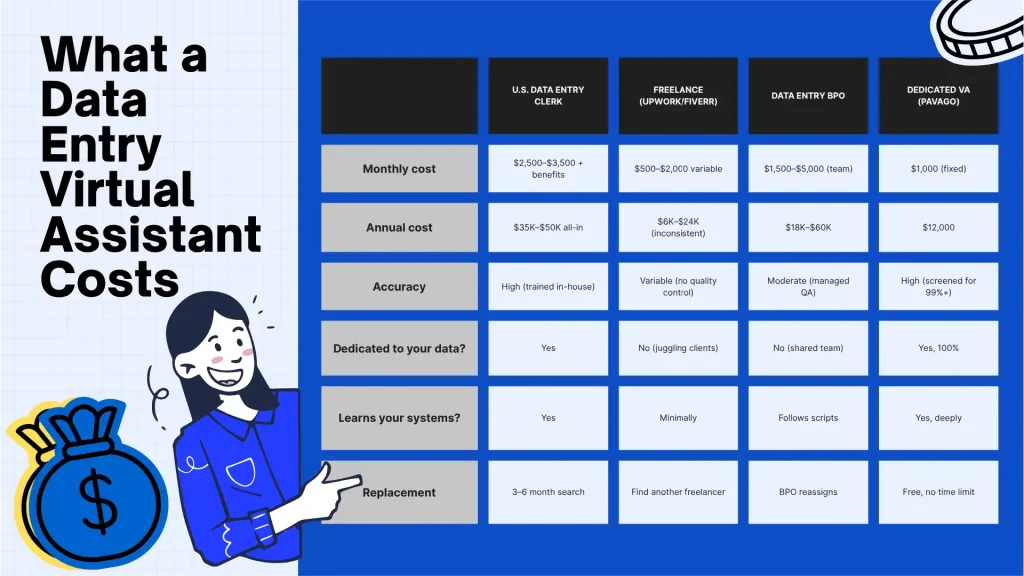
At $1,000/month producing 2,000–5,000 records, the per-record cost is $0.20–$0.50. Compare that to $1–$3 per record on freelance platforms (when you factor in management time and error correction). The dedicated model is both cheaper and better.
Frequently Asked Questions
How much does a data entry virtual assistant cost?
Offshore dedicated through Pavago: $1,000/month. Freelance: $3–15/hour. U.S. data entry clerk: $2,500–$3,500/month + benefits. BPO team: $1,500–$5,000/month.
What accuracy rate should I expect?
99%+ from a properly vetted data entry VA. Pavago screens with a 50-record accuracy test before presenting candidates. Anything below 98% during screening = disqualified.
What tools should a data entry virtual assistant know?
Excel/Google Sheets (advanced: filters, VLOOKUP, pivot tables, data validation). CRM platforms (HubSpot, Salesforce, Pipedrive). E-commerce (Shopify, WooCommerce). Accounting (QuickBooks, Xero). The specific tool is less important than the ability to learn new systems quickly.
How fast should a data entry virtual assistant work?
Trained benchmark: 50 simple records in 30–45 minutes. 50 complex records in 45–75 minutes. At scale: 2,000–5,000 records per month for a full-time VA, depending on complexity.
Freelancer vs dedicated VA for data entry?
Freelancer for one-time projects (database cleanup, migration, digitization). Dedicated VA for ongoing daily data entry. The breakeven: if you need 15+ hours/week of data entry, a dedicated VA at $1,000/month is cheaper and more reliable.
Can I trust a VA with sensitive data?
Yes, with proper controls: NDAs, role-based system access (read/write without delete or export), two-factor authentication, audit trails, and encrypted communication. Most CRMs and ERPs have built-in permission controls that work for remote professionals.
How long until a data entry virtual assistant is productive?
Week 1: learning your systems, formatting rules, and processes. Week 2: producing work at 80% of full speed with quality checks. Week 3+: full productivity with minimal supervision. Data entry has the shortest onboarding curve of any VA function. For structuring the ramp, our hire overseas virtual assistant guide covers the onboarding process.
Accuracy Is the Only Metric That Matters
Hiring a data entry VA isn’t about finding the cheapest typist. It’s about finding someone who maintains 99%+ accuracy across thousands of records month after month. The 5-step process works because it tests the only things that matter: accuracy under formatting constraints, speed at volume, tool proficiency, consistency across batches, and performance on live data.
At $1,000/month, a Pavago data entry VA processes 2,000–5,000 records at 99%+ accuracy. That’s $0.20–$0.50 per record with a person who learns your systems and gets better every month. No freelancer rotation. No quality roulette. Just clean data.
Hire a Data Entry Virtual Assistant Through Pavago
Dedicated data entry VAs across CRM, e-commerce, finance, medical, real estate, and operations. Every candidate screened with a 50-record accuracy test. 99%+ accuracy standard.
- Data entry VAs from $1,000/month
- Multi-industry: HubSpot, Shopify, QuickBooks, Excel, and more
- Free replacements | Candidates in 1–2 weeks