
Why Most SMBs Overpay for Software Development
The typical path: you need a web app, a mobile app, or custom software. You don’t have in-house developers. You Google “software development company” and get quoted $50,000–$300,000 for a project. Or you go to Upwork and hire a $40/hour freelancer who delivers something that mostly works until it doesn’t.
The software development outsourcing market is projected to exceed $500 billion by 2028, according to Statista’s global outsourcing data. (external, dofollow, new tab) That’s a lot of money being spent. But the market is split across four fundamentally different models, and most SMBs don’t understand the difference until they’ve already committed to the wrong one.
The problem isn’t talent. There are millions of skilled developers globally. The problem is the model: how you engage that talent, what you pay for, and how much control you have over the process.
The 4 Models for Outsourcing Software Development
Model 1: Software Development Agency
How it works: You hire an agency to build your product. They provide a project manager, designers, developers, and QA testers. You pay a fixed project fee or an hourly rate. The agency manages the team. You manage the relationship with the agency.
Cost: $100–$250/hour for U.S. agencies. $40–$100/hour for nearshore (LATAM). $25–75/hour for offshore (Asia). Project quotes: $50,000–$500,000+ depending on scope.
Works for: Companies with a well-defined product specification who want a turnkey build. You know exactly what you want and need someone to execute it.
Breaks for: Companies still figuring out product-market fit, iterating on features, or needing ongoing development. Agency economics are built for projects with endpoints, not ongoing product development. Every change request is a change order. Every scope expansion costs extra. The incentive structure rewards delivering a spec, not building the right product.
Model 2: Freelance Developers (Upwork, Toptal)
How it works: You hire individual developers on hourly or project contracts. You manage them directly. You define the work, review the output, and handle coordination.
Cost: $30–80/hour on Upwork. $60–$150/hour on Toptal (pre-vetted). Project fees vary widely.
Works for: Specific, well-scoped tasks: build this feature, fix this bug, integrate this API. Defined input, defined output, defined timeline.
Breaks for: Ongoing product development. Freelancers juggle clients. Availability drops when they get busier projects. The code they write walks out the door when they leave. No institutional knowledge. No long-term architecture thinking. And managing 2–3 freelancers across time zones becomes a part-time job in itself.
Model 3: Staff Augmentation Firms (Andela, BairesDev)
How it works: A vendor supplies pre-vetted developers who work as part of your team. The vendor employs them. You manage them. You pay the vendor a markup over the developer’s actual compensation.
Cost: $4,000–$12,000/month per developer ($50–$150/hour effective). Premium pricing for senior and specialized roles.
Works for: Companies with a technical lead or CTO who can manage developers directly. You need a React developer for 6 months or a DevOps engineer for a platform migration. The vendor handles sourcing and payroll. You handle management.
Breaks for: Companies without technical leadership. Staff augmentation assumes you know what to tell the developer to build. If you don’t have someone who can write tickets, review code, and make architecture decisions, the augmented developer will idle or build the wrong thing. Also: the markup. A developer earning $2,000/month in Pakistan gets billed to you at $6,000–$10,000. The vendor takes $4,000–$8,000 for sourcing and admin.
Model 4: Dedicated Offshore Team / Direct Hire
How it works: A recruitment platform sources, vets, and places developers who work directly for you. No vendor markup on their salary. No middleman employer. They’re your team members.
Cost: $1,500–$4,000/month per developer through Pavago. Mid-level: $2,000. Senior: $3,000–$4,000. No markup beyond Pavago’s $329/month platform fee.
Works for: SMBs building a real product team. You want developers who build institutional knowledge, care about your codebase, and are invested in the long-term success of your product. You manage them like any team member. The difference is cost and location.
Breaks for: Companies that need a turnkey build with zero technical involvement. If you can’t manage developers at all, the agency model’s project management layer may be worth the premium. But most SMBs with a founder or product owner who can define requirements can manage a dedicated team.
Cost Comparison: What Outsourced Development Actually Costs
| Agency | Freelance (Upwork) | Staff Augmentation | Dedicated Team (Pavago) | |
|---|---|---|---|---|
| 1 mid-level developer/month | $15,000–$40,000 | $5,000–$12,000 | $6,000–$12,000 | $2,000 |
| 1 developer/year | $180K–$480K | $60K–$144K | $72K–$144K | $24,000 |
| 3-person team/year | $540K–$1.4M | $180K–$432K | $216K–$432K | $72,000 |
| Project management included? | Yes (agency manages) | No (you manage) | No (you manage) | No (you manage) |
| Developer works for | The agency | Themselves (contractor) | The vendor (markup) | You (direct employment) |
| Institutional knowledge stays? | No (walks out with agency) | No (walks out with freelancer) | Partially (vendor retains talent) | Yes (your team) |
| Replacement | Agency reassigns (may not improve) | Find new freelancer | Vendor reassigns | Free, no time limit (Pavago) |
The cost difference is staggering at the team scale. A 3-person development team through an agency: $540K–$1.4M/year. Through Pavago: $72K. For the same developers, using the same tools, writing the same code. The gap is model overhead, not talent quality.
At Pavago, we’ve placed both individual developers and full development teams. Browse our hire engineering category for available talent across all specializations. For full-stack specifically, see our offshore full stack developer page.
Which Tech Stacks Outsource Best
Not every technology outsources equally well. Here’s what the talent market looks like:
| Stack | Offshore Talent Depth | Typical Monthly Rate (Pavago) | Best Outsourced For |
|---|---|---|---|
| React / Node.js | Very deep. Largest pool globally. | $1,800–$3,000 | Web apps, SPAs, full-stack products |
| Python / Django / FastAPI | Deep. Strong in Pakistan and Eastern Europe. | $1,800–$3,000 | Backend APIs, data engineering, ML/AI applications |
| PHP / Laravel | Deep. Very large legacy and active pool. | $1,500–$2,500 | SaaS products, CMS platforms, e-commerce |
| Java / Spring Boot | Deep. Enterprise-heavy talent pool. | $2,000–$3,500 | Enterprise applications, fintech, Android |
| .NET / C# | Moderate to deep. | $2,000–$3,500 | Enterprise applications, Windows ecosystem |
| Mobile (React Native / Flutter) | Growing fast. | $2,000–$3,500 | Cross-platform mobile apps |
| DevOps / Cloud (AWS, Azure, GCP) | Deep. | $2,500–$4,000 | Infrastructure, CI/CD, cloud migration |
| WordPress / Shopify | Very deep. Commoditized. | $1,000–$1,800 | Marketing sites, e-commerce, content platforms |
Pavago placed across all of these stacks. The most common: React/Node.js full-stack, Python backend, and PHP/Laravel SaaS. According to Stack Overflow’s Developer Survey, JavaScript and Python are the two most commonly used programming languages globally, which means the offshore talent pool for these stacks is massive. (external, dofollow, new tab)
How to Vet Outsourced Developers
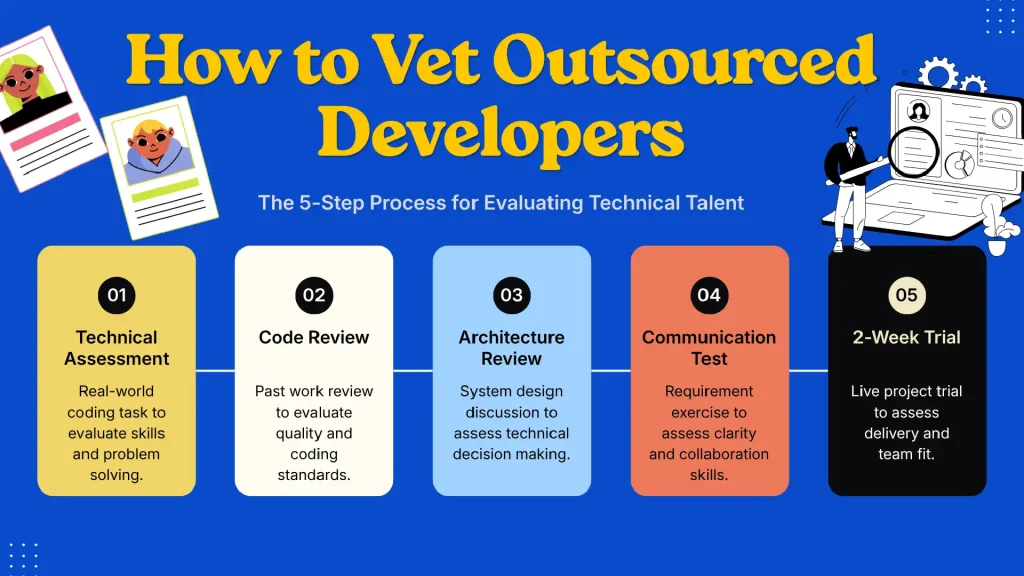
Step 1: Technical assessment (paid, $150–$300). Give a real-world coding challenge in your stack. Not a LeetCode puzzle. A practical task: build a small feature, fix a realistic bug, or refactor a messy function. Evaluate: code quality, architecture decisions, testing, and whether they ask clarifying questions about requirements before coding.
Step 2: Code review. Look at their GitHub or past work. Evaluate: naming conventions, folder structure, commit messages, and test coverage. Code style tells you how they think, not just what they can produce.
Step 3: Architecture conversation. Describe a system you’re building (or one they’ve built). Ask how they’d structure it. What database? How would they handle scaling? Where would they put caching? This separates developers who can code from developers who can architect.
Step 4: Communication test. Give an ambiguous requirement. See how they handle it. Good developers ask questions. Bad developers make assumptions and build the wrong thing. After screening 100+ technical candidates, the failure pattern we see most at Pavago: candidates strong in one framework who can’t adapt to the client’s stack. We screen for adaptability across tools, not just depth in one.
Step 5: 2-week trial on your actual codebase. There is no substitute for this. Give them a real task, real code access (sandboxed), and real deadlines. Evaluate: code quality, communication, speed, and whether they write code that other developers can understand. For how we’ve structured engineering team placements, see the Press Advantage case study on building an in-house technical team offshore, and the Eversite case study on building a performance-focused engineering team.
For broader engineering recruitment options, our engineering search firms guide compares providers, and our hire remote developers guide covers the full process.
When Each Model Makes Sense
Agency: You have a defined spec, a fixed budget, and zero internal technical capability. You want to hand off a project and receive a product. Budget: $50K+ per project. Ongoing cost: high if you need changes.
Freelance: You need a specific feature built, a bug fixed, or a short-term technical task completed. Budget: $30–80/hour. Ongoing cost: management time + re-hiring when freelancers leave.
Staff augmentation: You have a CTO or tech lead who can manage developers. You need to scale the team quickly for 3–12 months. Budget: $6K–12K/month per developer.
Dedicated team (Pavago): You’re building a product team for the long term. You want developers who build institutional knowledge, ship features continuously, and care about your codebase because it’s THEIR codebase. Budget: $2K–4K/month per developer. This is the model that builds companies.
Frequently Asked Questions
How much does it cost to outsource software development?
Agency: $100–$250/hour ($180K–$480K/year per developer). Freelance: $30–80/hour. Staff augmentation: $50–$150/hour. Dedicated offshore through Pavago: $2,000/month per mid-level developer ($24K/year).
Which countries are best for outsourcing development?
Pakistan and Eastern Europe for technical depth (Python, React, Java). Philippines for WordPress/Shopify and simpler web development. LATAM for time zone alignment with U.S. teams. Pavago sources from Pakistan, Philippines, LATAM, Eastern Europe, and South Africa.
Can I outsource my entire development function?
Yes. Pavago has placed full development teams (frontend + backend + QA) for clients who outsource their entire engineering function. The key requirement: someone on your side who can define requirements, prioritize features, and review work. That’s usually the founder or a product owner.
What’s the biggest risk of outsourcing development?
Code quality and communication. A developer who writes working-but-unmaintainable code creates technical debt that costs 10x to fix later. The 5-step vetting process above screens for both. The 2-week trial catches everything the screening doesn’t.
How do I manage an offshore development team?
Same tools as any remote team: GitHub for code, Jira or Linear for project management, Slack for communication, and daily standups via Zoom. The time zone difference actually helps: your developers code overnight (their daytime), and you review in the morning. Continuous progress.
Staff augmentation vs dedicated team: what’s the real difference?
Staff augmentation = the vendor employs the developer, marks up their salary 2–4x, and retains the option to reassign them. Dedicated team = the developer works directly for you, no markup, no middleman. The developer is more invested in your product because they’re your team member, not a vendor’s resource.
What if I need a developer for just one project?
Freelance or agency is fine for true one-off projects with a defined scope. But most “one-off” software projects become ongoing: you ship v1 and immediately need bug fixes, feature additions, and performance improvements. If there’s any chance you’ll need development beyond the initial build, the dedicated model is cheaper and better. For a broader hiring context, see our how to hire offshore software developers guide.
The Code Is the Same. The Cost Shouldn’t Be 5x.
A React component written by a $150/hour agency developer and a $12/hour Pavago developer is the same React component. It compiles the same way, renders the same pixels, and ships the same product. The difference is model overhead: account managers, creative directors, office space, and markup.
The companies building the best software in 2026 aren’t the ones with the biggest development budgets. They’re the ones who found the right model for their stage: a dedicated team that writes quality code, ships features continuously, and costs a fraction of what the agency model charges for the same output.
Outsource Software Development Through Pavago
Individual developers and full teams. React, Node, Python, PHP, Java, .NET, mobile, DevOps. Every developer is screened with practical coding challenges, architecture conversations, and adaptability testing. Direct hire, no markup.
- Mid-level developers from $2,000/month
- Full teams (frontend + backend + QA) available
- Free replacements | No lock-in | Candidates in 1–2 weeks