The 3 HR Outsourcing Models With Real Costs
The phrase “HR outsourcing” covers three fundamentally different models. The cost, the control, and the scope differ dramatically.
| PEO | HRO Firm | Dedicated Offshore HR Hire | |
|---|---|---|---|
| How it works | Vendor handles specific HR tasks on contract. You remain the sole employer. | Payroll, benefits, compliance, HR admin, and some include recruiting | One full-time professional who owns your HR function remotely. |
| Pricing model | Per employee per month | Flat fee or per-service | Flat monthly (Pavago: $329/mo platform fee + hire’s salary) |
| Cost: 10 employees | $490–$2,500/month | $500–$2,000/month | $1,000–$2,000/month |
| Cost: 25 employees | $1,225–$6,250/month | $500–$3,000/month | $1,000–$2,000/month |
| Cost: 50 employees | $2,450–$12,500/month | $1,000–$5,000/month | $1,000–$2,000/month |
| Scales with headcount? | Yes — cost rises with every hire | Somewhat (scope may expand) | No — fixed cost regardless of headcount |
| What’s included | Payroll, benefits, compliance, HR admin, some include recruiting | Varies: recruiting, compliance audit, handbook creation, specific projects | Everything the hire can do: recruiting, payroll admin, compliance docs, onboarding, employee handbook, performance tracking |
| Control | Low (co-employment = shared decisions) | Moderate (project-based) | High (direct employment) |
| Lock-in | 12-month contracts common | Project or annual terms | No lock-in with Pavago |
The inflection point is clear: above 15–20 employees, the per-employee PEO model costs more than a dedicated HR professional while giving you less control. At 50 employees, a PEO can cost $5,000–$12,500/month. A dedicated offshore HR pro costs the same $1,000–$2,000/month regardless.
What Most Clients Look Like Before They Come to Pavago
Here’s what makes this keyword different from what the PEO vendors assume: most of our clients who need HR help had no HR function at all before Pavago. They’re not switching from a PEO. They’re a 15–40 person company where the founder has been handling hiring, payroll questions, and compliance on a Post-It note system. They don’t need a PEO’s infrastructure. They need one competent person to build the HR function from scratch.
According to SHRM (Society for Human Resource Management), 54% of small businesses handle HR responsibilities without a dedicated HR professional. (external, dofollow, new tab) Pavago places HR professionals who become the first dedicated HR person, building a function that doesn’t exist yet. At Pavago, browse our hire admin category for HR and admin roles.
Hidden Costs Nobody Mentions
- PEO setup fees: $500–$2,500 one-time. Plus annual renewal fees at some providers.
- Benefits markup: PEOs bundle health insurance and 401(k), but mark up 10–25% over what you’d pay going direct. In a 25-person company, that’s $5,000–$15,000/year in hidden margin.
- Switching costs: Leaving a PEO means migrating payroll, benefits, and compliance infrastructure. Budget 2–4 weeks of disruption and $2,000–$5,000 in transition costs.
- Per-employee scaling: Every new hire increases your PEO bill. A dedicated HR professional’s cost stays flat whether you have 15 employees or 50.
- HRO scope creep: Firms quote for a specific project, then upsell when the scope expands. A $2,000/month compliance audit becomes a $4,000/month ongoing engagement.
The Real Math: What Each Model Costs Over 12 Months
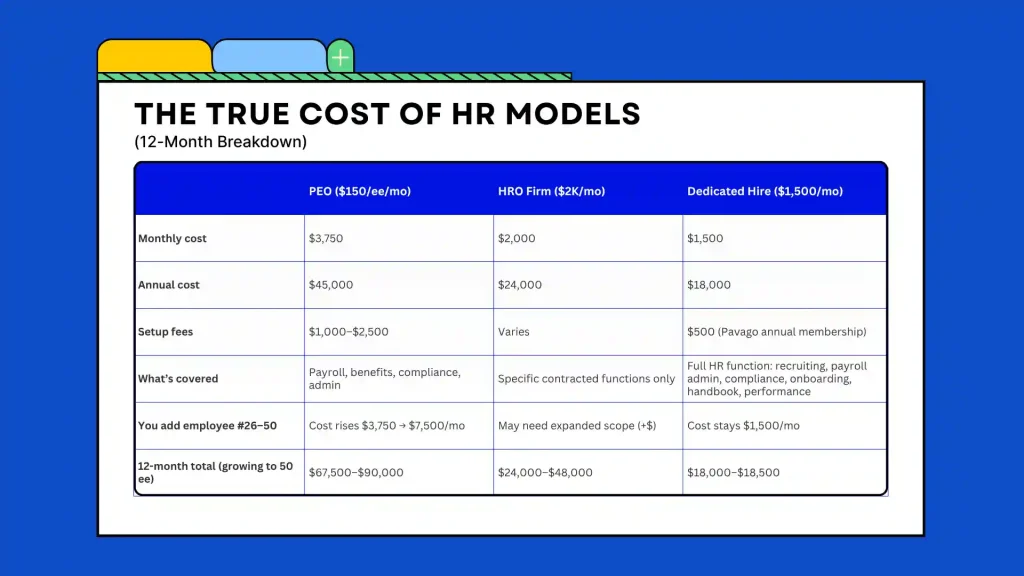
The dedicated hire model is 60–80% cheaper than PEO at the 25–50 employee range, and gives you more control AND doesn’t scale with headcount. According to NAPEO, roughly 175,000 U.S. businesses use PEOs, but the model was designed for companies that want zero HR involvement, not companies building a real HR function. (external, dofollow, new tab)
For how we’ve helped companies build operational functions from scratch, see the FLLR Consulting case study on building scalable operations offshore. For broader cost-saving strategies, our decrease recruitment cost guide covers the economics. And our how to recruit employees on a small business budget guide shows how to build a team affordably.
When Each Model Makes Sense
PEO: You have 5–15 employees, want zero HR involvement, and value the bundled benefits access (health insurance through PEO is often cheaper for very small companies). You’re okay with co-employment and 12-month lock-in.
HRO: You need a specific HR project done (compliance audit, employee handbook creation, benefits broker search) and don’t need ongoing HR support. Project-based, defined scope.
Dedicated offshore HR hire: You have 15–50+ employees, need someone to build and own the HR function, want direct control, and don’t want your cost to scale with every new hire. This is the model for companies building real HR for the first time.
Frequently Asked Questions
How much does HR outsourcing cost per employee?
PEOs: $49–$250/employee/month depending on services. Basic (payroll + compliance): $49–$100. Full-service (payroll + benefits + compliance + HR admin): $100–$250. A dedicated hire is not priced per employee; it’s a flat monthly cost of $1,000–$2,000.
Is it cheaper to outsource HR or hire in-house?
In the U.S., an HR generalist costs $55,000–$85,000/year plus benefits ($70K–$110K all-in). A PEO for 25 employees costs $30K–$75K/year. A dedicated offshore HR professional costs $12K–$24K/year. Offshore is the cheapest and gives you the most control.
What does HR outsourcing include?
Depends on the model. PEOs include payroll, benefits admin, compliance, and HR admin. HRO firms include whatever you contract for. A dedicated HR professional includes whatever the role requires: recruiting, onboarding, compliance documentation, payroll admin, employee handbook, and performance management.
Is a PEO worth it for a small business?
Under 15 employees, often yes, especially for benefits access. Above 20, the per-employee cost adds up fast and alternatives (dedicated hire + benefits broker) deliver more value at lower cost.
Can I outsource HR to another country?
Yes for payroll admin, recruiting, compliance documentation, onboarding, and HR operations. The professional needs U.S. labor law knowledge for compliance-related work. Pakistan and the Philippines produce HR professionals with U.S. client experience. For a broader outsourcing context, see our outsourcing employees guide.
What happens when I outgrow a PEO?
Transitioning off a PEO is disruptive: migrating payroll, establishing benefits directly, and building internal HR processes. Budget 2–4 weeks and $2K–$5K in transition costs. A dedicated HR hire from day one avoids this entirely.
The Cost Depends on the Model, Not Just the Headcount
HR outsourcing doesn’t have one price. PEOs charge per employee and scale with every hire. HRO firms charge per project. Dedicated hires stay flat. The companies overpaying for HR in 2026 are the ones who defaulted to a PEO without realizing a $1,500/month offshore HR professional does everything the PEO does, without the co-employment trade-off, without the per-employee scaling, and without the lock-in.
Build Your HR Function Through Pavago
Dedicated HR professionals who build the function from scratch: recruiting, payroll admin, compliance, onboarding, handbook creation, performance management. Most of our HR clients had no HR person before Pavago. Now they do.
HR professionals from $1,000/month | No per-employee fees | No lock-in | Free replacements