What Recruitment Process Outsourcing Actually Means
RPO is one of those terms that sounds more complicated than it is. At its core, you hand some or all of your hiring process to an external partner who specializes in finding and vetting talent. Instead of your internal team posting jobs, reviewing resumes, conducting phone screens, scheduling interviews, and managing offers, an RPO provider does it for you. They become an extension of your hiring function.
The model has been around for decades in the enterprise world. According to the Recruitment Process Outsourcing Association (RPOA), the global RPO market is projected to exceed $20 billion by 2027, driven primarily by talent shortages, the shift to remote work, and the growing complexity of global hiring. (external, dofollow, new tab)
RPO is not the same as staffing. A staffing agency fills individual positions when you have a request. An RPO provider owns the recruitment PROCESS: they design the sourcing strategy, build candidate pipelines, create screening methodologies, manage the candidate experience, and report on hiring metrics. The relationship is strategic and ongoing, not transactional and one-off.
And RPO is not the same as a job board. Indeed and LinkedIn generate applicant volume. They don’t screen, assess, interview, or place. You still do all of that. RPO takes the entire process off your plate.
How Enterprise RPO Works (The Traditional Model)
Enterprise RPO providers like Cielo, AMS, Hays, Alexander Mann Solutions, and ManpowerGroup serve Fortune 500 companies and large organizations hiring at scale. Here’s what the engagement looks like:
Phase 1: Implementation (Month 1–3)
The RPO provider embeds a dedicated recruitment team within your organization. They learn your culture, your hiring standards, your tech stack, and your employer brand. They integrate with your ATS (Greenhouse, Lever, Workday, iCIMS). They build custom assessment frameworks for each role family. Implementation alone takes 2–3 months before the first hire is made.
Phase 2: Ongoing Recruitment
| RPO Component | What the Provider Handles | What You Handle |
|---|---|---|
| Talent strategy | Workforce planning, employer branding, sourcing channel optimization, market mapping | Define business needs and headcount projections |
| Sourcing | Job postings across 50+ channels, database mining, headhunting, referral program management, LinkedIn outreach at scale | Approve job descriptions and compensation bands |
| Screening | Resume review (often AI-assisted), phone screens, initial qualification against role requirements, compliance checks | Define must-have vs nice-to-have criteria |
| Assessment | Technical assessments, behavioral interviews, case studies, reference checks, and culture fit evaluation | Participate in final-round interviews |
| Offer management | Offer letter drafting, salary benchmarking, negotiation support, counteroffer strategy, and onboarding coordination | Final approval and sign-off |
| Reporting | Weekly pipeline reviews, monthly KPI dashboards (time-to-fill, cost-per-hire, quality-of-hire, source effectiveness, diversity metrics) | Review metrics and adjust strategy |
Phase 3: Optimization
The RPO provider continuously refines the process based on data: which sourcing channels produce the best hires, which assessment methods predict performance, where candidates drop off in the funnel, and how to reduce time-to-fill without sacrificing quality.
What Enterprise RPO Costs
| Contract Type | How It Works | Annual Cost Range | Best For |
|---|---|---|---|
| Full RPO | Provider owns the entire recruitment function | $200K–$500K+/year | 50–500+ hires/year, enterprise companies |
| Project RPO | Provider handles recruitment for a specific initiative (new office, product launch, rapid scaling) | $50K–$200K per project | 20–50 hires in a defined timeframe |
| Selective RPO | Provider handles recruitment for specific role families (engineering only, sales only) | $75K–$300K/year | Companies with a strong internal HR team that needs support in specialized areas |
| Recruiter on Demand (ROD) | Provider supplies individual recruiters who work within your process | $5K–15K/month per recruiter | Companies needing temporary recruitment bandwidth |
At these price points, the economics only work if you’re hiring at volume. 50+ hires per year amortize the setup cost, the dedicated team, and the technology integration. Below that threshold, enterprise RPO is a mismatch.
Why Enterprise RPO Doesn’t Work for SMBs Hiring 1–20 People
If you’re hiring 3–7 people per year for remote global roles, enterprise RPO is like chartering a 747 for a commuter flight. The infrastructure is impressive. The price tag is absurd for your scale.
- Cost mismatch: $50K–$500K/year contracts when you need $5K–$20K worth of recruitment support.
- Volume assumptions: RPO providers build their economics around 20–50+ hires per year. Below that, you’re paying for infrastructure capacity you’ll never use.
- Implementation overhead: 2–3 months of setup before the first hire. SMBs need someone starting in 3–4 weeks, not 3–4 months.
- Complexity mismatch: Enterprise RPO involves ATS integration, custom assessment design, dedicated account teams, and compliance frameworks built for regulated industries. An SMB hiring a marketing specialist and a bookkeeper doesn’t need any of this.
- Minimum commitments: Most enterprise RPO contracts require 12–24 month commitments with monthly retainers. If you only need to hire 5 people this year, you’re paying for months where no hiring happens.
The SMB-Friendly Version: How Pavago Delivers the Same Recruitment Process at 1/10th the Cost
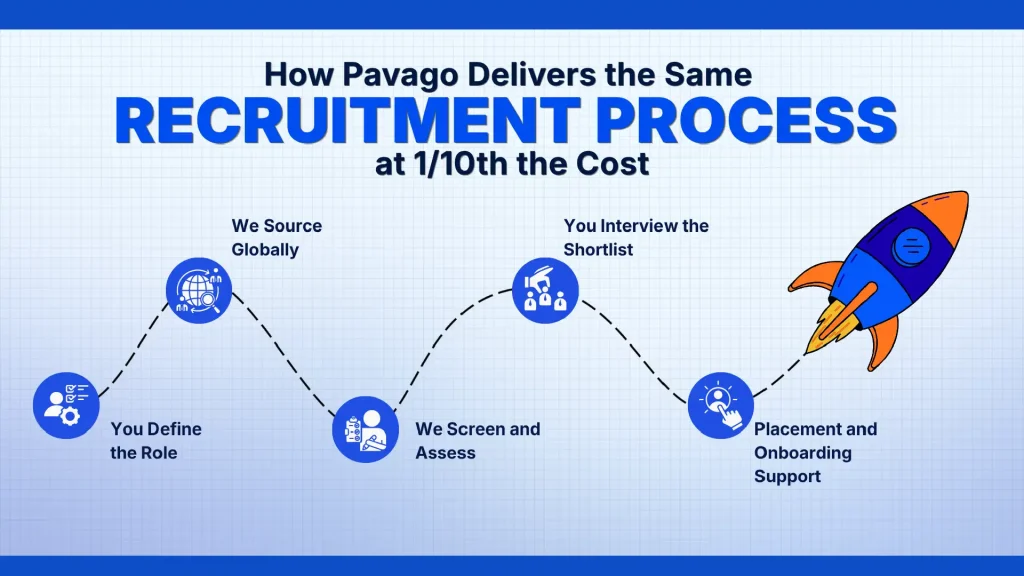
At Pavago, we deliver every component of the RPO process—sourcing, screening, assessment, interviewing, and placement—without the enterprise price tag, the implementation phase, or the contract lock-in.
Here’s how the process works, step by step:
Step 1: You Define the Role
You tell us what role you need filled, the key requirements, and the budget range. No 2-month implementation. No workforce planning engagement. One conversation.
Step 2: We Source Globally
Pavago’s sourcing reaches across Pakistan, the Philippines, LATAM (Colombia, Argentina, Mexico, Brazil), Eastern Europe, and South Africa. AI-powered candidate matching identifies professionals whose skills, experience, and communication quality match your requirements.
Step 3: We Screen and Assess
Multi-layer screening: AI profile analysis, skills testing specific to the role, communication quality evaluation (written and verbal), and work history verification. After screening 100+ candidates across all roles we’ve placed, the most common failure pattern is candidates strong in one tool or framework who can’t adapt to the client’s specific stack. We screen for adaptability, not just proficiency.
Step 4: You Interview the Shortlist
We present 2–3 qualified candidates with detailed screening notes. You conduct final interviews. You make the hiring decision. No one chooses your team member except you.
Step 5: Placement and Onboarding Support
Once you select a candidate, they start working directly for you. Pavago provides onboarding guidance to help the first 30 days go smoothly. The hire is your team member from day one. No co-employment. No buyout fees. No middleman.
Enterprise RPO vs Pavago: Component-by-Component Comparison
| RPO Component | Enterprise RPO | Pavago |
|---|---|---|
| Sourcing | Dedicated sourcing team, 50+ channels, headhunting, database mining | AI-powered global sourcing across Pakistan, the Philippines, LATAM, Eastern Europe, and South Africa |
| Screening | Custom assessment frameworks, multi-round screening, and compliance checks | Multi-layer AI-vetted screening, skills testing, and communication evaluation |
| Interviewing | RPO team conducts first 1–2 rounds, presents shortlist | Pavago screens and presents 2–3 qualified candidates; you interview directly |
| Placement | RPO manages offer, negotiation, and onboarding coordination | Pavago supports onboarding; you manage the hire directly |
| Reporting | Weekly pipeline reviews, monthly KPI dashboards with 10+ metrics | Transparent process updates; candidates presented in 1–2 weeks |
| Time to first hire | 2–3 months (implementation) + 4–8 weeks per hire | 3–4 weeks total (1–2 weeks sourcing/screening + 2 weeks trial) |
| Cost | $50K–$500K+/year | $500/year + $329/month per hire |
| Minimum commitment | 12–24 months | None |
| Replacement | Varies by contract (some charge, some don’t) | Free, no time limit |
| Best for | 50–500+ hires/year | 1–20 hires/year |
The output is the same: qualified candidates, vetted and ready to work. The difference is in the cost structure and scale. Browse our pricing page for the full breakdown.
According to SHRM, the average cost-per-hire in the U.S. is $4,700, and the average time-to-fill is 36 days. (external, dofollow, new tab) Enterprise RPO aims to improve both metrics, but amortizes the investment across high volume. Pavago delivers comparable speed (3–4 weeks to productive hire) at a fraction of the cost per hire.
What Roles Remote RPO Covers
Pavago’s recruitment process covers every major business function. Browse by category:
- Hire Admin: Executive assistants, virtual assistants, customer service reps, data entry, HR support
- Hire Marketing: SEO specialists, content writers, social media managers, paid ads specialists, and email marketing
- Hire Engineering: Full stack, frontend, backend, DevOps, QA, cybersecurity, data engineering
- Hire Finance: Bookkeepers, staff accountants, senior accountants, payroll specialists, financial analysts
- Hire Sales: SDRs, BDRs, account executives, sales operations
- Hire Product: Product managers, UX designers, 3D animators, video editors
For a real example of how our recruitment process placed high-caliber talent, see the Tenant Planet case study on finding offshore A-players. For strategic context on RPO providers in the market, our recruitment process outsourcing companies guide compares the enterprise options. Our global talent acquisition guide covers the strategic framework, and our offshore recruitment strategies guide covers tactical execution.
Frequently Asked Questions
What is recruitment process outsourcing (RPO)?
RPO means outsourcing part or all of your recruitment function to an external provider who handles sourcing, screening, assessing, interviewing, and placement. It’s different from staffing (which fills individual positions on demand) because RPO owns the recruitment PROCESS, not just individual hires.
How much does RPO cost?
Enterprise RPO: $50,000–$500,000+/year depending on contract type and hiring volume. SMB-friendly RPO through Pavago: $500/year membership + $329/month per active hire. The process is equivalent; the cost structure is designed for different scales.
Is Pavago an RPO provider?
Pavago delivers every component of the RPO process (sourcing, screening, skills assessment, interviewing, placement) at SMB-friendly pricing. Whether you call it RPO, recruitment-as-a-service, or an offshore recruitment platform, the output is the same: vetted candidates ready to work, presented within 1–2 weeks.
What countries does Pavago recruit from?
Pakistan, Philippines, LATAM (Colombia, Argentina, Mexico, Brazil), Eastern Europe, and South Africa. Pavago does not source from India.
How long does the recruitment process take?
Pavago presents qualified candidates within 1–2 weeks. With a 2-week onboarding trial, the total time from request to productive hire is 3–4 weeks. Enterprise RPO: 2–3 months for implementation plus 4–8 weeks per individual hire.
What’s the difference between RPO and a staffing agency?
Staffing agencies fill individual positions on demand. RPO providers own the recruitment function: they design the process, build the pipeline, create the methodology, and report on metrics. Staffing is transactional (pay per hire). RPO is strategic (pay for process ownership). Pavago combines both: a strategic recruitment process with the simplicity and affordability of a transactional model.
When should I use enterprise RPO vs Pavago?
Enterprise RPO if: you’re hiring 50+ people per year, have complex compliance or regulatory requirements, need ATS integration with custom workflows, and have the budget for a $200K+ annual engagement. Pavago if: you’re hiring 1–20 people per year for remote global roles, want the full recruitment process handled without the enterprise overhead, and need it done in weeks, not months.
Do I need to use an ATS with Pavago?
No. Pavago’s process is standalone. If you use an ATS (Greenhouse, Lever, BambooHR), we can coordinate with your system. If you don’t have one, we manage the candidate pipeline and present shortlists directly. No technology integration required.
Enterprise Process. SMB Price. Same Result.
Recruitment process outsourcing isn’t just for enterprises anymore. The process—sourcing, screening, assessing, interviewing, placing—works at any scale. What changes is the cost structure. Enterprise RPO charges $200K+/year for 50+ hires because the infrastructure demands it. Pavago charges $500/year + $329/month per hire because the infrastructure is built to serve SMBs directly.
If you’re building a remote global team of 1–20 people, you don’t need a $200K RPO contract with a 3-month implementation phase. You need a partner who delivers the same recruitment rigor at a price and timeline that matches your stage. That’s what Pavago is.
Get RPO-Level Recruitment at SMB-Level Pricing
Pavago handles the full recruitment process: sourcing, AI-vetted screening, skills assessment, interviewing, and placement. Pakistan, Philippines, LATAM, Eastern Europe, South Africa. Admin, marketing, engineering, finance, sales, and product roles.
- $500/year + $329/month per hire
- Full recruitment process: sourcing through placement
- Candidates in 1–2 weeks, productive hire in 3–4 weeks
- Free replacements, no time limit, no lock-in