How Remote CS Staffing Agencies Actually Work
The term “remote customer service staffing agency” lumps together three businesses that operate completely differently. Comparing them as if they’re interchangeable is like comparing Uber, a chauffeur service, and buying a car.
| BPO / Shared Agent Pool | Gig Agent Network | Direct-Hire Recruitment | |
|---|---|---|---|
| Examples | TaskUs, Concentrix, Liveops, Teleperformance | Arise, Working Solutions, Support Ninja | Pavago, Somewhere, Near |
| How it works | Company employs agents. Your customers are one of 3–5 brands each agent handles per shift. | Network of independent contractors pick up shifts. You pay per hour or per interaction. | Platform sources, vets, and places a dedicated CS rep who works exclusively for you. |
| Monthly cost (per agent) | $2,000–$5,000 per agent slot | $10–20/hour per agent (variable) | $1,000–$1,500 per dedicated rep |
| Agent dedication | Shared across multiple brands | Shared (gig model, variable availability) | 100% dedicated to your business |
| Product knowledge | Minimal — script-based | Minimal — brief-based | Deep — learns your products, policies, and voice |
| Quality control | BPO manages QA internally | Network manages loosely | You manage directly (highest control) |
| Replacement | BPO reassigns from pool | Another contractor picks up the shift | Free replacement through Pavago, no time limit |
| Best for | High-volume operations: 200+ tickets/day, call centers | Seasonal overflow, unpredictable volume spikes | SMBs building consistent CS: 20–200 tickets/day |
According to Statista’s outsourcing research, the global customer service outsourcing market exceeds $100 billion annually. (external, dofollow, new tab) Most of that spending goes to BPO models. But for SMBs with under 200 tickets/day, the BPO model is overkill, and the gig model is inconsistent. The direct-hire model delivers better quality at lower cost.
Why Traditional Customer Service Staffing Agencies Don’t Work for SMBs
The fundamental problem with staffing agencies for customer service: they’re built for volume, not quality. When you need 100 agents to answer calls for a telecom company, filling seats quickly matters more than deep product knowledge. That’s the BPO model. When you need 1–3 reps who learn your product catalog, speak in your brand voice, and turn frustrated customers into repeat buyers, the volume model fails.
At Pavago, we’ve placed both individual CS reps and full CS teams. The difference between our model and a traditional staffing agency: we don’t employ the rep. You do. They’re your team member, not a vendor’s employee. That means direct management, institutional knowledge that stays with you, and no markup on the rep’s compensation.
What to Look for in Any Remote Customer Service Staffing Provider
- Ask: Are agents dedicated or shared? Shared agents juggle your tickets alongside 3–5 other brands. Your customers feel the difference. Dedicated reps learn your products and voice.
- Ask: What’s the replacement policy? Free replacement vs restaffing fee vs “start your search over.” This is the #1 differentiator between models.
- Ask: Can I interview the agent? If the agency won’t let you meet the person handling your customers, walk away.
- Ask: What tools do they support? Zendesk, Gorgias, Freshdesk, Intercom, Shopify, WooCommerce. If your stack isn’t supported, onboarding gets expensive.
- Ask: What’s the all-in cost? Staffing agencies hide margins. Base rate + markup + setup fee + minimum hours = actual cost.
Browse our customer service representative page for available talent, or the broader hire admin category.
Cost Comparison: What Remote Customer Service Actually Costs
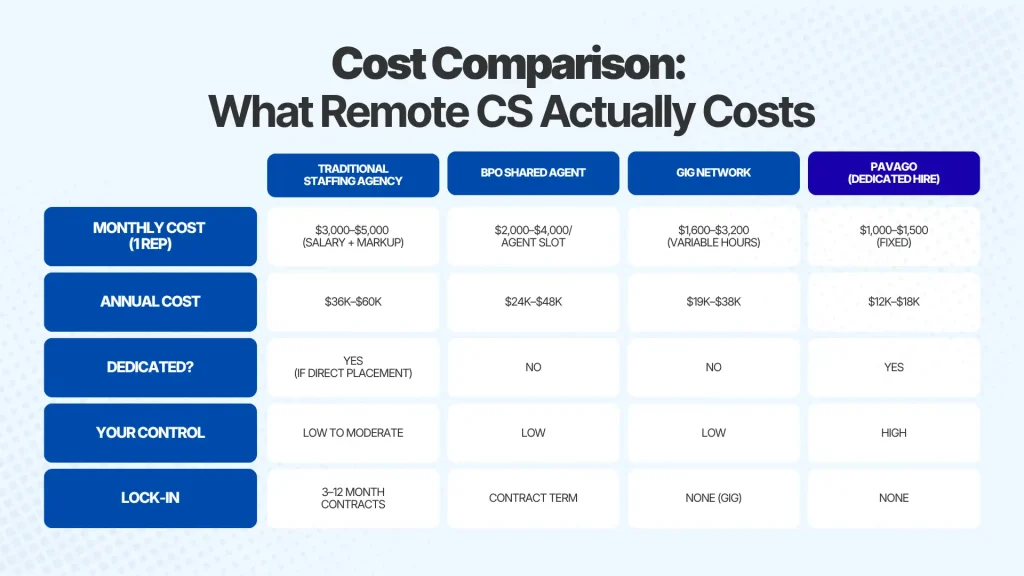
According to HubSpot’s State of Service report, 93% of customers are likely to make repeat purchases from companies with excellent customer service. (external, dofollow, new tab) The staffing model you choose directly impacts service quality, which directly impacts retention and revenue.
Pavago placed a dedicated rep for OPW Commercial Services who enhanced their customer-facing operations. Read the OPW Commercial Services case study for how we structured the placement. For broader CS outsourcing guidance, our outsource customer service guide covers all models, and our remote staffing agencies guide compares providers across all functions.
When Each Model Makes Sense
BPO: 200+ tickets/day. Call center operations. Standardized scripts. You need scale, not personalization.
Gig network: Seasonal spikes (Black Friday, holiday). Unpredictable volume. You need overflow capacity, not consistent coverage.
Direct-hire (Pavago): 20–200 tickets/day. You need dedicated reps who learn your product and brand. Consistent quality matters more than scale. Building a real CS function, not buying a service.
For companies evaluating the broader staffing agency landscape, our customer service virtual assistant for SMBs guide covers the VA model specifically.
Frequently Asked Questions
How much does a remote customer service staffing agency charge?
Traditional agencies: $3,000–$5,000/rep/month (salary + 25–50% markup). BPO: $2,000–$4,000/agent slot. Gig networks: $10–20/hour. Direct-hire recruitment (Pavago): $1,000–$1,500/month for a dedicated full-time rep.
Should I use a staffing agency or hire directly?
Agency if you need 10+ agents with managed QA and can absorb the markup. Direct-hire if you need 1–5 dedicated reps who learn your products and brand deeply. Most SMBs get better results with direct-hire at a lower cost.
What tools should remote CS reps know?
Zendesk, Gorgias, Freshdesk, and Intercom for helpdesk. Shopify, WooCommerce for e-commerce. Slack and Zoom for communication. HubSpot, Salesforce for CRM. Screen for multi-tool proficiency.
Can offshore CS reps handle phone support?
Yes. The Philippines is strongest for phone (neutral accent). Pakistan is strongest for email and chat. LATAM provides U.S. time zone alignment for all channels.
How fast can I get a remote Customer Service rep?
Through Pavago: candidates in 1–2 weeks, productive in 3–4 weeks. Traditional agencies: 2–6 weeks. BPOs: 1–2 weeks for agent assignment.
What if the rep doesn’t work out?
Pavago: free replacement, no time limit. Traditional agencies: 30–90 day guarantee period, then you pay a new placement fee. BPOs: reassign from pool (quality may not improve).
The Model Matters More Than the Agency
Remote customer service staffing agencies aren’t interchangeable. BPO for volume. Gig for overflow. Direct-hire for quality. Pick the model first, then the provider. If your customers deserve better than a shared agent reading a script, they deserve a dedicated rep who knows your business.
Hire Remote Customer Service Reps Through Pavago
Individual reps and full teams. Zendesk, Gorgias, Freshdesk, and Intercom are proficient. Dedicated to your business. No markup. No lock-in.
Dedicated CS reps from $1,000/month | Free replacements | Candidates in 1–2 weeks