The Admin Problem Every Insurance Agency Ignores Until It Costs Them
Here’s the scenario that plays out in every independent agency. A producer closes a commercial account worth $15,000 in annual premium. Great. Then they spend the next 4 hours processing the paperwork: entering the policy into the AMS, generating certificates for the insured’s landlord, contractor, and lender, sending the welcome packet, and setting up the renewal reminder. That’s 4 hours of $15/hour work done by someone billing $150/hour.
Now multiply that across 50–200 active policies. Add the daily COI requests from contractors and property managers. Add the renewal reviews starting 90 days out. Add the claims calls that need documented. Add the quoting for prospects who may or may not bind. The admin load isn’t a nuisance. It’s a structural drag on revenue.
According to the Independent Insurance Agents & Brokers of America (IIABA), independent agencies cite staff retention and hiring as their #1 operational challenge. (external, dofollow, new tab) Finding and keeping U.S.-based CSRs is getting harder every year. Salaries are climbing. Turnover is high. And every time a CSR leaves, they take institutional knowledge with them. Offshore VAs solve the staffing problem without competing for local talent in a market that doesn’t have enough of it.
Insurance-Specific Tasks a VA Handles (With Hours and Tools)
This isn’t generic VA work. Insurance agency admin is specialized, process-driven, and tool-dependent. Here’s what a trained insurance VA owns:
| Task | What It Involves | Hours Saved/Week | AMS/Tools Used |
|---|---|---|---|
| Policy renewals | Review expiring policies 90 days out, pull current loss runs from carriers, prepare renewal comparison worksheets, send renewal reminder letters to insureds, follow up with carriers for renewal quotes and terms, update AMS with renewal data | 4–6 hours | Applied Epic, Hawksoft, EZLynx, QQCatalyst, AMS360, carrier portals |
| Certificate of insurance (COI) requests | Generate certificates from AMS, add certificate holders, send to requestors (landlords, GCs, lenders, mortgagees), track compliance requirements, manage ongoing certificate holder databases | 3–5 hours | Applied Epic, Hawksoft, ACORD certificate forms, email |
| Claims intake | Receive first notice of loss (FNOL) from insured by phone or email, enter claim details into AMS, report claim to carrier portal, track claim status, follow up on adjuster assignments, update insured on claim progress | 2–4 hours | Applied Epic, carrier claim portals, phone/email |
| Quoting | Enter prospect information into comparative rating systems, run quotes across multiple carriers, prepare coverage comparison proposals, follow up on outstanding quotes, enter bound policies into AMS | 3–5 hours | EZLynx, PL Rater, Applied Rater, carrier portals, Canopy Connect |
| AMS data entry | New client setup, policy detail entry (limits, deductibles, endorsements), cancellation processing, endorsement processing, contact updates, activity logging, document filing and indexing | 3–5 hours | Applied Epic, Hawksoft, AMS360, QQCatalyst, NowCerts |
| Carrier submissions | Complete ACORD applications (125 for commercial general, 126 for GL section, 130 for workers comp, 140 for property), upload to carrier underwriting portals, follow up on pending submissions, respond to underwriter questions | 2–4 hours | Carrier submission portals, ACORD forms, email |
| Client communication | Welcome calls and emails for new policyholders, policy delivery, payment reminder calls, follow-up on outstanding documents (signed applications, loss payee changes), birthday and anniversary outreach for retention, Google review requests after positive interactions | 2–3 hours | AMS task systems, email, phone, agency CRM |
Total: 19–32 hours per week of work that requires insurance knowledge but not an insurance license. That’s a half-time to near-full-time role of pure admin that your producers or licensed CSRs are currently absorbing. At Pavago, we’ve placed VAs for both independent agencies and brokerages who handle all of these functions. The VAs work across whatever AMS the client uses. Browse our virtual assistant page for available talent in the hire admin category.
Which AMS Systems an Insurance VA Needs to Know
The AMS is the VA’s primary workspace. Every task in the table above flows through it. Here’s what each major system looks like from a VA’s perspective:
Applied Epic
The industry standard for mid-to-large agencies. Epic is powerful but complex. The interface has a steep learning curve: expect 2–4 weeks for basic navigation (client lookup, certificate generation, activity logging) and 6–8 weeks for full proficiency (policy processing, endorsement entry, renewal workflow management). If your agency runs Epic, screening for prior Epic experience cuts onboarding time in half.
Hawksoft
Popular with small to mid-size agencies. More intuitive than Epic. The workflow is logical enough that a VA with general insurance knowledge can navigate the basics within 1–2 weeks. Hawksoft’s built-in templates for certificates and proposals speed up output.
EZLynx
Primarily a comparative rating tool, not a full AMS. Many agencies use EZLynx for personal lines quoting alongside another AMS (typically Epic or Hawksoft) for policy management. A VA using EZLynx needs to understand how data flows between the rating system and the primary AMS. The quoting interface itself is straightforward: enter prospect data, select carriers, run quotes, generate proposal.
AMS360 (Vertafore)
Cloud-based, mid-market focused. Popular with agencies doing $2M–$10M in revenue. Interface is more modern than Epic but less intuitive than Hawksoft. 2–3 weeks for basic proficiency.
QQCatalyst
Newer entrant, modern UI. Popular with small agencies and agencies migrating from legacy systems. Easiest to learn of all major AMS platforms. A VA with general admin skills can be functional in 1 week.
Key insight: The AMS is trainable. Insurance knowledge is not. A VA who understands what a COI is, how renewals work, and what a loss run means can learn any AMS in 2–4 weeks. A VA who knows Applied Epic but doesn’t understand insurance will struggle with every task regardless of tool proficiency. Screen for insurance knowledge first, AMS skills second.
How to Vet an Insurance Agency VA (4-Step Process)
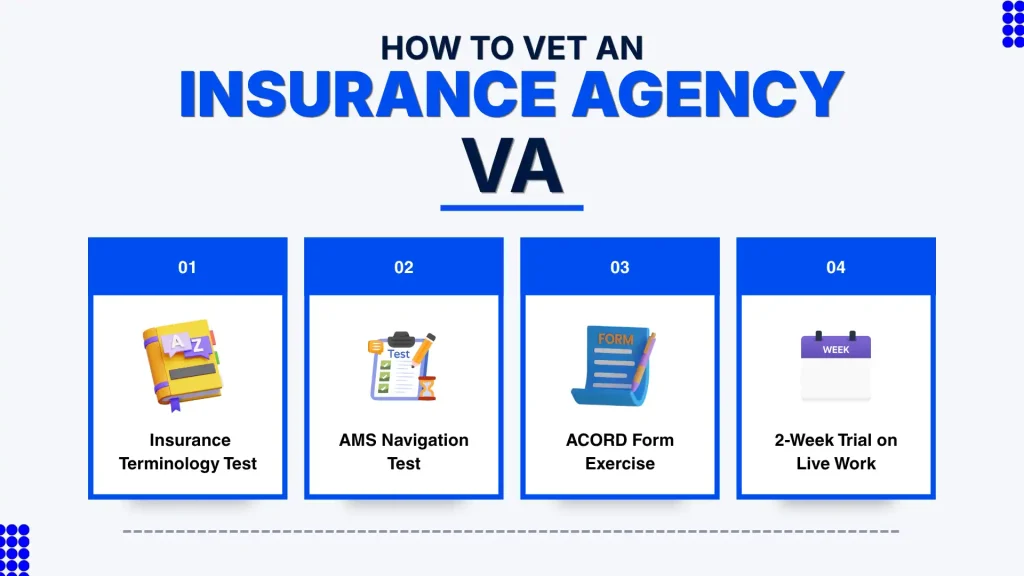
Step 1: Insurance Terminology Test
Before anything else, test whether the candidate understands insurance basics. These five questions filter out 80% of unqualified candidates:
- “What is a certificate of insurance and who requests them?” (Expected: a document proving coverage, requested by landlords, lenders, general contractors, and other third parties.)
- “What’s the difference between a claims-made policy and an occurrence policy?” (Expected: claims-made covers claims filed during the policy period; occurrence covers events that happened during the policy period regardless of when the claim is filed.)
- “What is a loss run and why does it matter for renewals?” (Expected: a report from the carrier showing claim history; used by underwriters to assess risk and price renewals.)
- “What’s an ACORD form?” (Expected: standardized insurance application forms used across the industry for submissions to carriers.)
- “What does it mean when a policy has a ‘binder’?” (Expected: temporary proof of coverage issued before the formal policy is delivered.)
If they miss more than one, they need too much training to be productive quickly. Move on.
Step 2: AMS Navigation Test
Set up a sandbox environment in your AMS (most allow test accounts). Ask the candidate to:
- Create a new client record from provided prospect information
- Generate a certificate of insurance with a specific certificate holder and coverage description
- Log a policy change (endorsement adding an additional insured)
- File a document to the client’s electronic folder
Time them. A candidate with prior AMS experience completes these in 15–20 minutes. A candidate learning the system takes 30–45 minutes. Above 45 minutes = the learning curve will be too steep for fast productivity.
Step 3: ACORD Form Exercise
Give them sample prospect data (business name, address, operations description, revenue, number of employees, prior coverage details) and ask them to complete an ACORD 125 (Commercial Insurance Application) and ACORD 126 (Commercial General Liability Section). Evaluate:
- Accuracy: Are all fields populated correctly from the prospect data?
- Completeness: Did they fill sections that many people skip (operations description, additional coverages requested)?
- Questions: Did they flag information gaps? (A good sign. It means they know what’s supposed to be there.)
Step 4: 2-Week Trial on Live Work
Assign real tasks: 20 COI requests, 10 renewal reviews, and 5 new client data entries. Track: accuracy (how many require corrections), speed (how many completed per day), and proactive behavior (did they flag issues before you asked?). According to PropertyCasualty360, agencies that delegate administrative tasks see 20–30% increases in producer productivity. (external, dofollow, new tab) That productivity gain starts with this trial period.
We’ve placed VAs who handle operational and administrative support across business types. See the QBM Services case study for how we structured a dedicated support placement that integrated quickly into the client’s workflow.
Where to Find Insurance Agency Virtual Assistants
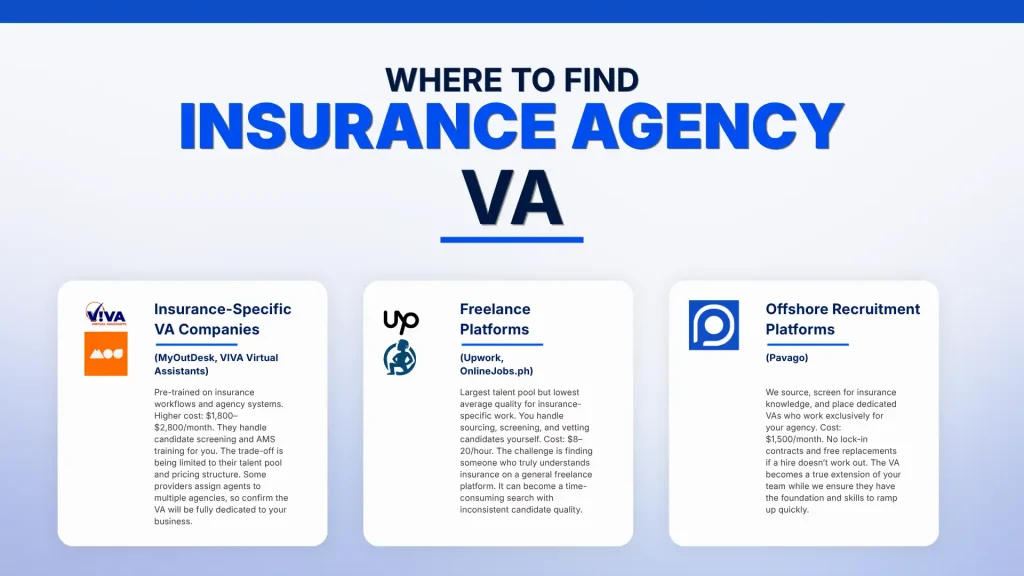
Insurance-Specific VA Companies (MyOutDesk, VIVA Virtual Assistants)
Pre-trained on insurance workflows. Higher cost: $1,800–$2,800/month. They handle screening and AMS training. Trade-off: you’re locked into their talent pool and their pricing. Some shared agents handle 2–3 agencies simultaneously. Ask specifically whether the VA will be 100% dedicated to your agency.
Freelance Platforms (Upwork, OnlineJobs.ph)
Largest pool, lowest average quality for insurance-specific work. You do all the vetting (Steps 1–4 above) yourself. Cost: $8–20/hour. The challenge: finding someone who actually understands insurance on a generalist freelance platform is a needle-in-haystack problem.
Offshore Recruitment Platforms (Pavago)
We source, screen for insurance knowledge, and place dedicated VAs who work exclusively for your agency. Cost: $1,500/month. No lock-in. Free replacements if a hire doesn’t work out. The VA is your team member, not a vendor’s employee. You train them on your agency’s specific processes; we ensure they have the foundation to learn fast.
For broader VA guidance, our outsource B2B lead generation guide covers using VAs for outbound agency prospecting. Our guide to outsourced executive assistant covers EA/VA best practices that apply to insurance VAs too.
What an Insurance Agency VA Costs in 2026
| U.S. Insurance CSR | Insurance VA Company | Offshore Dedicated (Pavago) | |
|---|---|---|---|
| Monthly cost | $3,500–$5,000 + benefits | $1,800–$2,800 | $1,500 |
| Annual cost | $50K–$75K all-in | $21,600–$33,600 | $18,000 |
| AMS proficiency | Trained on the job (3–6 months to full productivity) | Pre-trained on 1–2 AMS platforms | Screened for insurance knowledge; trained on your AMS in 2–4 weeks |
| Dedicated to your agency? | Yes | Sometimes (ask specifically) | Yes, 100% |
| Insurance knowledge | Licensed (but spending time on unlicensed tasks) | Trained by the VA company | Screened for terminology during hiring |
| Replacement timeline | 3–6 months to find, hire, and train | Company reassigns (timeline varies) | Free replacement, no time limit |
| Contract | Employment relationship | Monthly or annual contracts | No lock-in |
The math is straightforward. A U.S. CSR costs $50K–$75K/year. A Pavago VA costs $18K/year. The savings: $32K–$57K per year per position. For an agency with 2–3 CSR equivalents worth of admin work, that’s $64K–$171K in annual savings. For how other companies have structured cost-efficient admin operations, our hiring full time virtual assistants guide covers the practical best practices.
Frequently Asked Questions
How much does an insurance agency virtual assistant cost?
Offshore dedicated through Pavago: $1,500/month. Insurance-specific VA companies (MyOutDesk, VIVA): $1,800–$2,800/month. U.S. CSR: $3,500–$5,000/month plus benefits. The cost difference between offshore and domestic for equivalent admin output is 60–75%.
What AMS should an insurance VA know?
Applied Epic, Hawksoft, EZLynx, AMS360, QQCatalyst, and NowCerts are the most common. The specific platform matters less than insurance knowledge: a VA who understands insurance can learn any AMS in 2–4 weeks. A VA who knows Applied Epic but doesn’t understand insurance will struggle with every task.
Do insurance VAs need a license?
No. VAs handle administrative tasks that don’t require a license: COI generation, data entry, renewal packet preparation, claims intake documentation, ACORD form completion, and client communication. They do not bind coverage, advise on limits or deductibles, negotiate with carriers on coverage terms, or provide insurance advice. Licensed producers or CSRs review and approve the VA’s work product.
Can an insurance VA handle claims?
First notice of loss (FNOL) intake and documentation: yes. They receive the call or email, record the details, enter the claim into the AMS, report to the carrier, and track status. Claims adjusting, settlement negotiation, and coverage determination: no. Those require licensed adjusters or producers with claims authority.
How long until an insurance VA is productive?
Week 1–2: Basic COI generation, simple data entry, client communication. Week 3–4: Renewal reviews, quoting in rating systems, carrier submissions. Week 6–8: Full proficiency across all assigned tasks. Most VAs are handling routine work independently by the end of week 3.
Can a VA do quoting?
Yes. They enter prospect data into comparative rating platforms (EZLynx, PL Rater, Applied Rater, carrier portals), run multi-carrier quotes, and prepare coverage comparison proposals. A licensed producer reviews the quotes, discusses options with the prospect, and makes the coverage recommendations. The VA handles the data entry and document preparation that makes quoting possible.
What about phone calls with insureds?
Yes. Insurance VAs handle inbound and outbound calls: claims FNOL intake, renewal reminders, document follow-ups, payment reminders, and new client welcome calls. Philippines and Pakistan both produce VAs with strong English phone skills. The key is screening for both communication quality AND insurance knowledge so the VA can handle basic insurance questions on calls without transferring every interaction to a producer. For companies also evaluating broader admin outsourcing, our virtual assistant cost guide covers all-in pricing across models.
Your Producers Should Be Selling, Not Processing Paperwork
Every COI request a producer processes personally is 10–15 minutes they’re not spending on revenue-generating activities. Every renewal packet they prepare is an hour they’re not cross-selling or prospecting. Every claims call they document is time they’re not building relationships that generate referrals.
The agencies growing fastest in 2026 aren’t the ones with the biggest marketing budgets. They’re the ones that figured out which work requires a license and which doesn’t, then hired accordingly. Licensed producers do licensed work. Trained VAs do everything else. At $1,500/month, that’s the simplest ROI calculation in the agency.
Hire an Insurance Agency VA Through Pavago
Placed for both independent agencies and brokerages. Policy renewals, COIs, claims intake, quoting, carrier submissions, AMS data entry, client communication. Applied Epic, Hawksoft, EZLynx, AMS360, QQCatalyst. Every candidate screened for insurance terminology before you see their profile.
- Insurance VAs at $1,500/month
- All major AMS platforms supported
- Free replacements if a hire doesn’t work out
- Candidates presented in 1–2 weeks