The $150/Hour Problem Nobody in Construction Talks About
A general contractor billing clients $100–$200/hour has a hidden productivity leak. It’s not material waste or schedule delays. It’s admin. Every week, that GC spends hours downloading bid documents from PlanHub, calling the county about permit status, chasing subcontractors for updated schedules, processing lien waivers, creating invoices in QuickBooks, and compiling closeout packages. None of this work requires being on a job site. None of it requires a contractor’s license. All of it requires organization, attention to detail, and access to a laptop.
According to McKinsey’s construction productivity research, construction professionals spend 35% of their time on non-productive activities, including administrative tasks and rework. (external, dofollow, new tab) For a GC working 50–60 hours a week, that’s 17–21 hours on tasks that don’t build anything, don’t close any deals, and don’t generate any revenue. At $150/hour billing rate, that’s $2,550–$3,150 per week in opportunity cost. Per month: $10,000–$12,000 in productive capacity being absorbed by paperwork.
A construction VA at $1,000–$1,500/month takes 15–25 of those hours off your plate. The ROI isn’t ambiguous. It’s the clearest return on any hire a GC can make.
Construction-Specific Tasks a VA Handles (With Hours, Tools, and Process Detail)
This isn’t generic admin work. Construction company admin is specialized, deadline-driven, and consequential. A missed permit inspection means a project delay. A missing lien waiver means a payment hold. A late bid submission means a lost opportunity. Here’s what a trained construction VA owns:
| Task | What It Involves In Detail | Hours Saved/Week | Primary Tools |
|---|---|---|---|
| Bid coordination | Download complete bid packages from plan rooms and GC portals. Organize specifications, drawings, addenda, and scope documents by trade. Track submission deadlines on a master bid calendar. Compile required documents (bid bonds, insurance certificates, subcontractor lists). Submit completed bids electronically before deadline. Follow up on bid results. | 3–6 hours | PlanHub, BuildingConnected, SmartBid, iSqFt, Procore bidding module |
| Permit tracking | Monitor permit application status through municipal portals. Schedule inspections when work reaches milestone stages. Call municipalities for status updates when portals are delayed. Maintain a master permit log with application dates, status, inspector names, and notes. Track permit expiration dates for long-running projects. | 2–4 hours | Municipal permit portals, Google Sheets/Excel, Procore, calendar apps |
| Subcontractor scheduling | Coordinate sub availability for upcoming phases. Confirm start dates 1 week and 1 day before mobilization. Manage scheduling conflicts when multiple subs need access to the same area. Send daily and weekly schedule updates to all relevant subs. Update the master project schedule when changes occur. | 3–5 hours | Procore, Buildertrend, CoConstruct, Google Calendar, email, phone |
| Lien waiver management | Request conditional and unconditional lien waivers from every sub and supplier after each payment application. Track receipt against payment schedules. Follow up on missing waivers before disbursement. Organize waivers by project, payment period, and sub. Ensure compliance with state-specific lien waiver requirements. | 2–4 hours | LienWaiverPro, Procore, Google Drive, spreadsheets |
| Invoicing and accounts payable | Create progress billing (pay applications) using AIA-style or custom templates. Process subcontractor invoices against contracted amounts. Track retainage across all active projects. Manage aging reports and follow up on overdue payments from clients. Reconcile project costs against budgets. | 3–6 hours | QuickBooks, Xero, Sage, Procore cost tracking, AIA billing templates |
| Change order documentation | Prepare change order forms with scope description, cost breakdown, and schedule impact. Route for signatures through DocuSign or PandaDoc. Track approval status. Update project budgets and schedules after approval. Maintain a change order log per project. | 1–3 hours | Procore, DocuSign, PandaDoc, Excel |
| Project closeout | Compile warranty packages from all subcontractors and manufacturers. Organize operations and maintenance (O&M) manuals. Collect and index as-built drawings. Track punch list completion and schedule final inspections. Prepare final project documentation for owner delivery. | 2–4 hours | Procore, Google Drive, Dropbox, project-specific document systems |
| Daily reporting | Compile daily logs including weather conditions, crew counts, work completed, materials delivered, and safety incidents. Distribute to project stakeholders. Maintain photo documentation log. | 1–2 hours | Procore daily log, Buildertrend, photo management tools |
Total: 17–34 hours per week. That’s the equivalent of a half-time to full-time position’s worth of admin work that doesn’t require a contractor’s license, doesn’t require being on-site, and doesn’t require your $150/hour time. At Pavago, we’ve placed VAs for general contractors who handle all of these functions. Browse our administrative assistant page or the broader hire admin category for available construction-ready talent.
The Construction Tool Stack Your VA Needs to Know
Construction admin revolves around project management software. Your VA’s proficiency with your specific tools determines how fast they become productive.
Project Management Platforms
- Procore: The industry standard for commercial GCs and mid-to-large residential builders. Complex but comprehensive: project management, cost tracking, bidding, daily logs, change orders, RFIs, submittals, document management, and closeout. Learning curve: 2–4 weeks for core modules, 6–8 weeks for advanced features.
- Buildertrend: Most popular for residential builders and remodelers. More intuitive than Procore. Covers scheduling, client portal, selections, daily logs, financial tools. Learning curve: 1–2 weeks.
- CoConstruct: Purpose-built for custom home builders and remodelers. Strong in selections management, client communication, and spec writing. Learning curve: 1–2 weeks.
Bidding and Plan Room Tools
- PlanHub: Online plan room for finding and managing bid opportunities. VA downloads docs, tracks deadlines, organizes by trade.
- BuildingConnected: Bid management platform. VA manages invitations, tracks submissions, organizes qualification documents.
- SmartBid/iSqFt: Legacy plan rooms still used by many GCs. Interface is dated but functional.
Accounting and Financial Tools
- QuickBooks: Most common for GCs under $10M revenue. Job costing, invoicing, AP/AR, retainage tracking.
- Sage 100 Contractor / Sage 300 CRE: Standard for larger operations. More complex, requires specific training.
- Xero: Growing alternative. Cloud-based, integrates with Procore and others.
Communication and Document Management
- Slack/Google Workspace/Microsoft Teams: Daily communication with subs, suppliers, and internal team.
- DocuSign/PandaDoc: Electronic signatures for change orders, subcontracts, lien waivers.
- Google Drive/Dropbox: Document storage and organization. Critical for closeout packages.
- Dedicated phone number: Google Voice, OpenPhone, or Grasshopper for calling subs, municipalities, and suppliers. Keeps business calls separate from the VA’s personal line.
Pavago-placed construction VAs work across all of these tools. We screen for general tool aptitude and train on your specific stack during the 2–4 week onboarding. For companies evaluating admin outsourcing more broadly, our 3 reasons to outsource admin tasks guide covers the business case.
How to Vet a Construction Virtual Assistant (4 Steps)
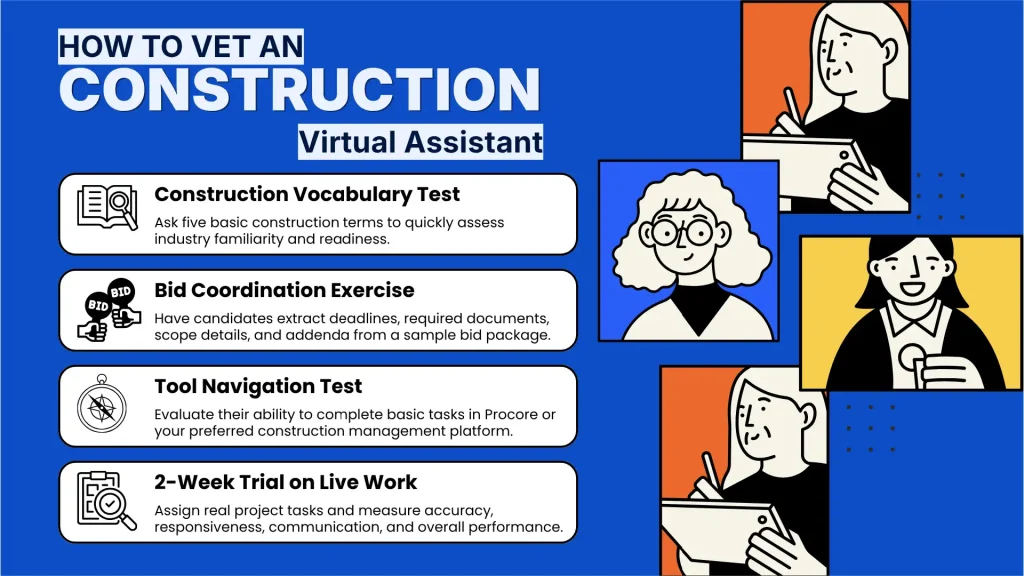
Step 1: Construction Vocabulary Test
This is the single fastest filter. Ask these five questions:
- “What is a lien waiver and why is it important?” (Expected: a document from a sub/supplier waiving their right to file a mechanic’s lien against the property; required before payment disbursement.)
- “What is an RFI?” (Expected: Request for Information. Used when drawings or specifications are unclear and the contractor needs clarification from the architect or engineer.)
- “What is a change order?” (Expected: a formal document modifying the original scope, cost, or schedule of the contract.)
- “What is retainage?” (Expected: a percentage of payment withheld from each progress payment until project completion, typically 5–10%.)
- “What is a punch list?” (Expected: a list of items that need to be corrected or completed before final project acceptance.)
If they miss more than one, they don’t have enough construction context to be productive quickly. This doesn’t mean they need construction experience. It means they need to have done at least basic research into the industry before applying for a construction VA role.
Step 2: Bid Coordination Exercise
Provide a sample bid package (you can use a real one from a past project with sensitive info redacted). Ask them to extract: the bid submission deadline, the required documents for submission (bid bond, insurance certificate, subcontractor list), the scope of work summary, and any addenda dates. Evaluate their organization, attention to detail, and how they present the extracted information.
Step 3: Tool Navigation Test
If you use Procore, set up a sandbox project (Procore allows test environments). Ask the candidate to: create a new subcontractor record, log a daily report with weather and crew data, and generate a change order. If they can’t navigate the basics in 30 minutes, the learning curve will extend onboarding significantly. According to the U.S. Bureau of Labor Statistics, administrative support roles are increasingly shifting toward remote and specialized functions. (external, dofollow, new tab) Construction admin is exactly this kind of specialization.
Step 4: 2-Week Trial on Live Work
Assign real tasks across 3–5 active projects: permit status checks (call the municipality and report back), lien waiver collection for a recent pay application, bid document download and organization for an upcoming bid, and daily log compilation. Track: accuracy, turnaround time, communication quality (do they report back proactively or wait to be asked?), and how many questions they need to complete each task (fewer is better, but asking clarifying questions early is a good sign).
We placed an architectural assistant for Sudberry Southern who handled construction-adjacent admin work. Read the Sudberry Southern case study. For broader VA hiring best practices, our hire overseas virtual assistant guide covers the full process, and our hiring full time virtual assistants dos and donts guide covers common mistakes to avoid.
What a Construction Virtual Assistant Costs in 2026
| U.S. Office Admin | Construction VA Company | Offshore Dedicated (Pavago) | |
|---|---|---|---|
| Monthly cost | $3,000–$4,500 + benefits | $2,000–$3,000 | $1,000–$1,500 |
| Annual cost | $42K–$65K all-in | $24K–$36K | $12K–$18K |
| Construction knowledge | Trained on the job (2–6 months) | Pre-trained on basics | Screened for vocabulary; trained on your processes 2–4 weeks |
| Dedicated? | Yes | Usually yes | Yes, 100% |
| Tools | Your tools | Their tools (may not match yours) | Your tools (Procore, Buildertrend, CoConstruct, QuickBooks, etc.) |
| Replacement | 3–6 month search | Company reassigns | Free, no time limit |
The ROI math in construction is the most straightforward of any industry. If your billing rate is $150/hour and a VA saves you 20 hours/week, that’s $3,000/week in recaptured productive capacity. The VA costs $1,000–$1,500/month. The VA pays for itself in 3–4 DAYS per month. The remaining 26–27 days are pure leverage.
Frequently Asked Questions
What can a construction virtual assistant do?
Bid coordination, permit tracking, subcontractor scheduling, lien waiver management, invoicing and AP, change order documentation, project closeout compilation, daily reporting, and general client/subcontractor communication. Essentially: every administrative task that doesn’t require physically being on a job site or holding a contractor’s license.
How much does a construction VA cost?
Offshore dedicated through Pavago: $1,000–$1,500/month. Construction VA companies: $2,000–$3,000/month. U.S. office admin: $3,000–$4,500/month + benefits.
Do they need construction experience?
Helpful but not required. The most important prerequisites are: organizational ability, attention to detail, comfort with phone calls (for municipalities and subs), and willingness to learn construction terminology. Most VAs with strong admin skills and basic construction vocabulary become functional in 2–3 weeks and proficient in 6–8 weeks.
Can they use Procore?
Yes. Procore’s interface is learnable with guided onboarding and sandbox access during screening. A VA who’s already worked in Procore saves 1–2 weeks of training. A VA learning it fresh needs 2–4 weeks for core modules (daily logs, submittals, change orders, document management).
What about phone calls to subs and municipalities?
Yes. Construction VAs make and receive calls daily: subcontractor scheduling confirmations, permit status inquiries with county offices, supplier follow-ups on material deliveries, and client updates. Philippines and Pakistan both produce VAs with strong English phone skills suitable for these interactions.
How many projects can one VA support?
One experienced VA can support 5–10 active projects simultaneously, depending on project complexity and admin volume per project. At 10+ active projects or during bid-heavy seasons, consider a second VA or splitting responsibilities (one for bidding/preconstruction, one for active project admin).
What’s the most impactful task to hand off first?
Bid coordination or lien waiver management. Bid coordination has immediate time savings (3–6 hours/week) and is deadline-driven, so results are visible within the first week. Lien waiver management is the most tedious admin task and the one GCs hate most. Handing it off is the fastest way to feel the impact of having a VA.
Your $150/Hour Time Has No Business Processing Lien Waivers
The general contractors building the most in 2026 aren’t the ones who work the most hours. They’re the ones who spend the most hours on high-value activities: estimating, client relationships, project oversight, and business development. Everything else—every bid download, every permit call, every lien waiver chase, every QuickBooks invoice—is leverage work. And a $1,000–$1,500/month VA is the cheapest, highest-ROI leverage available in construction.
The math takes 10 seconds. 20 hours/week saved × $150/hour billing rate = $12,000/month in recaptured capacity. VA cost: $1,250/month. That’s a 10:1 return. Every month. For as long as the VA is on your team./hammad
Hire a Construction VA Through Pavago
Placed for general contractors. Bid coordination, permit tracking, sub scheduling, lien waivers, invoicing, change orders, closeout. Procore, Buildertrend, CoConstruct, QuickBooks, PlanHub. Every candidate screened for construction vocabulary before you see their profile.
- Construction VAs from $1,000/month
- All major project management tools supported
- Free replacements if a hire doesn’t work out
- Candidates presented in 1–2 weeks