The Freelance Designer Trap Every SMB Falls Into
The pattern looks like this. You need a logo. You go to 99designs or Upwork. You get 10 concepts, pick one, and pay $500–$2,000. It looks good. Then you need business cards, a letterhead, social media templates, a pitch deck, email headers, trade show banners, packaging mockups, and website graphics. Suddenly, you’re managing 3–5 freelancers across time zones, each interpreting your “brand” differently because none of them built it.
The result: your Instagram looks like one brand, your website looks like another, your pitch deck looks like a third, and your packaging looks like it belongs to a different company entirely. According to Lucidpress research, consistent brand presentation across all platforms increases revenue by up to 23%. (external, dofollow, new tab) Inconsistent design isn’t just ugly. It costs you money.
The root cause isn’t bad designers. Freelance platforms are full of talented people. The root cause is the model: project-based hiring for a function that requires continuity. Graphic design isn’t a project. It’s an ongoing function. And ongoing functions need dedicated people, not rotating contractors.
What “Outsource Graphic Design” Actually Means in 2026
The phrase covers a huge range. Before you outsource anything, understand what you’re actually buying:
| Design Category | Deliverables | Frequency | Best Outsourced To |
|---|---|---|---|
| Brand identity | Logo, color palette, typography, brand guidelines, icon set, letterhead, business cards | One-time (with periodic updates) | Specialized brand designer or agency (project-based is fine here) |
| Marketing collateral | Social media graphics, email headers, blog images, ad creatives, infographics, flyers, brochures | Ongoing (weekly/monthly) | Dedicated designer — this is where freelance breaks down |
| Presentation design | Pitch decks, investor decks, sales presentations, webinar slides, internal training decks | Recurring (monthly/quarterly) | Dedicated designer who knows your brand system |
| Web and UI design | Website pages, landing pages, app interfaces, icon design, dashboard layouts | Project-based or ongoing depending on product | UI/UX designer (separate specialization from graphic design) |
| Packaging and print | Product packaging, labels, trade show materials, signage, merchandise | Project-based with seasonal bursts | Dedicated or freelance depending on volume |
| Video and motion | Thumbnails, social video graphics, animated logos, motion graphics, video overlays | Ongoing for brands with video content | Dedicated designer with motion skills, or separate motion specialist |
For most SMBs, the design need is dominated by marketing collateral and presentations. These are ongoing, high-volume, brand-sensitive deliverables. This is exactly the category where a dedicated designer beats freelancers. At Pavago, we place graphic designers who handle the full range: brand assets, social media graphics, presentations, web graphics, and marketing collateral. Browse our hire product category for all creative roles, or see our offshore graphic designer page for available talent.
The 3 Models for Outsourcing Graphic Design
Model 1: Freelance Designers (Upwork, 99designs, Fiverr)
Cost: $25–$75/hour on Upwork. $200–$5,000 per project on 99designs. $50–$500 per deliverable on Fiverr.
Works for: One-time projects with a clear brief: a logo, a brochure, a specific presentation. Defined scope, defined deliverable, done.
Breaks for: Ongoing design needs. You end up managing multiple freelancers, re-explaining your brand every time, getting inconsistent output, and losing momentum when your preferred freelancer is unavailable.
The cycling problem: Freelancers move on. They get busier clients. They raise rates. They disappear. Every 3–6 months you’re onboarding a new designer who has to learn your brand from scratch. The institutional knowledge walks out the door every time.
Model 2: Design Agency
Cost: $2,000–$10,000+/month for a retainer. $5,000–$50,000+ per project.
Works for: Companies with $2,000+/month design budgets who want a polished creative team with a creative director, project manager, and multiple specialists.
Breaks for: SMBs. Agency overhead means 30–50% of your budget goes to management, not design. A junior designer at the agency does your work while you pay senior rates. The creative director reviews it for 15 minutes. You’re funding infrastructure you don’t need.
Model 3: Dedicated Offshore Designer
Cost: $800–$1,500/month through Pavago. Full-time. Dedicated to your brand.
Works for: SMBs producing 10–30+ design deliverables per month across social media, marketing, presentations, and web graphics. One person learns your brand system, your tools, your preferences, and your audience. Output gets better every month because institutional knowledge compounds.
Breaks for: Companies that need one logo and nothing else. If your design need is truly one-off, a freelancer is fine.
What Outsourced Graphic Design Actually Costs
| Freelance (Upwork) | Design Agency | Design Subscription (Penji, Kimp) | Dedicated Offshore (Pavago) | |
|---|---|---|---|---|
| Monthly cost | $1,000–$4,000 variable | $2,000–$10,000+ | $400–$700 | $800–$1,500 (fixed) |
| Deliverables/month | 5–15 (project-based) | 10–25 (retainer) | Unlimited (queue-based) | 20–40+ (full-time) |
| Dedicated? | No (juggling clients) | Partially (agency assigns rotating designers) | No (pool of designers, first-come-first-served) | Yes, 100% |
| Brand consistency | Low (different designers, different interpretations) | Moderate (creative director maintains standards) | Low (multiple designers in pool) | High (one person learns your brand deeply) |
| Communication | Async, variable response time | Account manager (adds overhead) | Dashboard/chat (no calls) | Direct (Slack, Zoom, daily standups if needed) |
| Revision turnaround | 24–72 hours | 24–48 hours | 24–48 hours (queue-dependent) | Same day (dedicated to you) |
| Replacement | Find a new freelancer (start over) | Agency reassigns | Company reassigns from pool | Free, no time limit |
The design subscription model (Penji, Kimp, Design Pickle) deserves special mention. At $400–$700/month for “unlimited” design, the price is attractive. The catch: unlimited means unlimited requests, not unlimited output. You submit a request, it enters a queue, and a designer from a pool works on it. The designer changes from request to request. Brand consistency is poor. Complex requests take days. And “unlimited” doesn’t mean “fast.” According to Forbes, brand consistency is a top-3 challenge for growing businesses, and design models that rotate creators actively undermine it. (external, dofollow, new tab)
At $800/month, a dedicated Pavago designer produces 20–40 deliverables per month with same-day revisions, brand consistency from day one, and direct communication. The per-deliverable cost is $20–40 vs $67–$200 on freelance platforms.
Design Tools Your Outsourced Designer Should Know
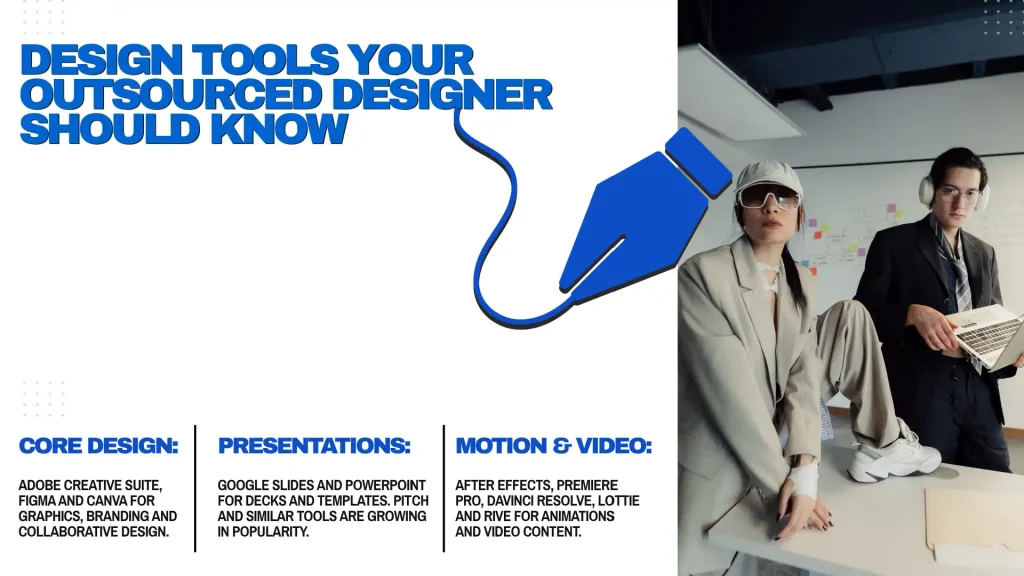
Pavago-placed graphic designers work with whatever tools the client uses. Here’s what we screen for:
Core Design Tools
- Adobe Creative Suite: Photoshop (photo editing, web graphics), Illustrator (vector graphics, logos, icons), InDesign (print layouts, brochures, presentations). The industry standard. Any serious designer knows these.
- Figma: Collaborative design for web and UI. Increasingly used for social media templates and brand systems because of real-time collaboration features.
- Canva: Not a replacement for Adobe/Figma, but essential for creating editable templates that non-designers on your team can use and customize.
Presentation Design
- Google Slides / PowerPoint: Most clients need presentation design in one or both. The designer creates master templates and individual decks.
- Pitch.com / Beautiful.ai: Emerging presentation tools. Less common but growing.
Motion and Video
- After Effects: For motion graphics, animated logos, and social video overlays.
- Premiere Pro / DaVinci Resolve: For video thumbnail design and light video editing.
- Lottie / Rive: For web animations and interactive graphics.
We placed design talent for OneNine that covered their full creative needs. Read the OneNine case study on global design talent for how we structured the placement.
How to Vet a Graphic Designer for Ongoing Work
Step 1: Portfolio review with the right questions. Don’t just look at the final output. Ask: Which projects were solo vs team? What was the brief? How many revisions did it take? What would you change looking back? These questions reveal process thinking, not just aesthetic skill. A portfolio of pretty work means nothing if it took 15 revisions and a creative director holding their hand.
Step 2: Brand interpretation test ($100–$200 paid). Give them your brand guidelines (or a competitor’s) and ask them to create 3 social media posts, 1 email header, and 1 presentation title slide. This is the single most important test: can they take a brand system and produce ON-BRAND work without heavy direction? Most freelancers fail here because they’re used to working from detailed mockups, not brand guidelines.
Step 3: Speed and revision test. During the paid test, track turnaround time. First drafts in 4–8 hours are good. Same-day revisions is the standard for dedicated designers. Next-day revisions mean they’re juggling clients.
Step 4: Tool proficiency check. If you use Figma, can they navigate components, auto-layout, and shared libraries? If you use Adobe, can they work in Illustrator for vector and Photoshop for raster without confusion? Tool proficiency determines speed.
Step 5: 2-week trial on real work. Assign actual design tasks from your backlog. Evaluate: speed, brand consistency across deliverables, revision responsiveness, and proactive suggestions (do they offer improvements you didn’t ask for?). For structuring the trial, our hiring full time virtual assistants dos and donts guide covers practical best practices.
For companies also needing video content alongside design, our hiring a remote video editor guide covers that adjacent creative role. And for broader creative team building, our digital marketing roles guide covers how design fits into the marketing function.
When Freelance Graphic Design Is Actually the Right Choice
Freelance isn’t always wrong. It’s wrong for ongoing work. Here’s when it’s right:
- Brand identity projects. A logo, a brand guide, a visual identity system. This is inherently project-based with a defined endpoint. Hire a specialist, get the deliverable, move on.
- One-time print projects. A trade show booth design, a product label, and a specific brochure. Defined scope, single deliverable.
- Specialized work outside your designer’s skill set. 3D rendering, complex illustration, animation. Even with a dedicated designer, some projects require a specialist.
- Testing the waters. Before committing to a dedicated hire, a 2–4 week freelance engagement tests whether you have enough ongoing design work to justify full-time. If you’re producing fewer than 10 deliverables per month, freelancing may actually be the better model.
When You Need a Dedicated Designer (The Breakeven)
The breakeven is simpler than most people think:
If you need 10+ design deliverables per month, a dedicated designer at $800/month is cheaper and better than a freelancer.
At 10 deliverables, the per-piece cost is $80 with a dedicated designer vs. $100–$300 per piece on Upwork. At 20 deliverables, it’s $40 per piece. At 30, it’s $27. The more you produce, the more the dedicated model wins. And the brand consistency advantage compounds over time because one person learns your visual language deeply.
Frequently Asked Questions
How much does it cost to outsource graphic design?
Freelance: $25–75/hour or $200–$5,000 per project. Agency: $2,000–10,000+/month. Design subscription: $400–$700/month. Dedicated offshore through Pavago: $800/month full-time.
What’s better: a design agency or a dedicated designer?
Agency if you have $3,000+/month and want a creative team with a director. Dedicated designer if you have $800–$1,500/month and want one person who knows your brand inside-out. Most SMBs get more output from the dedicated model at 1/3 the cost.
What about design subscription services (Penji, Kimp)?
Good concept, weak execution for brand-sensitive work. You get rotating designers from a pool. Brand consistency suffers. Complex requests queue behind simpler ones. Fine for generic social media graphics. Poor for anything requiring deep brand knowledge.
What tools should an outsourced designer know?
At minimum: Adobe Photoshop, Illustrator, and InDesign. Figma for web/UI and collaborative work. Canva for creating templates that non-designers can use. Presentation design (Google Slides or PowerPoint). Motion skills (After Effects) are a bonus.
Can a graphic designer from another country understand my brand?
Yes. Design is visual, not cultural. Your brand guidelines communicate the visual system. Your feedback refines execution. Pakistan, the Philippines, and LATAM all produce strong graphic designers trained on global brand standards. The key is the 2-week trial: you’ll see within 5 deliverables whether they’ve internalized your brand.
How long until a dedicated designer is productive?
Week 1: learning your brand system, tools, and preferences. Week 2: producing work with moderate direction. Week 3+: producing on-brand work with minimal direction. By month 2, most dedicated designers are faster and more on-brand than any freelancer you’ve used.
Should I outsource design or hire in-house?
In-house U.S. graphic designer: $50,000–75,000/year + benefits. Offshore dedicated through Pavago: $9,600/year. Same tools, same deliverables, same brand commitment. The cost difference is labor market economics, not quality. For how companies build creative operations offshore, our outsource email marketing expert guide covers adjacent creative outsourcing.
Your Design Problem Isn’t Talent. It’s the Model.
The freelance marketplace is full of talented designers. The problem has never been finding good people. The problem is using a project-based model for an ongoing function. Every time you hire a new freelancer, you lose the brand knowledge the last one built. Every time you onboard someone new, you spend 2 weeks getting them to where the previous designer was when they left.
A dedicated designer at $800/month doesn’t just produce more. They produce better because they learn your brand once and build on that knowledge for months. The output in month 6 is dramatically better than in month 1. That’s not something you get from a rotating cast of freelancers, no matter how talented they are.
Outsource Graphic Design Through Pavago
Dedicated graphic designers at $800/month. Adobe Creative Suite, Figma, Canva, presentation design, motion graphics. One person who learns your brand and produces 20–40+ deliverables per month with same-day revisions.
- Graphic designers from $800/month
- All major design tools: Adobe, Figma, Canva, After Effects
- Free replacements if a hire doesn’t work out
- Candidates will be presented in 1–2 weeks