
The Signal That You Need a Project Manager
You don’t need a PM when you have one project with one team and one deadline. You need a PM when you have multiple workstreams happening simultaneously, and nobody except the founder knows how they connect. The signals:
- Deadlines slip, and nobody notices until the client asks for an update.
- The same status question gets asked in 3 different Slack channels.
- Two team members are working on the same task because nobody assigned it clearly.
- Scope changes happen verbally and never get documented.
- The founder spends 10+ hours per week tracking projects that other people should be tracking.
When more than two of these are true, a PM pays for itself immediately.
What a Remote Project Manager Actually Handles
| Function | What It Involves | Hours/Week | Tools |
|---|---|---|---|
| Project planning | Break projects into phases, milestones, and tasks. Define dependencies. Set realistic timelines. Identify risks before they become problems. | 3–5 hours | Asana, Monday, Jira, ClickUp, MS Project, Notion |
| Task management | Create and assign tasks with clear ownership, deadlines, and acceptance criteria. Track completion. Follow up on overdue items without being asked. | 5–8 hours | Asana, Monday, Jira, ClickUp, Trello, Basecamp |
| Team coordination | Run standups (daily or async). Resolve blockers. Manage handoffs between teams. Ensure nobody is waiting on someone else without knowing it. | 4–6 hours | Slack, Zoom, Loom, async standup tools |
| Scope management | Document scope changes formally. Assess impact on timeline and budget. Get approval before work begins. Prevent scope creep from eating margin. | 2–3 hours | PM software, shared docs, change request templates |
| Client communication | Provide regular project updates. Manage client expectations when timelines shift. Translate between technical teams and non-technical stakeholders. | 3–5 hours | Email, Slack, Zoom, Loom, reporting dashboards |
| Risk management | Identify potential delays, resource conflicts, and dependency bottlenecks before they materialize. Escalate early. | 2–3 hours | Risk registers, PM software, spreadsheets |
| Reporting and documentation | Weekly status reports, project health dashboards, retrospectives, lessons learned, process documentation. | 2–4 hours | Looker Studio, PM software reports, Google Slides, Notion |
| Resource management | Track team workloads across projects. Flag over-allocation before burnout. Coordinate hiring needs with leadership. | 2–3 hours | PM software resource views, spreadsheets |
Total: 23–37 hours per week. A full-time role. At Pavago, we place dedicated PMs who handle this entire scope. Browse our hire admin category for available PM talent.
According to the Project Management Institute’s Pulse of the Profession report, organizations that undervalue project management report 67% more project failures. (external, dofollow, new tab) For SMBs where every project directly impacts revenue, a single project failure can cost more than the PM’s annual salary.
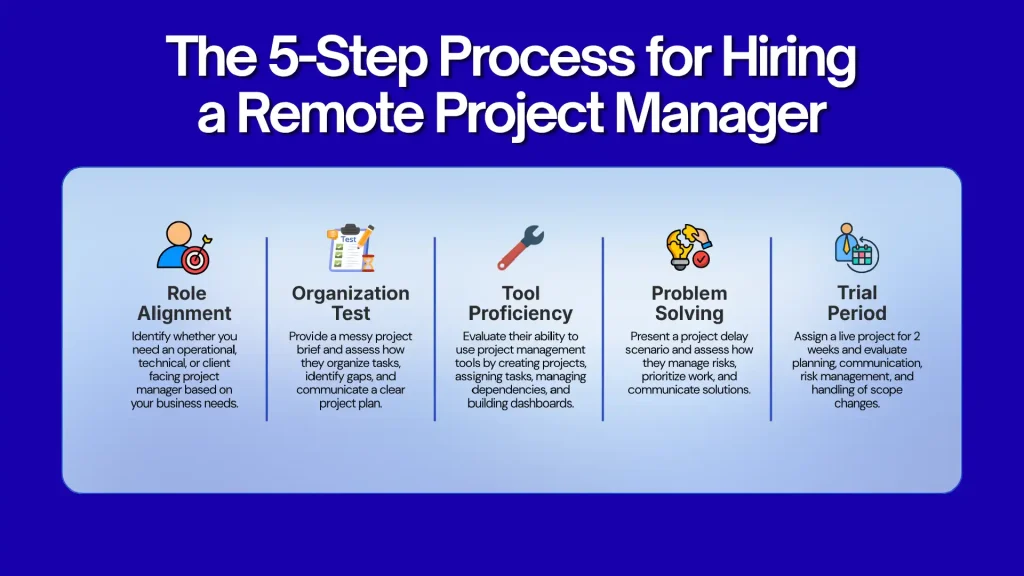
The 5-Step Process for Hiring a Remote Project Manager
Step 1: Define the PM Type You Need
Not all PMs are the same. Know which type fits your work:
- Operational PM: Manages recurring workflows (marketing campaigns, client onboarding, content production). Best for agencies, service businesses, and ops-heavy companies.
- Technical PM: Manages software development, product builds, and engineering teams. Speaks the language of sprints, APIs, and deployment pipelines.
- Client-facing PM: Manages client relationships and project delivery simultaneously. Communicates status, manages expectations, and ensures deliverables match client requirements.
Hire for the type you need. A technical PM who’s never managed client relationships will struggle in an agency. An operational PM who doesn’t understand sprint velocity will struggle with a dev team.
Step 2: Communication and Organizational Test
Give the candidate a messy scenario: a project brief with incomplete information, overlapping deadlines, and unclear ownership. Ask them to:
- Identify the gaps in the brief and list the questions they’d ask before proceeding.
- Create a basic project plan with phases, milestones, and task assignments.
- Write a project kickoff email to the team summarizing scope, timeline, and responsibilities.
This single exercise reveals: can they impose structure on chaos? Can they communicate clearly in writing? Do they ask the right questions before starting?
Step 3: Tool Proficiency Check
Give them a sandbox in your PM tool. Ask them to: create a project with 3 phases, add tasks with dependencies, assign team members, and set up a status dashboard or view. Time them. An experienced PM completes this in 15–20 minutes. A PM learning the tool takes 30–45 minutes. Above 45 = steep onboarding.
Step 4: Scenario-Based Problem Solving
Scenario: “A key team member is 2 weeks behind on their deliverable. This impacts 3 downstream tasks, and the client’s deadline is in 4 weeks. The team member says they need 3 more weeks. What do you do?”
B-player PMs: push the deadline back and notify the client. A-player PMs: assess which downstream tasks are actually blocked, identify which can be parallelized or reordered, determine if the scope can be reduced to meet the deadline, and present the client with options (reduced scope on time vs full scope delayed) before it becomes a crisis.
Step 5: 2-Week Trial on a Real Project
Assign them an active project with real stakeholders and real deadlines. Evaluate: do they impose structure immediately? Do they send status updates without being asked? Do they flag risks before they become problems? Do they push back on scope creep or accept everything passively? For structuring the trial, our virtual assistant onboarding process guide covers the first 30-day framework.
We helped FLLR Consulting build a scalable operational infrastructure, including project coordination. Read the FLLR Consulting case study. For broader remote team management, our managing remote employees guide covers the operational framework, and our guide on how to work with offshore teams covers communication and workflow best practices.
What a Remote Project Manager Costs
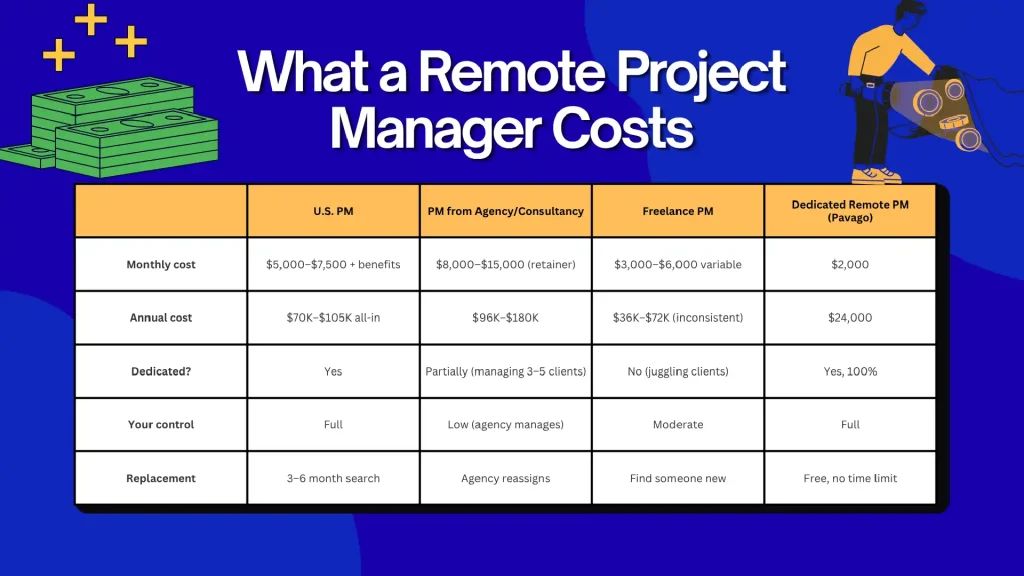
At $2,000/month vs $7,000+/month for a U.S. PM, the dedicated offshore model saves $60K–$80K/year with the same tools, same processes, and same project outcomes. According to Gartner’s project management research, effective project management improves project success rates by up to 2.5x. (external, dofollow, new tab) At $24K/year, that’s the cheapest insurance policy for on-time delivery you can buy.
Frequently Asked Questions
How much does it cost to hire a remote project manager?
U.S.: $70K–$105K/year. Freelance: $50–$100/hour. Dedicated offshore through Pavago: $2,000/month ($24K/year).
What tools should a remote PM know?
Asana, Monday, Jira, ClickUp, Trello, or Basecamp for project management. Slack and Zoom for communication. Google Workspace or Microsoft 365 for documentation. Looker Studio or similar for reporting.
Operational PM vs technical PM: which do I need?
Operational if you’re managing service delivery, marketing, or business operations. Technical if you’re managing software development or engineering projects. Client-facing if you manage projects FOR clients.
Can a remote PM manage a team across time zones?
Yes. Async communication (Loom, recorded standups, written status updates) bridges time zone gaps. Many distributed companies find that 4–6 hours of overlap is enough for effective PM coordination.
When should I hire a PM?
When 3+ projects are active simultaneously, deadlines are slipping, and the founder spends 10+ hours/week tracking project status. Below that threshold, the founder can manage. Above it, a dedicated PM is the highest-leverage hire.
What certifications matter?
PMP (Project Management Professional) and CSM (Certified ScrumMaster) are valuable signals but not requirements. Practical experience managing real projects matters more than certifications. Screen for outcomes and process thinking, not credential letters. For related hiring guidance, our build a successful remote first company covers how PM fits into remote operations.
Projects Don’t Fail Because of Bad Teams. They Fail Because Nobody Is Managing Them.
The code gets written. The designs get made. The content gets produced. But without someone coordinating dependencies, tracking milestones, managing scope, and communicating status, good work still produces late, over-budget, misaligned projects. A remote PM at $2,000/month is the difference between shipping on time and apologizing to clients.
Hire a Remote Project Manager Through Pavago
Dedicated PMs for operations, technical, and client-facing project management. Asana, Monday, Jira, ClickUp, Trello, Basecamp. Every candidate screened with scenario-based problem solving and real project planning exercises.
Remote project managers at $2,000/month | All major PM tools | Free replacements