
Why the Published Number Never Matches Anyone’s Offer
Search the question and you get a figure. Then you talk to actual VAs and nobody recognises it. Some earn a fraction of it, some earn several times it, and almost nobody earns the number itself.
That is what happens when an average is taken across populations that do not overlap. A VA in Ohio employed by a US company, a VA in Manila bidding on a freelance marketplace, and a VA in Lahore hired directly by a US company on a monthly retainer are not three points on one distribution. They are three distributions, and the mean between them is a statistical artefact.
The market you are in determines your pay more than your experience does. A VA with two years of experience working directly for a US company usually earns more than one with six years bidding on a marketplace. That is not a comment on skill. It is a comment on pricing structures.
The Three Markets
| Domestic US | Freelance marketplace | Direct hire, offshore | |
|---|---|---|---|
| Who employs | US company, W2 or contractor | Nobody. Client-by-client engagements. | US company, usually a contractor agreement |
| How pay is set | US labour market | Competitive bidding against a global pool | Negotiated once, then fixed monthly |
| Direction of pressure | Rises with local cost of living | Downward. Someone always bids lower. | Set relative to the role, not the bidding floor |
| Stability | Steady | Variable. Gaps between contracts are unpaid. | Steady monthly |
| Platform cut | None | Typically 10–20% of what you earn | None on a direct-hire platform |
| Who this reflects | A minority of VAs, a majority of published data | Large volume, lowest rates | Growing, and the least represented in salary data |
Look at the bottom row. Published averages over-represent the domestic market because that is where salary aggregators collect data. They under-represent direct offshore hiring almost entirely, because nobody submits a monthly retainer from a US company to a US salary site.
What Actually Moves Pay Within Each Market
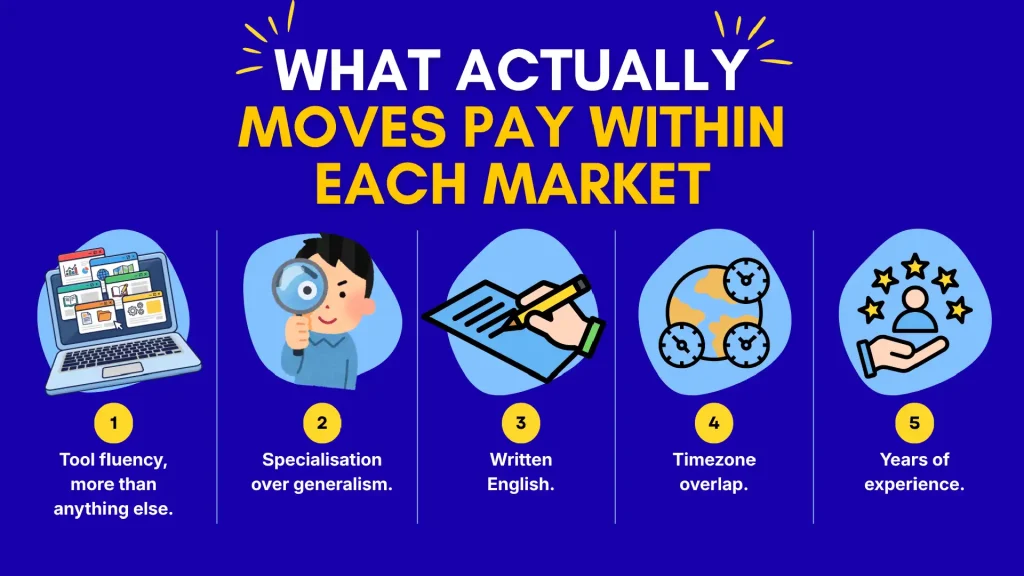
Once you are in a market, the variables that move your number are narrower than most advice suggests, and almost all of them are acquirable.
- Tool fluency, more than anything else. QuickBooks, Xero, Shopify, Zendesk, HubSpot. Certifications for most are free and take days. This is the single highest-return use of a week.
- Specialisation over generalism. Real estate, ecommerce, insurance, and legal VAs consistently earn above general admin, because each carries workflows that general experience does not cover.
- Written English. Assessed constantly and involuntarily, from your first message onward. It is the most heavily weighted soft skill and the least discussed.
- Timezone overlap. Four or more hours with US business hours widens the roles open to you, and roles requiring live overlap generally pay above async-only work.
- Years of experience. Matters, but less than the four above. Experience in the wrong market does not transfer into a better rate.
The pattern is that most of what determines pay is learnable, which is not true of the domestic market where the largest single factor is geography. Our guide to virtual assistant skills covers which of these employers can actually verify before hiring you.
Reading an Offer Correctly
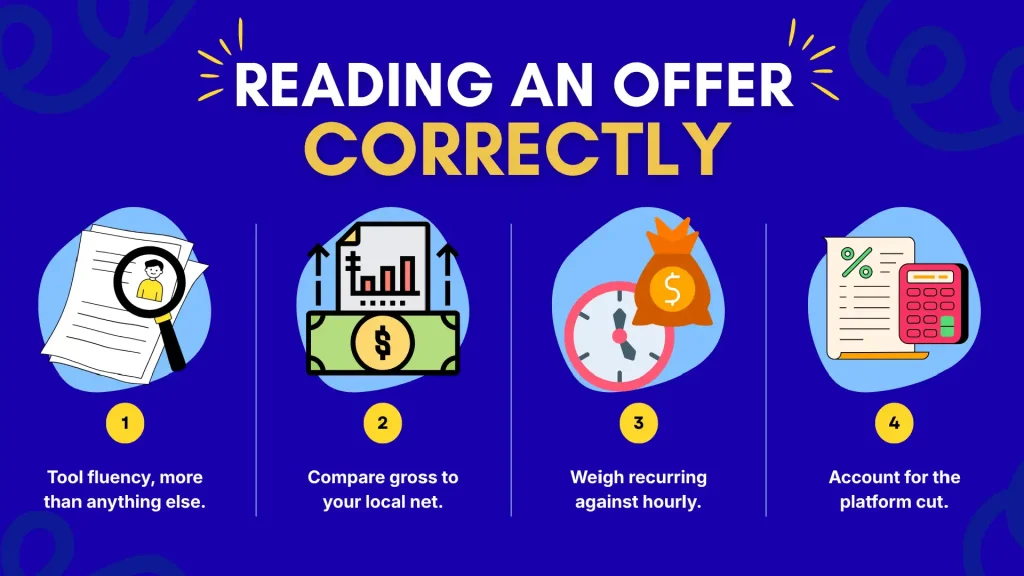
Ask which market the number came from. A listing quoting a range is often quoting for domestic candidates even when it is open internationally. Ask directly rather than assuming in either direction.
Compare gross to your local net. Most cross-border arrangements are contractor relationships. You receive the gross and handle tax locally. Comparing a foreign gross against your local gross overstates the gap.
Weigh recurring against hourly. A steady monthly retainer at a modest rate beats a higher hourly rate that ends in eight weeks. Marketplace earnings look better per hour and worse per year.
Account for the platform cut. A marketplace taking 15% of a $1,200 monthly engagement is $180 a month, or $2,160 a year, on work you did.
Why the Direct-Hire Number Exists
It is reasonable to ask why a US company would pay meaningfully above the marketplace rate when the marketplace rate exists. The answer is that they are not comparing against the marketplace. They are comparing against hiring domestically, and the gap there is much larger.
According to ADP’s breakdown of employment costs, benefits add roughly $14,950 to a $50,000 salary, taking real employer cost to about $64,950. SHRM’s cost-per-hire benchmark adds a further $4,700 to find the person. A company hiring directly offshore can pay well above the marketplace floor and still land far below that, which is why the direct-hire rate sits where it does.
That is the whole mechanism. Not generosity, and not exploitation. Two cost structures meeting somewhere neither market’s published average describes.
Where the Direct-Hire Market Is
General job boards rarely filter for international candidates. Freelance marketplaces have the most volume and the most downward rate pressure. Talent platforms vet once and make you visible to companies hiring specifically for remote roles.
At Pavago, the platform is free for candidates permanently, and you keep your full rate, with nothing deducted from what the company pays you. Companies search the pool and message you directly. Start with open roles, or your region: South Asia, LATAM, Africa. If you are earlier in the process, our guide to getting a remote job without experience covers building the evidence first.
Frequently Asked Questions
How much do virtual assistants make?
It depends entirely on which of three markets you are in. Domestic US employment, freelance marketplace bidding, and direct hire by a foreign company produce substantially different numbers for identical work. Published averages blend all three, which is why the figure rarely matches any real offer.
Why is marketplace pay lower than direct hire?
Because marketplaces price through competitive bidding, and someone will always bid lower. Direct hire prices against the cost of hiring domestically instead, which is a much higher reference point. The same work gets valued differently depending on what it is being compared to.
What raises a virtual assistant’s pay fastest?
Tool certifications, most of which are free and take days, followed by specialising in an industry rather than offering general admin. Both outperform additional years of general experience.
Do I get paid more for overlapping US hours?
Usually. Roles requiring live overlap with US business hours tend to pay above async-only work, because the pool willing to work those hours is smaller.
Should I use a freelance marketplace or look for direct hire?
Marketplaces are useful for building an initial track record when you have none. They are a poor place to stay, because the pricing mechanism pushes rates down and takes a cut of what remains. Direct hire is where the rate stops being set by bidding.
Get vetted once. Keep your full rate.
Free for candidates, always. Nothing is deducted from what the company pays you. Companies search the pool and message you directly.