
What Employers Mean When They Say Experience
A US company hiring remotely is not asking whether you have held a remote job before. Most of them do not care. What they are trying to establish, quickly, are three things.
- Can you do the task without supervision? Nobody is walking past your desk. The work either arrives finished, or it does not.
- Can you communicate in writing clearly enough that managing you is not expensive? This is the one that eliminates most applicants, and it has nothing to do with your CV.
- Do you already know the tools, or will teaching you cost weeks? Tool fluency is the cheapest thing on this list to acquire and the most heavily screened.
None of those three require prior remote employment. All of them require evidence. The gap most people call “no experience” is really the absence of evidence for things they can already do.
Where Your Existing Experience Actually Counts
Work that does not look like a remote job on paper often maps directly onto one. The translation is usually obvious once you see it.
| What you have done | What it maps to | What you need to show |
|---|---|---|
| Ran a family business’s books or invoices | Bookkeeping, accounts payable | Familiarity with QuickBooks or Xero, and accuracy under volume |
| Handled customer complaints in a shop or call centre | Customer support | Written tone, de-escalation, response speed |
| Managed a shop or team roster | Operations, scheduling coordination | Comfort with a project tool and handling conflicting priorities |
| Ran social accounts for a local business or club | Social media coordination | Content produced, not follower counts |
| Data entry or records in any office job | Data operations, CRM maintenance | Accuracy rate and speed, demonstrated on a real task |
| Tutored, taught, or trained anyone | Onboarding, documentation, support | Ability to explain something in writing without hand-holding |
The right-hand column is the work. It is where most people stop, because producing evidence feels harder than claiming experience. It is not. It is just less familiar.
How to Build Evidence in Three or Four Weeks
Get the tool certifications that show up in filters
Most entry-level remote listings screen on tools before anything else. QuickBooks ProAdvisor and Xero certifications are free. Google Analytics and HubSpot offer free certifications. Meta’s Blueprint basics are free. These take days, not months, and they move you past an automated filter that does not read your cover letter.
Do the task once, on something real
Pick a small local business, a community organisation, a relative’s shop. Do the actual job for free once, deliberately, and keep the output. Reconcile three months of their books. Write eight social posts. Build the spreadsheet they have been doing by hand. You are not doing charity work for exposure. You are manufacturing one concrete artefact you can point at.
Write like the job requires writing
Written communication is the screen most people fail without knowing it. Async work means almost everything is written, and it is judged constantly. If your application email is unclear, the hiring manager has already learned what managing you would cost. Read your own messages back and cut every sentence that is not carrying something.
Fix the timezone question before it is asked
If you can offer four or more hours of overlap with US business hours, say so explicitly and say which hours. Vagueness here reads as a problem. Specificity reads as someone who has already thought about how the arrangement works.
What Not to Do
Do not pay for a course to get hired. The certifications that matter are free. Paid “get hired remotely” programmes sell access and confidence, not credentials employers screen for. If a programme guarantees placement, that guarantee is the product.
Do not claim remote experience you do not have. It surfaces in the first interview, and it converts a solvable gap into a trust problem.
Do not apply to two hundred listings. Volume applications to general job boards are how people conclude remote work is fake. Fifteen applications with real evidence attached will beat two hundred without.
Do not accept unpaid trials longer than a few hours. A short paid or unpaid test task is normal. A two-week unpaid “trial project” is not a trial, it is free work. Our guide on working with offshore teams covers what legitimate hiring processes look like from the company side, which is a useful benchmark.
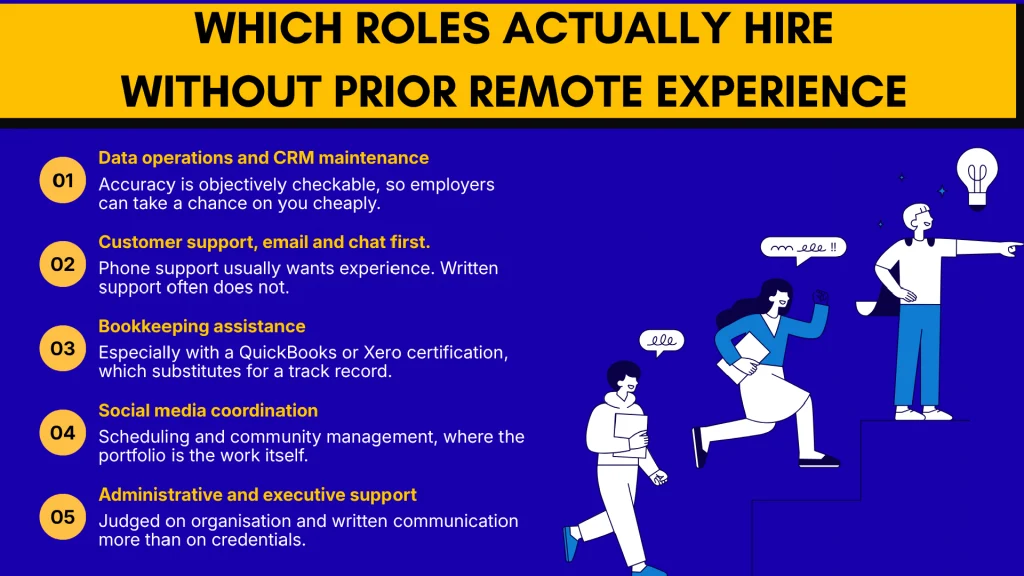
Which Roles Actually Hire Without Prior Remote Experience
Some functions are far more open to first-time remote workers than others, because the work is measurable and the training cost is low.
- Data operations and CRM maintenance. Accuracy is objectively checkable, so employers can take a chance on you cheaply.
- Customer support, email and chat first. Phone support usually wants experience. Written support often does not.
- Bookkeeping assistance. Especially with a QuickBooks or Xero certification, which substitutes for a track record.
- Social media coordination. Scheduling and community management, where the portfolio is the work itself.
- Administrative and executive support. Judged on organisation and written communication more than on credentials.
Roles that generally do want prior experience: anything client-facing at a senior level, anything with legal or compliance exposure, and most engineering positions above junior. That is not a permanent barrier, it is a sequencing one. Our overview of how global hiring works covers how companies think about the risk of a first-time remote hire.
Where to Look
General job boards rarely filter for international applicants, so you compete against everyone and are usually screened out on location. Freelance marketplaces have volume but bid rates are down, which is a bad place to establish what your work is worth. Talent marketplaces sit between the two: you are vetted once, then visible to companies hiring specifically for remote roles.
At Pavago, the platform is free for candidates and always will be. You keep your full rate, nothing is deducted from what the company pays you. Companies search the pool and message you directly, so you are not applying into silence. Start with open roles, or your region: South Asia, LATAM, Africa.
Frequently Asked Questions
Can I get a remote job with no experience at all?
Yes, in functions where output is measurable, and training cost is low — data operations, written customer support, bookkeeping assistance, social coordination, admin support. What you need is evidence you can do the task and communicate in writing, not prior remote employment.
What skills do remote employers screen for first?
Tool fluency, written communication, and evidence of unsupervised work. Tool fluency is the fastest to acquire, since the certifications that matter most are free.
Do I need a certification to get hired remotely?
Not strictly, but free certifications like QuickBooks ProAdvisor, Xero, Google Analytics and HubSpot appear in screening filters and take days rather than months. They function as a substitute for a track record you do not yet have.
Should I pay for a course to get a remote job?
No. The certifications employers actually screen for are free. Paid programmes promising placement are selling access and confidence rather than credentials. Treat a placement guarantee as a warning sign.
How long does it take to land a first remote role?
With deliberate evidence-building, commonly a few months rather than a few weeks. The variable that shortens it most is having one concrete artefact of real work to point at, rather than a list of adjectives.
Get vetted once. Let companies come to you.
Free for candidates, always. You keep your full rate. Companies search the pool and message directly, so you are not applying into a void.