What the Salary Sites Are Actually Measuring
Payscale, Glassdoor, Indeed Salaries, and the rest build their numbers from self-reported data submitted by people employed in a given country. When you look up bookkeeper salary without a location filter, you are looking at a US average built from US submissions.
That number is accurate. It is also answering a question you may not have asked. It tells a bookkeeper in Ohio what a bookkeeper in Ohio earns. It tells a bookkeeper in Manila almost nothing, because the two are not competing for the same jobs — until remote work makes them compete for exactly the same jobs.
There are three different numbers, and they are routinely confused: what a bookkeeper earns locally in their own market, what a bookkeeper earns employed inside the US, and what a US company pays a remote bookkeeper working from elsewhere. The third sits between the other two, and it is the only one that is not published anywhere.
Why the Third Number Exists at All
A US company hiring a bookkeeper domestically is not only paying salary. Employer costs stack on top.
According to ADP’s breakdown of employment costs, benefits add roughly $14,950 to a $50,000 salary, bringing the real employer cost to about $64,950. (external, dofollow, new tab) On top of that, SHRM’s cost-per-hire benchmark puts the average at $4,700 to fill a position. (external, dofollow, new tab)
A company hiring remotely can pay a rate that is a substantial rise for the person receiving it and still lands well below their domestic all-in cost. Both sides gain. That is not charity or arbitrage in any sinister sense — it is two different local cost structures meeting in the middle, and it only became possible when the work stopped requiring a desk in the office.
What This Looks Like From the Bookkeeper’s Side
Pavago bookkeepers hired from outside the US typically earn more than five times what the same role paid them locally. That multiple is the entire reason remote work matters for finance professionals in these markets, and it is invisible on every salary aggregator, because none of them measure cross-border remote pay.
Worth being precise about what the multiple does and does not mean. It is a comparison against local employment in the same role, not against a US bookkeeper’s salary. A remote bookkeeper working for a US company is generally not paid a US domestic rate. The number sits between the two markets, which is why both sides find it worth doing.
What Changes the Number
Within remote work for US companies, pay is not flat. The variables that move it are specific and mostly learnable.
| What moves pay | Why it matters | Whether you control it |
|---|---|---|
| US GAAP familiarity | Most US companies need month-end close done to their standards, not local conventions | Yes! Learnable |
| Software fluency | QuickBooks Online and Xero are the two that appear in most US SMB job specs | Yes! Certifications are free or cheap |
| Industry specificity | Ecommerce, real estate, and construction bookkeeping each have their own rules and pay above generalist work | Yes! with deliberate positioning |
| Written English | Async work means most communication is written. It is judged constantly | Yes |
| Timezone overlap | Four or more hours with US business hours widens the roles open to you | Partly |
| Years of experience | Matters, but less than the five above for remote roles | Slowly |
The pattern in that table is that most of what determines remote pay is acquirable. That is not true of the US-domestic salary bands, where the largest single factor is being in the United States. Our guide to bookkeeping and finance roles offshore covers what US companies actually screen for.
How to Read a US Remote Bookkeeping Job Listing
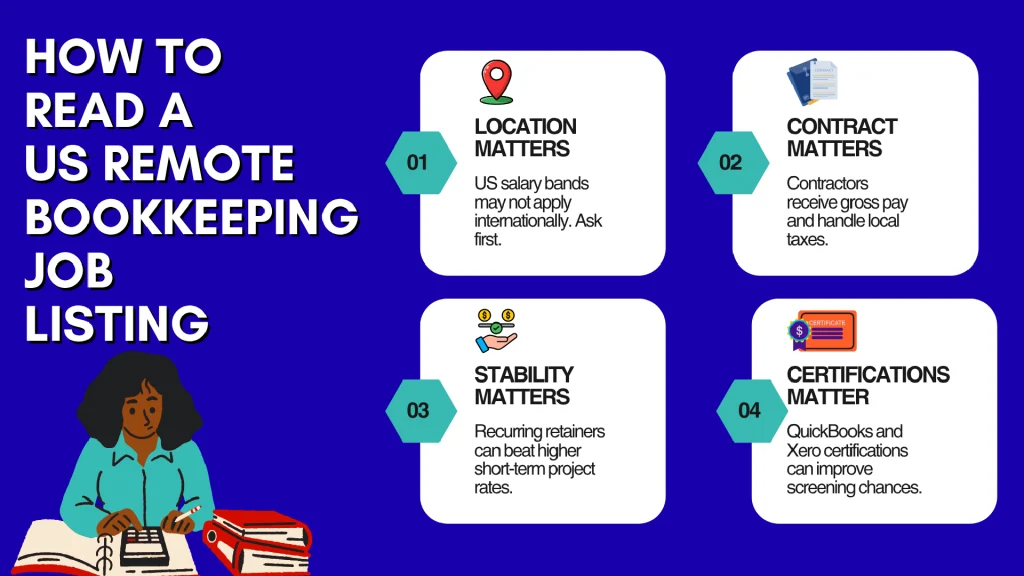
The stated range is often for US applicants. If a listing says $45,000–$55,000 and is open internationally, that band usually describes the domestic candidate. Ask rather than assume in either direction.
Contract versus employment changes the arithmetic. Most cross-border remote arrangements are contractor relationships. You receive the gross amount and handle your own tax locally. Compare against your local net, not your local gross.
Recurring versus project work matters more than the headline rate. A steady monthly retainer at a modest rate beats a higher hourly rate that stops after eight weeks.
Certifications appear in the filters. QuickBooks ProAdvisor and Xero certifications are free or inexpensive and show up as screening criteria on a large share of listings.
Where the Roles Actually Are
US SMBs hire remote bookkeepers through several routes, and they are not equivalent. Freelance marketplaces have volume but bid down rates. General job boards rarely filter for international applicants. Talent marketplaces sit in between: you are vetted once and then visible to companies hiring specifically for remote roles.
At Pavago, the platform is free for candidates. You keep your full rate, there is no cut taken from what the company pays you. Companies search the pool and message directly, so you are not applying into a void. You can see open roles, or look at your region: South Asia, LATAM, or Africa.
If you are weighing whether remote work for a foreign company is realistic at all, our guide to working with offshore teams covers it from the company side, which is useful for understanding what they are actually looking for. Our overview of global talent hiring covers how these roles get filled.
Frequently Asked Questions
What is the average bookkeeper salary?
Salary aggregators report US-domestic figures built from US submissions. If you are outside the US, that number describes a market you are not in. The relevant figure for you is what US companies pay remote bookkeepers, which sits between US domestic pay and your local market rate and is not published on those sites.
How much do remote bookkeepers make working for US companies?
It varies by software fluency, US GAAP familiarity, industry specialisation, and timezone overlap. Bookkeepers placed through Pavago from outside the US typically earn more than five times what the same role paid them locally.
Do I need US certifications to work as a remote bookkeeper?
Not legally required, but QuickBooks ProAdvisor and Xero certifications appear frequently in screening criteria and are free or inexpensive to obtain. Familiarity with US GAAP matters more than any single certificate.
Am I paid as an employee or a contractor?
Most cross-border remote bookkeeping arrangements are contractor relationships. You invoice, receive gross, and handle tax in your own country. Compare that gross against your local net pay, not your local gross, when judging an offer.
Which bookkeeping specialisations pay most for remote work?
Ecommerce bookkeeping, real estate and property management bookkeeping, and construction bookkeeping consistently pay above generalist work, because each carries rules that general bookkeeping training does not cover.
Get vetted once. Let US companies find you.
Free for candidates, always. You keep your full rate, nothing is taken from what the company pays you. Companies search the pool and message you directly.