

Pavago’s SEO is run by two remote hires: a technical SEO specialist and a content writer. We outsource exactly two things, link building and press releases. That setup brings us 6 to 10 signups a week from ChatGPT, Claude and Google’s AI Overviews, and before our recent pivot, SEO drove a quarter of our leads.
So my answer to “should we outsource SEO?” is: outsource the tasks, not the SEO. Hire a small remote team for the work that gets better over time, and buy the specialist work.
I’m Adeel, Head of Growth at Pavago. Below is what to hand off and what to keep, what each option costs (with rates from 1,116 SEO specialists and writers on Pavago), how to vet the people you hire, and how to measure results.
What to outsource and what to keep
The most common mistake is treating SEO as one job that you either outsource or don’t. It’s a set of tasks, and they don’t all belong in the same place.
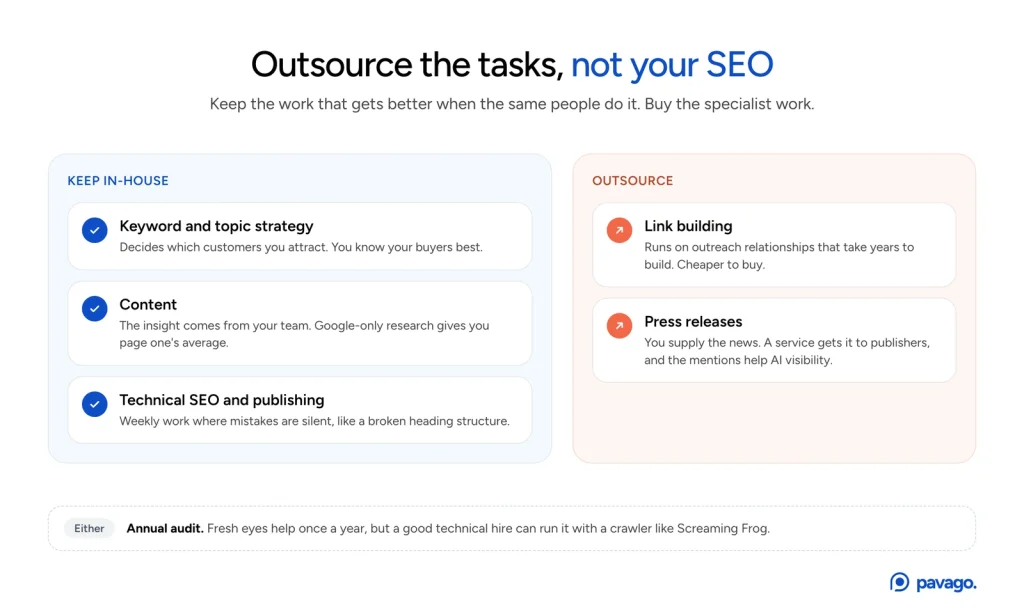
| Task | Keep or outsource | Why |
|---|---|---|
| Keyword and topic strategy | Keep | It decides which customers you attract. Nobody outside your company knows your buyers like you do. |
| Content | Keep | The insight has to come from your team. A writer working only from Google produces the same post as everyone else on page one. |
| Technical SEO and publishing | Keep | It happens every week, and mistakes are silent. A broken heading structure won’t announce itself. |
| Link building | Outsource | It runs on outreach relationships that take years to build. Buying good links is cheaper than building that skill. |
| Press releases | Outsource | You supply the news. A distribution service gets it in front of publishers. |
| Annual audit | Either | Fresh eyes once a year help, but a good technical hire can run it with a crawler like Screaming Frog. |
Everything in the “keep” column gets better the longer the same people do it, which is why I’d hire for it rather than rent it.
Agency vs freelancer vs remote in-house team
| Agency | Freelancer | Remote in-house team | |
|---|---|---|---|
| Monthly cost | $500 to $5,000+ | Mostly $1,000 or less | About $3,000 for two people |
| Typical output | 3 to 4 posts a month | Varies a lot | Set by your strategy |
| Who does the work | Often a junior on your account | One person, no backup | Two people working only on your site |
| Who keeps the customer knowledge | The agency | The freelancer | You |
| Best for | Niche businesses with no time to be involved | One-off projects | Most startups and SMBs |
Agency and freelancer pricing: Ahrefs survey of 439 SEO professionals. Agency output: our experience. Team cost: Pavago rate data, below.
Cost per post tells the real story. An agency charging $4,000 a month for three or four posts costs you $1,000 or more per post. A remote two-person team at $3,000 a month that publishes two strong posts a week comes to about $350 a post, and that price includes your technical upkeep.
You choose who does the work. Agencies sell you on senior people and often staff your account with someone junior. With your own hires, you pick the person after seeing their work.
The knowledge stays with you. A writer who works with you for a year understands your customers. When an agency contract ends, that understanding leaves with it. And everything your team writes is yours to reuse on LinkedIn, X and YouTube.
Our CEO, Parker, learned this with his property management company: his SEO agency charged a lot and never produced the volume the business needed.
When an agency is the right call: you’re in a narrow niche and can’t spend time briefing a writer, or you want an experienced team to set up the foundations before you hire. In that case, budget at least $4,000 a month. In Ahrefs’ survey, the most common SEO retainer was $500 to $1,000, but SEOs with 5 to 10 years in business averaged about $3,650. Cheap usually means junior. Then give them the same keyword test you’d give a hire (below).
How to vet an SEO agency
Most SEO vendors don’t fail because SEO stopped working. They fail because they were the wrong partner from the start. Before you sign:
- Ask what success means to them. A good agency asks about your goals (leads, signups, revenue) before it pitches. If it opens with traffic charts, it’s optimizing for its own report.
- Ask for proof, not promises. Case studies with before-and-after numbers tied to leads or revenue, and a client you can call.
- Ask how they work. You want technical audits that go beyond a checklist, content built around your buyers, and reporting that connects rankings to revenue.
- Start small. An audit or a few months of technical fixes shows how they communicate and report before you commit to a year.
- Put deliverables in writing: what they’ll ship each month, what they’ll measure, and what happens if results don’t hold.
Walk away if you hear any of these:
- “We guarantee #1 rankings.” Nobody can, Google included.
- “We’ll build hundreds of backlinks a month.” That’s how sites get penalized.
- “We use our own secret method.” Then you’ll never know what you’re paying for.
What a two-person SEO team costs
We looked at the monthly asking rates of 1,116 SEO specialists and SEO writers on Pavago, all with at least a year of experience.
| Role | Typical (median) | Strong (top 25%) | Hired in the US |
|---|---|---|---|
| Technical SEO specialist | $1,500 | $2,500 | $6,000–$7,000 |
| SEO content writer | $1,200–$1,500 | $2,000 | $4,000–$7,000 |
| Two-person team | About $3,000 | About $4,500 | $10,000–$14,000 |
Pavago data: self-reported monthly asking rates, October 2026; rates are negotiable. US salaries: SEO specialists $71,000 to $86,000 a year (Indeed, Glassdoor), content writers $49,000 to $84,000 (Indeed, ZipRecruiter).
Three things stood out in the data:
- Experience costs very little extra. Specialists with six or more years ask only $300 to $400 a month more than mid-level ones. The median senior technical SEO asks $1,700 against $1,400, and senior writers ask $1,500 against $1,100. At those prices, hire senior.
- The talent pools are deep in a few countries. Pakistan has the most technical SEO specialists on Pavago, at a median of $1,000 a month. For writers, the Philippines and Pakistan lead (median $1,000 each), with South Africa close behind ($1,750). More on this in the best countries to hire remote marketing talent.
- US candidates line up with US salaries. US-based SEO candidates on Pavago ask $5,000 to $5,800 a month, close to what the salary sites report.
Every rate above comes from profiles you can browse yourself with a free client account, filtered by role, experience and country.
People aren’t the whole budget:
| Line item | Cost |
|---|---|
| Ahrefs (keyword research, rank tracking) | $129–$249 a month (Lite or Standard) |
| Screaming Frog (technical audits) | $279 a year, free up to 500 URLs |
| Rank Math (WordPress SEO plugin) | Free, or about $9 a month for Pro |
| Claude (drafting, images) | $20 a month for Pro, $100+ for Max, per person |
| Wispr Flow (voice to text) | Free, or $15 a month for Pro |
| Press releases, done for you | $1,500–$3,000 a month (what we pay Press Advantage) |
| Backlinks | $300–$600 per quality link |
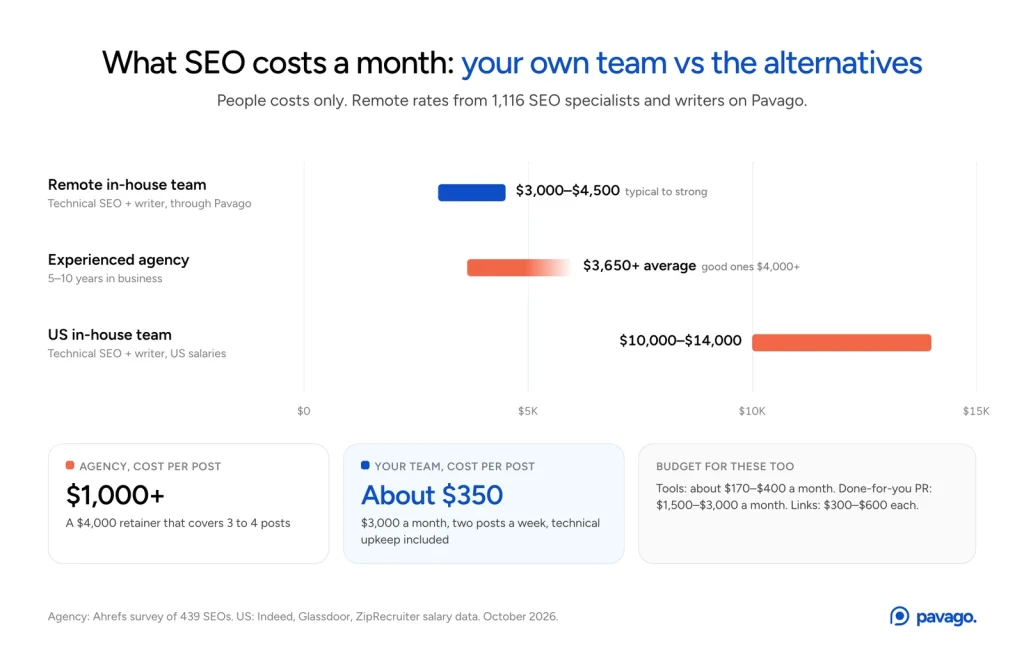
Tools come to about $170 to $400 a month. Our biggest outside cost is PR, not links. Done-for-you press releases are a deliberate bet on AI visibility (more on why below). If AI search isn’t a priority for you, put that money into links first. A survey of 518 SEO professionals by Editorial.Link put the price SEOs consider acceptable for one quality backlink at about $509, and links are the line we’ve underfunded so far.
All in, a setup like ours, meaning a typical two-person team, tools and done-for-you PR, runs about $4,700 to $6,400 a month before links.
How we run SEO at Pavago
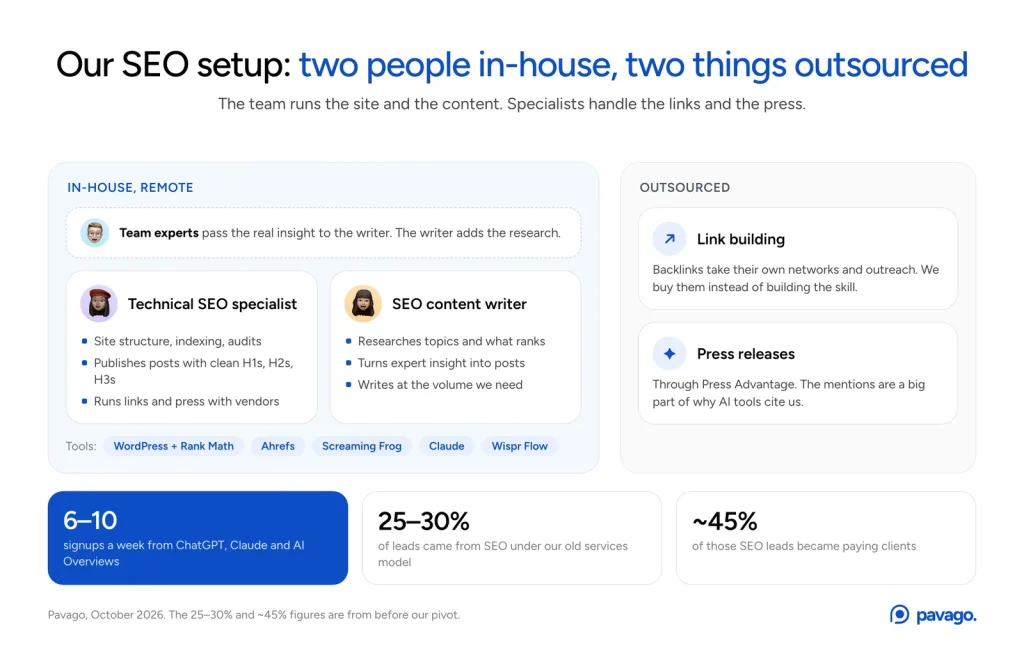
Our blog runs on WordPress, built with Elementor, with Rank Math for on-page SEO and Google Site Kit for analytics. The team works in Ahrefs, Screaming Frog, Claude and Wispr Flow. Link building is outsourced, and press releases go through Press Advantage (who, full disclosure, also hire through Pavago).
I won’t pretend we’re the best at SEO. We’re not the worst either. About 18 months ago we deliberately chose to prioritize showing up in AI answers, and press releases were a big part of that bet. It’s paid off: AI is one of our best sources of signups, at 6 to 10 a week from ChatGPT, Claude and Google’s AI Overviews.
Our Google rankings have moved more slowly, and the data suggests why. Ahrefs studied 75,000 brands and found that mentions of a brand across the web track AI visibility about three times as closely as backlinks do. Press releases create mentions. Google still leans on backlinks, which we haven’t bought much of yet. If AI search matters to you, budget for PR as well as links.
SEO pulled its weight before the pivot too. Under our old professional-services model, 25% to 30% of our leads came from SEO, and about 45% of those leads became paying clients.
How to hire and vet your SEO team
Both roles below sit in Pavago’s marketing talent pool, alongside the video editor covered at the end of this section.
Technical SEO specialist
What they own: site structure and indexing, clean publishing (H1s, H2s and H3s in the right places), internal links, page speed, regular audits, and managing your link building and PR vendors.
How to vet them: give them a scenario. “Our goal is leads, not traffic. How would you pick our keywords and topics?”
- Red flag: “We’ll target high-volume, top-of-funnel topics.” If you’re a hiring marketplace and they want to write general posts about hiring, they’re chasing traffic, not customers.
- Good answer: bottom-of-funnel keywords, even at low volume, searched by people who are close to buying.
Then ask how they’d structure a post for your ideal customer. A busy B2B owner needs the answer first, or they leave.
Finally, ask how they use AI. It should speed them up, not replace their judgment. When we used Claude to rework some of our landing pages, it broke our heading structure, and we had to catch it and re-prompt it. Your technical hire is the person who catches that.
SEO content writer
What they own: researching each topic and what already ranks, turning your team’s knowledge into posts, and keeping up the pace your plan needs.
How to vet them: look at how they write for your customer, how deep their research goes, and whether their writing is specific and enjoyable or robotic and vague. Then give them a test: a rough voice note of someone on your team explaining a topic. See what they turn it into. That’s exactly how this post started.
Don’t over-index on big names. A newer writer with a real voice often beats a seasoned one writing on autopilot. (We go deeper on this in our guide to hiring SEO writers.)
Optional third hire: a video editor
Long-form YouTube and SEO feed each other, so a video editor who turns your best posts into videos multiplies the other two hires. We’re starting on this ourselves, and we cover the full setup in how to build a content marketing team.
How to measure SEO
Start with the numbers that pay the bills:
- Leads and signups that started on a blog post
- Revenue from those leads
- Rankings for the keywords you chose on purpose
- Click-through rate and time on page, which tell you whether people find a post worth reading
I don’t manage to impressions. They’re a useful early sign that a new post is getting picked up, but not a goal, and they’ve become hard to read: Ahrefs found the top result gets 58% fewer clicks when an AI Overview appears.
That doesn’t make SEO weaker. Good SEO is also good AEO (answer engine optimization), because the pages that rank are the ones AI tools cite, and AI visitors convert. Ahrefs reported that AI search sent it 0.5% of its visitors but 12.1% of its signups.
Is SEO still worth it in 2026?
Yes, because it compounds. A social post gets 24 to 48 hours of attention, and Meta ads burn out in two or three weeks. A useful blog post keeps working for years.
It takes patience. Grow and Convert found across 40+ clients that it takes just over a year, on average, for each post to earn a first-page ranking. That matches our experience of 10 to 14 months. Plan for a year, and pair SEO with channels that pay off faster, like social and paid ads, in the meantime.
How we wrote this post
I talked through our SEO setup into Wispr Flow, and Claude turned it into a draft. But it’s not as simple as “here’s my brain dump, write me a post.” Our AI setup already has the full context: what Pavago is, who our customers are, our voice, the facts we can and can’t claim, and examples of what good looks like for us. We built that up over time, and we still edit every draft hard. This one went through several rounds.
Hand a raw brain dump to an AI with no context and you’ll get a generic post. Train it on your taste and quality bar first. That’s the job your writer does with AI, too: the expert brings the insight, the writer brings the standard.
Where Pavago fits
If you’re building this team, you can browse technical SEO specialists and SEO writers on Pavago for free and see their experience, rates and a short intro video before you talk to anyone. Every profile goes through skills verification and reference checks before it’s listed.
Messaging and interviews are free, and you pay 3% of first-year salary when you hire (see pricing).
Browse remote SEO specialists and SEO content writers on Pavago.
FAQ
How much does it cost to hire someone to do SEO?
A remote technical SEO specialist on Pavago typically asks $1,500 to $2,500 a month. A US hire costs about $6,000 to $7,000 a month. Agencies range from $500 to over $5,000 a month, and experienced SEOs average about $3,650.
What is SEO outsourcing?
Paying an agency or freelancer to handle part or all of your SEO. Most companies do best outsourcing specific tasks, like link building and press releases, and keeping strategy and content in-house.
SEO agency vs freelancer: which is better?
An agency gives you a process but often a junior person doing the work. A freelancer is cheaper but has limited capacity and no backup. For ongoing SEO, a dedicated remote hire usually beats both.
Can AI do my SEO?
It can make your team faster, not replace them. It doesn’t know your customers, and left unchecked, it can break things like your heading structure.
How do I choose an SEO outsourcing partner?
Ask what success means to them, ask for case studies tied to leads or revenue, start with a small paid project such as an audit, and put deliverables in writing. Walk away from anyone who guarantees #1 rankings or promises hundreds of backlinks a month.
Where to start
List the questions your customers ask right before they buy. That list is your first quarter of content, and it’s the brief for your first two hires.