The Three Products
They get marketed interchangeably, which is why quotes come back so far apart.
| Payroll software | Payroll bureau | PEO | |
|---|---|---|---|
| What it is | A tool. You enter hours, it calculates and files. | A service. You send data, they run and file it. | Co-employment. They become the employer of record for tax and benefits. |
| Typical cost | $40–$150/month plus $6–$12 per employee | $100–$400/month plus $8–$15 per employee | $100–$250 per employee per month, or 2–6% of payroll |
| Who owns errors | You | Shared, with limits in the contract | The PEO, largely |
| Multi-state filing | You register in each state | They handle registration and filing | Included |
| Benefits | Not included | Not included | Group plans, usually better rates than you get alone |
| Workers comp | Separate policy | Separate policy | Included, pooled |
| Your time per cycle | 2–5 hours | 30–60 minutes | Under 30 minutes |
| Exit difficulty | Trivial | Easy | Hard. Tax accounts, benefits, and employment records all move. |
The last row is the one to read twice. Software and bureaus are reversible decisions. A PEO is not, because unwinding co-employment means re-establishing your own tax accounts, moving every employee off pooled benefit plans, and doing it without a gap in coverage. Budget four to eight weeks and real disruption.
Variable One: Headcount
Cost per employee moves in opposite directions across the three models, which is what makes the comparison confusing.
Software and bureaus get cheaper per head as you grow. The base fee amortises across more people. At five employees, a $150 base fee is $30 a head. At fifty, it is $3.
PEOs get more expensive as you grow, in absolute terms. There is no base fee to amortise. The per-employee charge multiplies. Twenty-five employees at $175 each is $4,375 a month, every month, and rising with every hire.
The practical effect is a crossover. Below roughly fifteen employees, a PEO is often competitive, because the bundled benefits and workers’ comp would cost more bought separately, and you have no HR capacity. Above roughly thirty, the per-head charge usually exceeds what the same functions cost assembled individually.
Variable Two: How Many Jurisdictions
This is the variable most companies underweight, and remote hiring has made it the one that changes fastest.
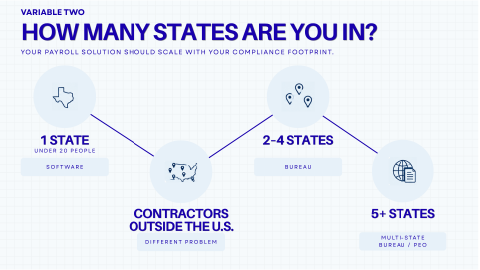
Every state where you have an employee generally requires registration with that state’s tax and unemployment agencies, and ongoing filing. One employee in a new state is not one extra line on a payroll run. It is a registration, a set of filings, and a compliance obligation that persists.
- One state, under 20 people. Software. The compliance surface is small enough to manage yourself.
- Two to four states. Bureau. Registration and filing is exactly what you are buying, and it is worth the step up from software.
- Five or more states, or you are adding them regularly. Bureau with multi-state support, or a PEO if you also want benefits solved. This is where doing it yourself stops being viable.
- Contractors outside the US. None of the three. Cross-border contractor payments are a different problem, usually solved with a payment platform and a contractor agreement rather than a payroll product.
Payroll errors carry real cost. Filing late or miscalculating withholding triggers penalties, and the penalty does not care whether the mistake came from software or a bureau. That is the actual argument for outsourcing rather than the time saved.
The Fourth Option Nobody Puts in the Comparison
Software, bureau, and PEO all solve the mechanics of paying people. None of them touch the work that surrounds payroll: reconciling the payroll journal to your books, tracking accruals, handling contractor invoices, chasing timesheets, and answering the questions employees ask about their pay.
That work does not disappear when you outsource payroll. It moves to whoever is nearest, which in most SMBs is a founder or an office manager. A dedicated payroll and finance person absorbs both, and at that point the question stops being which payroll product and becomes whether the surrounding work justifies a hire.
At Pavago, placement is $1,999 flat regardless of what the role pays. Search is free, full profiles and messaging are $100 a month, cancel anytime. The pricing page has the full structure. You can look at the payroll consultant role, or the broader finance talent pool.
To be clear about what this does and does not replace: a person is not a substitute for the filing infrastructure. They run payroll inside your software or coordinate with your bureau. What they replace is the hours you or your office manager spend on everything the payroll product does not cover.
How to Decide in Five Minutes
| If this is true | Choose |
|---|---|
| Under 20 people, one state, someone can spare a few hours a month | Payroll software |
| Two to four states, or nobody wants to own the filing calendar | Payroll bureau |
| Under 15 people, and you need group health and workers’ comp you cannot get it alone | PEO, accepting the exit cost |
| Over 30 people and paying per head for bundled services you could buy separately | Move off the PEO |
| Payroll runs fine, but the surrounding finance work is eating your week | Hire for it. The payroll product is not the problem. |
FLLR Consulting built out finance operations rather than layering another vendor on top; the FLLR Consulting case study covers the structure. Our guide to payroll outsourcing costs goes deeper on the numbers, and our guide to outsourcing payroll covers the transition itself.
Frequently Asked Questions
How much do outsourced payroll services cost?
Software runs $40–$150 a month plus $6–$12 per employee. A bureau runs $100–$400 a month plus $8–$15 per employee. A PEO charges $100–$250 per employee per month or 2–6% of total payroll, with benefits and workers comp bundled in.
What is the difference between a payroll bureau and a PEO?
A bureau processes payroll on your behalf while you remain the sole employer. A PEO enters co-employment, becoming employer of record for tax and benefits purposes. The bureau is a service you can leave easily. The PEO is a structural change that takes weeks to unwind.
At what headcount does a PEO stop making sense?
Usually somewhere around thirty employees, because PEO pricing is per head with no base fee to amortise. Below fifteen, the bundled benefits and workers’ comp often justify it. Between fifteen and thirty, run the comparison against buying those pieces separately.
Do I need outsourced payroll if I only have contractors?
Generally no. Contractor payments do not involve withholding, so a payroll product is solving a problem you do not have. You need a payment method and correct classification. Misclassifying an employee as a contractor is the actual risk in that setup.
Can payroll be run for a US company by someone outside the US?
Yes. Payroll software is cloud-based, and the rules are the same regardless of where the person operating it sits. What matters is familiarity with US payroll requirements and enough timezone overlap to handle pay-cycle deadlines.
Hire the person, not another vendor
Search the pool free. $100 a month for full profiles and messaging, cancel anytime. $1,999 flat on placement, 60-day replacement window.