Look at Who Actually Ranks for This Term
The current US top ten for remote staffing services is split down the middle, and the split tells you everything.
At the top sit small specialist shops with domain ratings in the teens and twenties. Below them, Randstad, Insight Global, and Robert Half, three of the largest staffing firms on earth. There is a Reddit thread at position four where people ask each other which agencies are real.
Those are not competitors. They are different businesses answering the same query. The enterprise firms sell contingent workforce programmes: managed service providers, vendor management systems, headcount forecasting, compliance across jurisdictions. The small shops sell placements. Google cannot tell them apart because the phrase does not distinguish them, so it ranks both and lets you sort it out.
The Two Products, Side by Side
| Enterprise contingent labour | SMB direct hire | |
|---|---|---|
| What you are buying | A workforce programme — sourcing, compliance, MSP tooling, vendor management | A person, hired directly by you |
| Typical engagement | 20–200+ placements, annual contract | 1–10 hires, no contract |
| Pricing | Markup on hourly rate, often 40–50%, or an annual programme fee | Flat fee or percentage per placement |
| Who employs the worker | The vendor | You |
| Minimum commitment | Usually annual, sometimes multi-year | None |
| Implementation | 4–12 weeks before the first hire | Days |
| What it costs to leave | Contract exit, data migration, possible buyouts | Nothing |
| Right for | Companies with a talent acquisition function | Companies where the founder is still doing the hiring |
The distinction that matters most is the employment line. Under contingent labour, the vendor employs the worker and bills you a markup for as long as that person is on your project. Standard markups on hourly staffing sit around 40–50% above what the worker actually receives. That is not a fee you pay once. It is a permanent tax on the working relationship.
How SMBs End Up on the Wrong Side of the Line
The path is predictable. A founder needs two remote hires. They search remote staffing services, fill in a form at the top result, and get routed to a discovery call. The person on the call is compensated on programme value, not placement count. So the conversation becomes about workforce strategy, scalability, and a pilot engagement.
Six weeks later the founder has a proposal for an annual arrangement with a minimum spend, for two hires they wanted to start last month.
None of that is dishonest. The enterprise firm is selling what it has. The mismatch happens upstream, in a search phrase that cannot tell a two-person hire from a two-hundred-person programme.
What the Real Cost Comparison Looks Like
Hiring is expensive before anyone quotes you anything. According to ADP’s analysis of true hiring costs, SHRM puts the average cost to fill a position at $4,129 over an average of 42 days. (external, dofollow, new tab) G2’s cost-per-hire breakdown tracks that figure climbing to $4,700 by 2023. (external, dofollow, new tab) That is your internal cost, before a vendor invoice exists.
Layer the two models on top of a single $55,000 remote hire kept for two years:
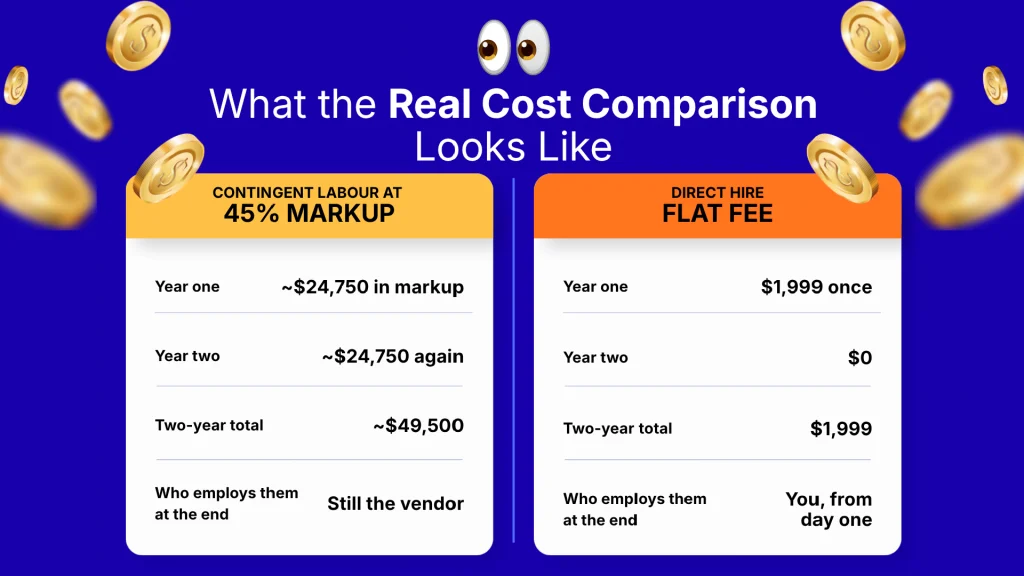
The markup does not amortise. It renews every month the person works. That is the structural difference, and it is invisible in a monthly quote.
When Enterprise Contingent Labour Is Genuinely Right
There are real cases. Ignoring them would make this a sales page rather than an argument.
- You are hiring at volume against a deadline. Forty seats in a quarter is a programme, not a series of placements.
- You need workers across many jurisdictions. Compliance in twelve countries is exactly what an MSP is for.
- The work is genuinely temporary. For a six-month project, permanent employment is the wrong structure, and a markup is a fair price for flexibility.
- You have a talent acquisition team to run the programme. These systems need an owner. Without one, they decay into an expensive vendor list.
If none of those describe you, you are an SMB direct-hire buyer being sold an enterprise product. Our comparison with Robert Half covers that gap against a named enterprise provider, and our guide to outsourcing software development covers the same split in a technical context.
How to Tell Which One You Are Being Sold
Ask what happens in month thirteen. If the answer involves continuing payments for the same person, it is contingent labour.
Ask who signs the worker’s contract. If it is not you, you are renting.
Ask for the fee in dollars for one specific role. Programme sellers cannot answer this without scoping. Placement sellers can answer in a sentence.
Ask what it costs to stop. Direct hire costs nothing to stop. Programmes have exits.
What Direct Hire Looks Like in Practice
At Pavago, search is free. Full profiles and direct messaging cost $100 a month and cancel whenever you like. Placement is $1,999 flat, whatever the role pays, with a 60-day replacement window that needs no fault determination. The whole structure is on the pricing page, which is itself unusual in this category — most providers in the top ten publish no price at all.
You hire the person. They work for you. There is no monthly markup and nothing to exit. Rovira Property Management structured it this way rather than through an agency arrangement; the Rovira case study covers what they hired and how it changed their operations. You can also browse admin and operations roles directly, or look at a specific role such as operations specialist.
Frequently Asked Questions
What are remote staffing services?
The phrase covers two different products. Enterprise contingent labour supplies workers the vendor employs and bills you a markup for, usually as part of a managed programme. Direct hire places a person who becomes your employee or contractor for a one-time fee. Both call themselves remote staffing services.
How much do remote staffing services cost?
Contingent labour typically runs a 40–50% markup on the worker’s hourly rate, charged for as long as they work. Direct hire is a one-time fee, either a percentage of first-year salary or a flat amount. Over a two-year engagement, the difference is usually more than tenfold.
Do I employ the remote worker or does the agency?
Under contingent labour, the agency does, which is why the billing continues. Under direct hire, you do, from the first day. Ask this question first because it determines the entire cost structure.
Is a remote staffing agency worth it for a small business?
An enterprise contingent-labour programme is rarely worth it below roughly twenty hires, because you pay for tooling and account management you will not use. Direct hire placement is worth it at any volume, since the cost is per hire rather than per programme.
Can I convert a contingent worker to a direct employee?
Often, but check for a conversion fee or buyout clause before you sign. These are standard in contingent agreements and are usually calculated as a percentage of salary or a number of months of billing.
Search remote talent without a sales call
Free to search. $100 a month for full profiles and direct messaging, cancel anytime. $1,999 flat when you hire, whatever the role pays. 60-day replacement.
Start at pavago.co/search
Search remote talent without a sales call
Free to search. $100 a month for full profiles and direct messaging, cancel anytime. $1,999 flat when you hire, whatever the role pays. 60-day replacement.