Why the Standard List Fails
Put yourself on the other side of the screen. A US company is hiring one virtual assistant. Forty profiles are open. Each gets roughly thirty seconds.
Every single profile says communication, organised, detail-oriented, fast learner. Those words carry no information because everyone uses them. They cannot be checked, they cannot be compared, and they cannot separate one candidate from another. The employer is not being lazy by skipping past them. They are being rational, because those claims are unfalsifiable.
A skill only counts if it can be verified before hiring. That is the whole filter. Everything else is a claim about yourself that the employer has no way to test until you are already working for them, which is exactly the risk they are trying to avoid.
What Employers Can Actually Verify
| Category | Specific skill | How it gets verified |
|---|---|---|
| Accounting tools | QuickBooks Online, Xero | Free certification, listed on your profile |
| Helpdesk | Zendesk, Freshdesk, Intercom | Named in your work history, tested in a task |
| CRM | HubSpot, Salesforce, Pipedrive | HubSpot certification is free and widely recognised |
| Project tools | Asana, ClickUp, Monday, Trello | Demonstrated in a short trial task |
| Ecommerce | Shopify admin, order and returns handling | Shopify has free training paths |
| Scheduling and calendar | Calendly, Google Workspace, Outlook | Shown in a scheduling scenario test |
| Written English | Drafting client emails, documentation | Judged from your first message onward |
| Data accuracy | Spreadsheet work at volume | Measured directly in a paid test task |
Every row in that table produces something an employer can point at. That is the difference. Not that these skills are more important than communication in the abstract, but that they survive contact with a hiring decision.
The One Soft Skill That Does Get Screened
Written English is the exception, and it is worth separating from the rest of the soft-skill list because it gets tested constantly and involuntarily.
Remote work is mostly written. Your application message is a work sample whether you intended it or not. So is every reply during the process. An employer forms a view of what managing you will cost long before any formal assessment, based purely on whether your messages are clear.
This is not about accent, vocabulary size, or grammatical perfection. It is about whether a busy person can read your message once and know what you mean. Short sentences. One idea at a time. Answer the question that was actually asked. That is the standard, and it is more learnable than most people assume.
How to Build the Verifiable Ones
Start with certifications, because they are free and fast
QuickBooks ProAdvisor and Xero certification cost nothing. HubSpot Academy is free. Google offers free Analytics and Workspace training. Shopify has free partner training. Each takes days. Together they move you past the automated filters that decide whether a human ever reads your profile.
Specialise rather than listing everything
A profile claiming twenty tools reads as someone who has used none of them seriously. A profile saying ecommerce support with Shopify and Gorgias reads as someone who has done the actual job. Depth in two or three tools beats a wide shallow list, because depth is what the trial task will test.
Pick an industry, not just a function
Real estate, ecommerce, insurance, legal and healthcare all have their own tools, vocabulary and workflows. A virtual assistant who knows property management software is competing in a far smaller pool than one offering general admin. Our guide to how global hiring works covers how employers narrow candidates, and specialisation is usually the first cut.
Produce one artefact
Do the job once for a small business, a community group, or a relative’s company, and keep the output. A reconciled set of books, a month of scheduled content, a rebuilt spreadsheet. One concrete thing you can show beats any adjective.
What Actually Separates Candidates in a Trial Task
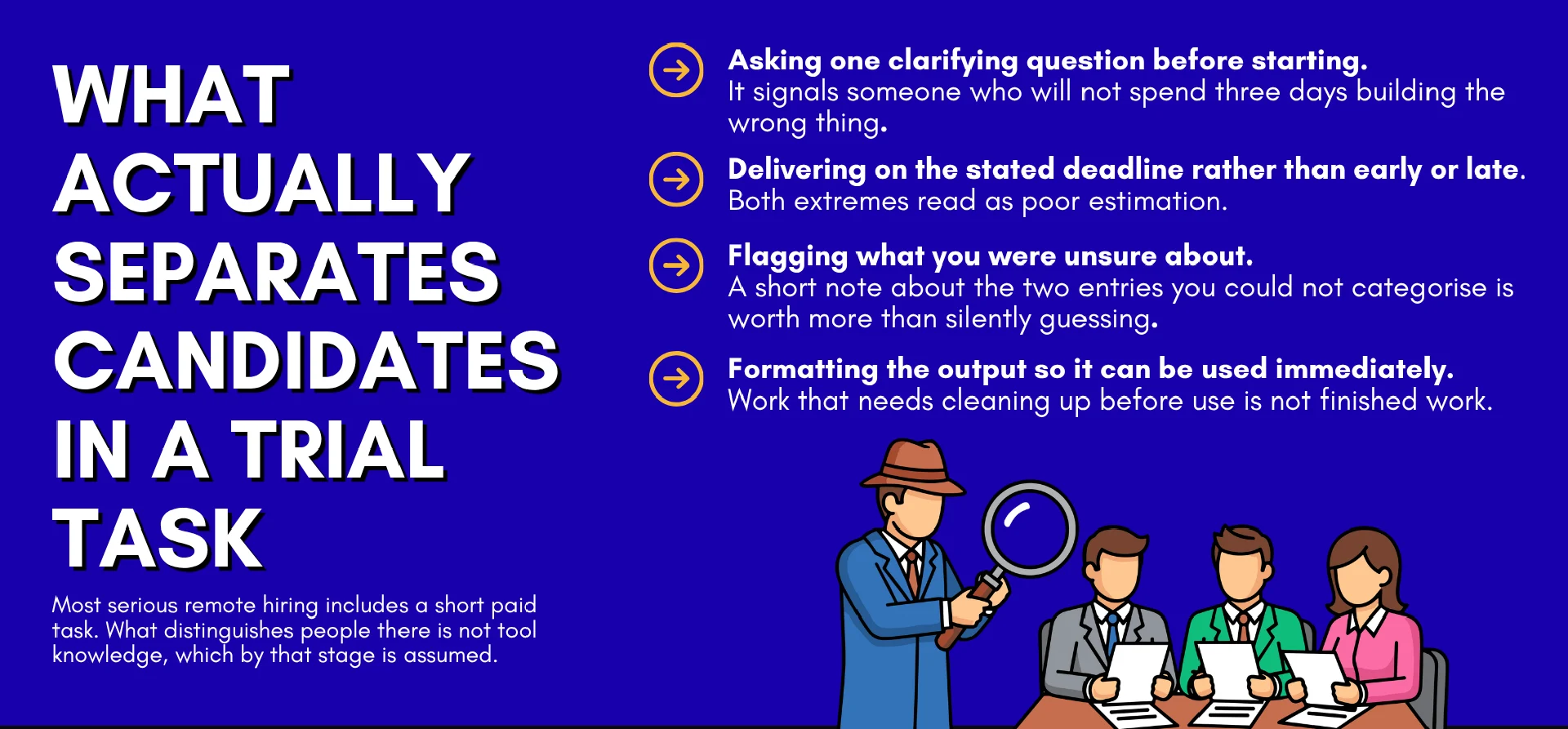
These are habits rather than skills, and they are the actual difference between a candidate who gets hired and one who does not. For context on what companies are trying to avoid when they run these tests, our guide on working with offshore teams covers it from the employer’s side.
Where These Skills Get You Hired
General job boards do not filter well for international candidates. Freelance marketplaces reward the lowest bid rather than the best fit, which is a poor place to establish what your work is worth. Talent marketplaces vet once, then make you visible to companies hiring specifically for remote roles.
At Pavago, the platform is free for candidates permanently, and you keep your full rate — nothing is taken from what the company pays you. Companies search the pool and message directly. Browse open roles, or your region: South Asia, LATAM, Africa.
Frequently Asked Questions
What skills does a virtual assistant need?
Verifiable ones. Tool proficiency in accounting software, helpdesk platforms, CRMs, project tools or ecommerce admin, plus clear written English. Soft skills like organisation matter on the job but cannot be checked before hiring, so they do not win you the role.
Do I need certifications to work as a virtual assistant?
Not required, but they function as proof when you have no track record. QuickBooks ProAdvisor, Xero, HubSpot Academy, Google and Shopify training are all free and take days rather than months.
Which virtual assistant skills pay the most?
Specialised ones. Bookkeeping with accounting software, ecommerce operations, real estate and property management admin, and insurance support consistently pay above general administrative work, because each requires knowledge that general training does not cover.
Is written English more important than spoken?
For most remote roles, yes. The majority of work is written, so your messages are assessed continuously from first contact. Spoken English matters mainly for phone-facing roles.
How many tools should I list on my profile?
Two or three you genuinely know well, not twenty. A long list signals shallow familiarity, and the trial task will expose it. Depth is more credible and more testable than breadth.
Get vetted once. Skip the bidding.
Free for candidates, always. You keep your full rate. Companies search the pool and message you directly.