
Why Most Real Estate VA Hires Fail Within 90 Days
The pattern is predictable. An agent gets overwhelmed. They search “hire a real estate virtual assistant.” They find a marketplace (Upwork, OnlineJobs.ph, MyOutDesk), hire someone based on a profile and a 20-minute interview, and hand them a list of tasks. Week 1: the VA follows instructions. Week 4: the agent realizes the VA can do data entry but can’t talk to clients, can’t prioritize competing deadlines, and doesn’t understand the urgency of a 5-minute lead response window.
The root problem: real estate VA work is client-facing, time-sensitive, and judgment-heavy. It’s not like data entry or scheduling where tasks are repeatable and self-contained. A real estate VA needs to make decisions: which lead to call first, how to handle a frustrated buyer, when to escalate to the agent vs handle independently. Most generic VAs can’t do this. That’s why the process matters more than the platform.
At Pavago, we’ve placed VAs for both real estate agents and property management companies. The Rovira Property Management team needed a VA who could handle their full operational workflow, from client communication to document management. The VA we placed handles A-to-Z tasks across the operation. Read the full Rovira Property Management case study for how the engagement was structured.
What a Real Estate Virtual Assistant Actually Handles
The scope is wider than most agents expect. A trained real estate VA covers five distinct functions:
| Function | Tasks Included | Tools Used | Hours Saved/Week |
|---|---|---|---|
| Lead management | Speed-to-lead response (under 5 min), lead qualification calls, CRM updates, drip campaign management, follow-up sequences | Follow Up Boss, kvCORE, BoomTown, Zillow Premier Agent, Sierra Interactive | 5–8 hours |
| Listing coordination | Upload listings to MLS, schedule photography and staging, order signs and lockboxes, create flyers and social posts, coordinate open houses | MLS portal, Canva, showing schedulers, social media platforms | 3–5 hours |
| Transaction coordination | Track contracts from acceptance to close, manage inspection/appraisal/title timelines, coordinate with lenders and attorneys, handle contingency deadlines | Dotloop, SkySlope, DocuSign, Google Calendar, transaction checklists | 4–6 hours |
| Client communication | Welcome emails/calls for new clients, status updates during transactions, post-closing follow-ups, review requests, anniversary and birthday outreach | Email, phone, CRM drip sequences, Loom for video updates | 3–5 hours |
| Marketing and social media | Create listing posts, neighborhood content, market update graphics, manage posting schedule across Instagram/Facebook/LinkedIn | Canva, Buffer, Later, Meta Business Suite, MLS data for market stats | 3–5 hours |
Total: 18–29 hours per week of work that doesn’t require your real estate license. According to the National Association of Realtors, 89% of buyers used an agent in their most recent home purchase, and agents who respond to leads within 5 minutes are dramatically more likely to convert. (external, dofollow, new tab) A VA handling speed-to-lead alone can transform your conversion rate.
The most requested task set from our real estate clients is client-facing work: lead follow-up, client communication, and relationship management. This is also the hardest to outsource because it requires judgment, empathy, and strong English. That’s why generic freelance platforms fail here and proper screening matters.
Our 6-Step Process for Hiring Real Estate VAs
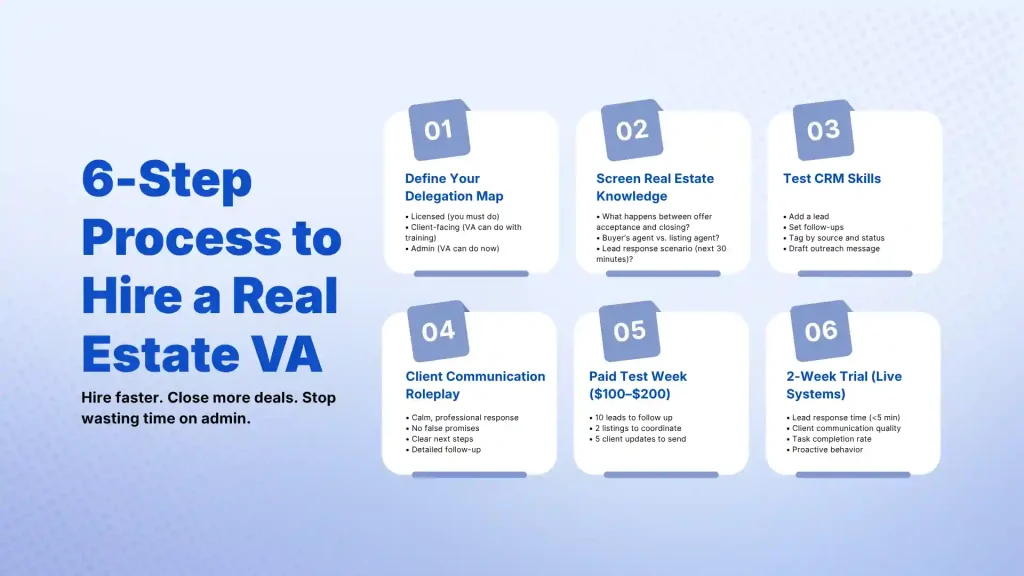
Step 1: Define Your Delegation Map
Before you screen anyone, list every task you do in a week. Categorize them: licensed (you must do), client-facing (VA can do with training), admin (VA can do immediately). Most agents discover that 60–70% of their weekly hours go to admin and client-facing tasks a VA could own.
Start with the task category that costs you the most deals or the most time. For most agents, that’s lead follow-up. Every unanswered lead is revenue walking away. Our virtual assistant onboarding process guide covers how to structure the initial task handoff.
Step 2: Screen for Real Estate Knowledge
Not everyone who calls themselves a “real estate VA” understands real estate. Test their knowledge:
- Ask: “What happens between offer acceptance and closing?” They should be able to walk through inspections, appraisals, title search, contingency periods, and closing steps.
- Ask: “What’s the difference between a buyer’s agent and a listing agent?” Basic, but eliminates candidates who have no real estate context.
- Ask: “A lead submits a form on Zillow at 2 PM. Walk me through what you do in the next 30 minutes.” This tests speed-to-lead urgency, which is the single most important trait for a lead management VA.
Step 3: CRM Proficiency Test
The CRM is the VA’s primary workspace. Set up a test environment in your CRM (Follow Up Boss, kvCORE, or whichever you use) and ask them to: create a new lead record from provided info, set a follow-up task for tomorrow, draft the initial outreach message, and tag the lead by source and status. If they can’t navigate this in 20 minutes, onboarding will take months.
Step 4: Client Communication Roleplay
This is the step most hiring processes skip and the one that matters most for real estate VAs.
Scenario: “A buyer calls frustrated because the inspection report found foundation issues. The agent is in a showing and can’t take the call. You answer. What do you say?”
Good VAs: acknowledge the concern, reassure without making promises, take detailed notes, set expectations for when the agent will call back, and follow up with a summary email. Bad VAs: freeze, transfer to voicemail, or make promises they shouldn’t.
According to Harvard Business Review research, companies that respond to leads within 5 minutes are 100x more likely to connect vs those who wait 30 minutes. (external, dofollow, new tab) Your VA’s communication quality directly affects your close rate.
Step 5: Paid Test Week ($100–$200)
Give them real work before committing: 10 leads to follow up on, 2 listings to coordinate, and 5 client status updates to send. Evaluate speed, accuracy, communication quality, and how many follow-up questions they need. The best VAs start anticipating your preferences by day 3.
Step 6: 2-Week Trial on Live Systems
Full access to your CRM, email, and transaction management tools with appropriate permissions. During the trial, track: lead response time (target: under 5 minutes), client communication quality, task completion rate, and proactive behavior (did they flag something before you asked?). For structuring the trial and beyond, our hiring full time virtual assistants dos and donts guide covers the best practices.
Where to Find Real Estate Virtual Assistants
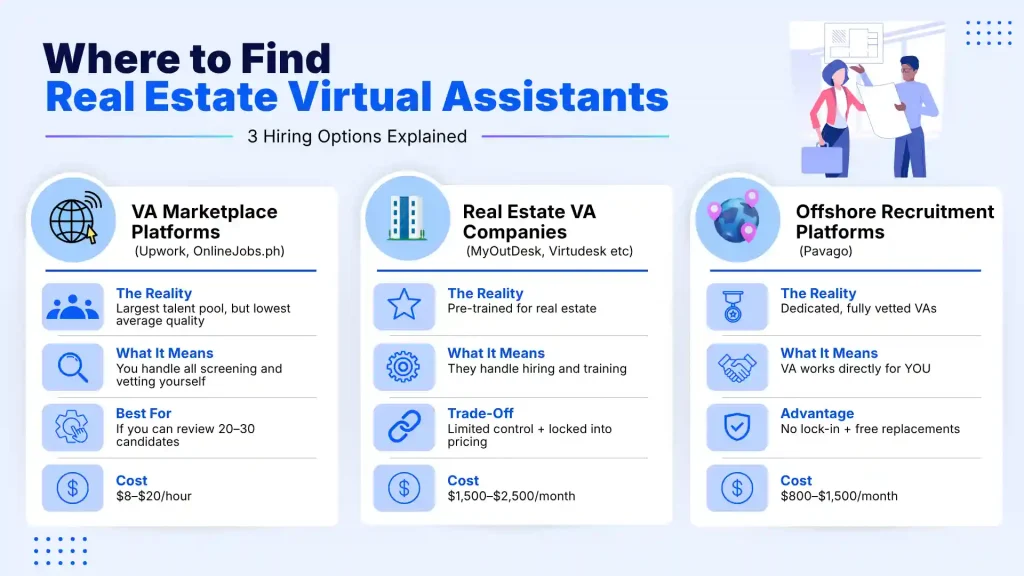
VA Marketplace Platforms (Upwork, OnlineJobs.ph)
Largest pool. Lowest average quality. You do all the vetting yourself. Works if you have time to screen 20–30 candidates and don’t mind doing the work described in Steps 2–4 yourself. Cost: $8–20/hour.
Real Estate VA Companies (MyOutDesk, Virtudesk, REVA Global)
Pre-trained for real estate. Higher cost: $1,500–$2,500/month. They handle screening and training. Trade-off: you’re locked into their pool and their pricing. Replacement is on their timeline.
Offshore Recruitment Platforms (Pavago)
We source, vet, and place dedicated VAs who work directly for you. Cost: $800–$1,500/month for full-time. No lock-in. Free replacements. The VA is YOUR team member, not a vendor’s employee. Browse our virtual assistant page for available talent, or the broader hire admin category for all admin roles.
What a Real Estate Virtual Assistant Costs in 2026
| U.S. Admin/Assistant | RE VA Company (MyOutDesk) | Offshore Dedicated (Pavago) | |
|---|---|---|---|
| Monthly cost | $2,500–$4,500 + benefits | $1,800–$2,500 | $800–$1,500 |
| Annual cost | $35K–$65K all-in | $21,600–$30,000 | $10,000–$18,000 |
| RE-specific training | You train them | Pre-trained (their curriculum) | Screened for RE knowledge, you customize |
| Dedicated to you? | Yes | Typically yes | Yes, 100% |
| Replacement | Start over (3–6 month search) | Company reassigns (timeline varies) | Free, no time limit |
| Lock-in | Employment relationship | Contract term | None |
The ROI math is simple: if your average commission is $8,000–$12,000 and a VA frees up 15–20 hours per week for selling, the VA pays for itself with one additional closing per quarter. At $1,000/month, that’s a 2–3x return even at minimal production lift. For a deeper look at VA costs across models, our virtual assistant cost guide breaks down all-in pricing.
Tools Your Real Estate VA Needs to Know
- CRM: Follow Up Boss (most common for teams), kvCORE (KW Command replacement), BoomTown, Sierra Interactive, LionDesk, Wise Agent. HubSpot or Salesforce for property management.
- Transaction management: Dotloop, SkySlope, Brokermint, or your brokerage’s transaction system.
- MLS access: VA needs read access (not login access) for listing data. Many brokerages allow virtual assistant MLS accounts.
- Communication: Slack, Google Workspace, Zoom. A dedicated phone number through Google Voice, OpenPhone, or Grasshopper for client calls.
- Marketing: Canva for graphics, Buffer or Later for scheduling, Loom for video messages, Mailchimp or Follow Up Boss drips for email campaigns.
Frequently Asked Questions
How much does a real estate virtual assistant cost?
U.S. admin staff: $2,500–$4,500/month + benefits. Real estate VA companies: $1,800–$2,500/month. Offshore dedicated through Pavago: $800–$1,500/month full-time. Freelance: $8–20/hour but inconsistent quality and availability.
What tasks can a real estate VA handle?
Lead follow-up (including calls), listing coordination, transaction coordination, client communication, CRM management, social media, and marketing. Anything that doesn’t require your real estate license: the VA can’t negotiate deals, write contracts, or provide legal/financial advice.
Does the VA need a real estate license?
No. VAs handle administrative and client-facing support, not licensed activities. They coordinate everything so you can focus on the licensed work: showings, negotiations, contracts, and closings.
What CRM should my VA know?
Follow Up Boss is the most common for teams and solo agents scaling. kvCORE is popular with KW agents. BoomTown for lead-heavy operations. If your VA doesn’t know your specific CRM, expect 1–2 weeks of onboarding to get proficient.
How many transactions can one VA support?
One experienced VA can support 10―20 active transactions simultaneously, depending on complexity. At higher volume (20+), consider a second VA or splitting into lead management VA + transaction coordinator.
Can a VA handle phone calls with clients?
Yes, and they should. Client communication is one of the highest-value VA tasks in real estate. The key is vetting for communication quality during hiring (Step 4 in our process). Philippines and Pakistan both produce VAs with strong English phone skills. For more on the broader VA landscape, our guide to hiring a latin virtual assistant covers LATAM options with U.S. time zone overlap.
Every Hour You Spend on Admin Is an Hour You’re Not Selling
The top-producing agents aren’t the ones who work the most hours. They’re the ones who spend the most hours on revenue-generating activities: showings, negotiations, and relationship building. Everything else is leverage, and a VA is the cheapest, most effective leverage available.
The process: define your delegation map, screen for real estate knowledge, test CRM proficiency, roleplay client communication, run a paid test week, and trial on live systems. Skip any step and you’re rolling the dice. Follow all six and you’ll hire a VA who gives you back 15–20 hours per week to do what you’re licensed for: close deals.
Hire a Real Estate Virtual Assistant Through Pavago
We’ve placed VAs for real estate agents and property management companies who handle the full A-to-Z: lead follow-up, listing coordination, transaction management, client communication, and marketing. Every candidate screened for real estate knowledge and client-facing communication quality.
- Real estate VAs from $800/month
- Follow Up Boss, kvCORE, Dotloop, SkySlope proficient
- Free replacements if a hire doesn’t work out
- Candidates presented in 1–2 weeks
Tell us your current transaction volume and what’s eating your time, and we’ll match you with a VA who fits.