
The Structure Nobody Puts on Their Pricing Page
Search offshore staffing services and open the first ten results. Count how many publish a price. In our check of the current US top ten, the answer was zero. Every one of them routes to a contact form or a discovery call.
That is not an accident of web design. It is the model working as intended. When the fee is a percentage of salary, the number cannot go on a page because it does not exist until they know what you are paying the person.
Here is what that looks like in practice. A contingency placement fee typically runs 15–30% of first-year compensation. Take a mid-level finance hire:
| What you pay the hire | Fee at 20% | What the staffing service did |
|---|---|---|
| $40,000 | $8,000 | Sourced, screened, presented candidates |
| $60,000 | $12,000 | Sourced, screened, presented candidates |
| $85,000 | $17,000 | Sourced, screened, presented candidates |
The third column does not change. Same sourcing channels, same screening process, same number of interviews arranged. The fee more than doubles because the candidate is better. You are not buying more service at $85,000. You are buying the same service on a bigger multiplier.
Why the Model Survives
It survives because it is genuinely reasonable in one situation: when the agency’s work scales with the salary. Filling a VP of Engineering role is harder than filling a bookkeeping role. The candidate pool is smaller, the outreach is more personal, the negotiation takes longer, and the agency carries more risk of the placement falling through.
For senior and executive search, percentage pricing reflects real effort. That is why retained search exists and why it costs 20–30% paid in installments.
The problem is that the same structure gets applied to roles where none of that is true. A staffing service filling a remote bookkeeper role from an existing candidate pool is not doing executive search. It is doing matching. But it still bills like search, because that is how the industry prices.
The Costs That Sit Outside the Fee
The placement fee is the visible number. It is not the whole number. According to ADP’s breakdown of true hiring costs, SHRM data puts the average cost to fill an open position at $4,129 and the average time at 42 days — before the agency fee enters the picture. (external, dofollow, new tab) That figure has climbed since: G2’s cost-per-hire analysis tracks SHRM’s number rising to $4,700 by 2023, a 14% increase. (external, dofollow, new tab)
So the real arithmetic on a $60,000 hire through a 20% agency is closer to $12,000 in fees plus roughly $4,700 in internal cost. Sixteen thousand dollars and change to fill one seat.
Then there is the part that only shows up later. If the hire does not work out in month three, most contingency agreements offer a replacement window of 30 to 90 days. Miss it, and the next search is a new fee at the same percentage.
Three Ways Offshore Staffing Actually Gets Priced
| Contingency agency | Staff augmentation | Flat-fee marketplace | |
|---|---|---|---|
| Pricing | 15–30% of first-year salary | $8,000–$15,000/month per person | Flat fee per placement |
| When you pay | On placement | Every month the person is embedded | Once, on hire |
| Cost scales with salary | Yes | Indirectly | No |
| Cost scales with tenure | No | Yes — indefinitely | No |
| Who employs the person | You | The vendor | You |
| Best fit | Senior and executive search | Short projects, 3–12 months | Ongoing roles you intend to keep |
The middle column deserves a second look. Staff augmentation is often pitched as the cheaper alternative to a placement fee because there is no lump sum. But at $8,000–$15,000 a month, a person embedded for a year costs $96,000 to $180,000, and you never stop paying. The agency fee is expensive once. Augmentation is expensive forever. Our comparison of offshore staffing models breaks down where each one actually fits.
What Flat Pricing Changes
At Pavago, the placement fee is $1,999 regardless of what the role pays. Search is free. Full profiles and direct messaging are $100 a month; cancel whenever. The full breakdown is on the pricing page.
Run the same three hires from earlier through that structure and the fee column stops moving:
| What you pay the hire | 20% agency fee | Flat placement fee | Difference |
|---|---|---|---|
| $40,000 | $8,000 | $1,999 | $6,001 |
| $60,000 | $12,000 | $1,999 | $10,001 |
| $85,000 | $17,000 | $1,999 | $15,001 |
Note what happens at the bottom of that table. The better the hire, the larger the gap. Percentage pricing quietly penalises you for hiring up. Flat pricing does not care.
The replacement window matters here too. Sixty days, no paperwork, no argument about whose fault it was. If the person leaves, or you part ways, or the fit was wrong from week one, you message your account manager. That is the whole process.
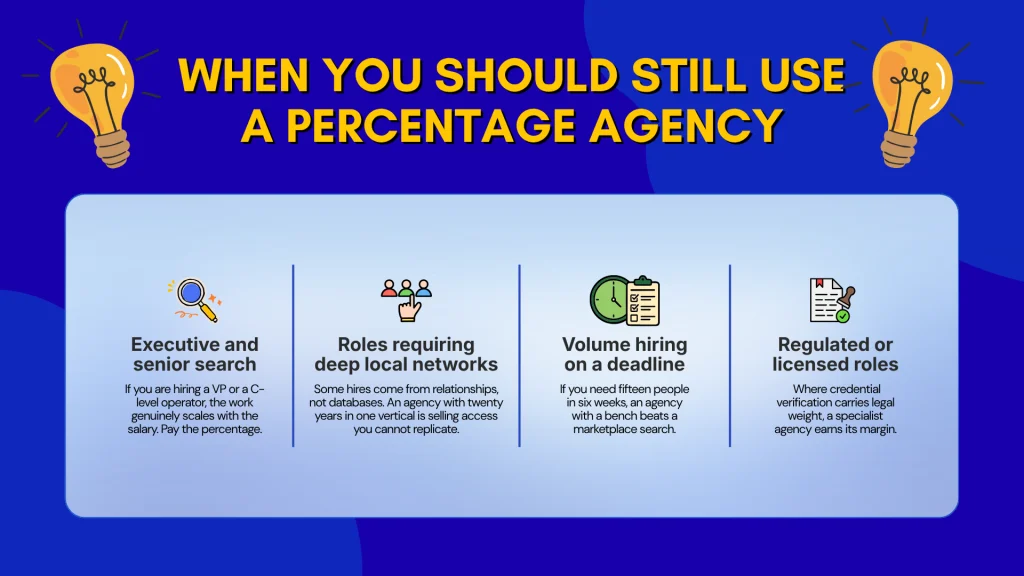
When You Should Still Use a Percentage Agency
This is not a case that flat fees win every time. They do not.
- Executive and senior search. If you are hiring a VP or a C-level operator, the work genuinely scales with the salary. Pay the percentage.
- Roles requiring deep local networks. Some hires come from relationships, not databases. An agency with twenty years in one vertical is selling access you cannot replicate.
- Volume hiring on a deadline. If you need fifteen people in six weeks, an agency with a bench beats a marketplace search.
- Regulated or licensed roles. Where credential verification carries legal weight, a specialist agency earns its margin.
Outside those four, the percentage is buying you a pricing structure rather than a better outcome. For a fuller comparison against named providers, see our breakdown of Pavago versus HireWithNear and our guide to international recruitment agencies.
Four Questions to Ask Before You Sign
1. What is the fee on this specific role, in dollars? If they will not answer without a call, the number is negotiable, which means it is arbitrary.
2. What is the replacement window, and what voids it? Thirty days is common and close to useless. Ask what happens if the person resigns in week nine.
3. Does the fee change if I hire at a higher salary? This is the question the model does not survive. Ask it directly.
4. Who employs the person, and what happens if I want to bring them in-house? Some agreements carry a buyout. Find it before you sign, not after.
Tenant Planet went through this and ended up hiring directly rather than through a percentage arrangement. The Tenant Planet case study covers how they structured it. If you want to see the candidate side before committing to anything, you can browse admin and operations talent or look at a specific role like virtual assistant without creating an account.
Frequently Asked Questions
How much do offshore staffing services cost?
Contingency agencies charge 15–30% of the hire’s first-year salary, so a $60,000 role costs $9,000 to $18,000. Staff augmentation runs $8,000–$15,000 per person per month for as long as they are embedded. Flat-fee marketplaces charge a fixed amount per placement regardless of salary.
Why do staffing agencies charge a percentage instead of a flat fee?
Because agency effort genuinely scales with salary at the senior end, where candidate pools are smaller and searches take longer. The structure made sense for executive search and then got applied to every role, including ones filled from an existing candidate pool where the work does not scale at all.
Is offshore staffing cheaper than hiring locally?
On salary, usually. On fees, it depends entirely on the pricing model. A 25% fee on an offshore hire can cost more than a flat fee on a domestic one. Compare the total of salary plus fee plus replacement risk, not salary alone.
What happens if the offshore hire does not work out?
It depends on the replacement window. Contingency agreements typically offer 30 to 90 days, often with conditions that void it. Read what voids it before signing. Pavago’s window is 60 days with no fault determination required.
Do I employ the person, or does the staffing service?
With a contingency placement, you do. With staff augmentation, the vendor employs them and bills you monthly, which is why that model costs more over time and why leaving it can involve a buyout. Marketplaces vary, so ask.
See the candidates before you talk to anyone
Search the pool for free. Full profiles and direct messaging are $100 a month, cancel anytime. Placement is $1,999 flat, whatever the role pays, with a 60-day replacement window.
Start searching at pavago.co/search
See the candidates before you talk to anyone
Search the pool for free. Full profiles and direct messaging are $100 a month, cancel anytime. Placement is $1,999 flat, whatever the role pays, with a 60-day replacement window.