
The Number You See and the Number You Pay
An accounting staffing agency quotes one engagement at a time, and each quote is defensible in isolation. A contract senior accountant for four months. A temp-to-perm staff accountant. A bookkeeper through year-end close. Each has a rate, each rate is competitive, each engagement ends.
What nobody puts in the quote is that the same requirement returns every year, because accounting work is seasonal in a way most functions are not. Year-end close, audit prep, tax season, and the reporting crunch that follows all land in the same window. So the same firm calls the same agency every January.
Three engagements over three years is not three separate decisions. It is one permanent role being funded on the most expensive possible schedule, and the seasonal framing hides that.
What the Three-Year Number Looks Like
Two ways an agency prices accounting staff, and both compound annually.
| Contract or temp placement | Direct hire placement | |
|---|---|---|
| How it is priced | Hourly bill rate at a markup over what the accountant receives, typically 40–60% for finance roles | Percentage of first-year salary, commonly 15–25% |
| Typical engagement | 3–5 months across busy season | One-time, permanent |
| What recurs | Everything. New engagement, new markup, every year. | Nothing, unless the person leaves |
| Year one on a $70,000-equivalent role | Roughly $28,000–$42,000 in markup across the engagement | $10,500–$17,500 once |
| Three-year total | Roughly $84,000–$126,000 | $10,500–$17,500 |
| Who employs the accountant | The agency | You |
The gap in the bottom rows is the whole point. Contract staffing is the cheaper decision in January and the far more expensive one by the third of December. Nobody makes that comparison because nobody is looking at a three-year window when the immediate problem is that close starts in two weeks.
The Costs That Never Appear on the Invoice
Hiring carries internal costs regardless of who you use. According to ADP’s breakdown of true hiring costs, SHRM data puts the average cost to fill a position at $4,129 over an average of 42 days, before any agency fee. G2’s cost-per-hire analysis tracks that figure rising to $4,700 by 2023.
For seasonal accounting staffing, that internal cost recurs too. Every January someone writes the brief, reviews the shortlist, runs the interviews, and handles onboarding. Three years of that is three times the 42 days, three times the internal spend, and three separate people who each had to learn your chart of accounts from scratch.
That last part is the cost that never gets counted. A contract accountant who leaves in May takes the accumulated knowledge of your close process with them. The one who arrives next January starts at zero, and the ramp comes out of the exact window when you have no slack.
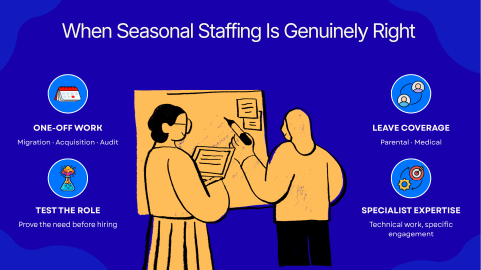
When Seasonal Staffing Is Genuinely Right
There are real cases, and pretending otherwise would make this a sales page.
- A genuine one-off. A system migration, an acquisition, a first audit. Work with a real end date and no reason to recur.
- Covering a leave. Parental or medical cover is exactly what temp staffing exists for.
- Testing whether the role is needed. If you are unsure a full-time controller is justified, one contract season is a reasonable way to find out. Just decide afterwards rather than defaulting into year two.
- Specialist technical work. Complex revenue recognition, a restatement, or transfer pricing. Buy the expertise for the engagement.
Outside those, the seasonal pattern is usually inertia rather than strategy. The tell is simple: if you have used an agency for the same window three years running, it is not seasonal demand. It is a permanent role you are renting.
What Changes If the Role Becomes Permanent
The obstacle is rarely the logic. It is that a permanent domestic finance hire is expensive enough to make the seasonal contract feel like the responsible choice. That comparison shifts if the permanent hire does not have to be domestic.
At Pavago, the placement fee is $1,999 flat regardless of what the role pays. Search is free, and full profiles with direct messaging are $100 a month, cancel whenever. Details are on the pricing page.
Against the three-year seasonal pattern, the arithmetic stops being close. One fee, once, for someone who is still there in year three and knows your close process because they ran it twice already.
The replacement window matters at this level too. Sixty days, no fault determination, no paperwork. If the hire is wrong you say so and get another. You can look at the accountant role directly, or browse the wider finance talent pool before deciding anything.
QBM Services took the permanent route for their finance and administrative support rather than continuing to staff around it; the QBM Services case study covers how the placement was structured. For payroll specifically, our guide to payroll outsourcing costs runs the same comparison, and our guide to offshore accounting covers what these roles actually cover.
Four Questions to Ask an Accounting Staffing Agency
1. What is the bill rate, and what does the accountant receive? The gap is the markup. Most agencies will give you the first number and resist the second. The resistance is the answer.
2. What happens if I want to keep this person permanently? Conversion fees are standard in contract staffing and are usually a percentage of salary or a number of weeks of billing. Find the clause before the engagement, not in May.
3. Will this be the same person next season? Almost never. Ask anyway, because the answer tells you whether you are buying continuity or a warm seat.
4. What is the three-year cost if I do this again? No agency will volunteer this calculation. Do it yourself before signing the first one.
Frequently Asked Questions
How much does an accounting staffing agency charge?
Contract and temporary placements are billed at a markup over the accountant’s rate, commonly 40–60% for finance roles. Direct hire placements are typically 15–25% of first-year salary. The contract model looks cheaper per engagement and costs substantially more if the engagement repeats annually.
Is it cheaper to use a staffing agency or hire directly?
For a genuine one-off, the agency. For anything recurring, direct hire, because the agency cost recurs with it while a placement fee does not. The break-even is usually somewhere in the second engagement.
What is a temp-to-perm accounting placement?
A contract engagement with an option to convert the accountant to your payroll, usually for a conversion fee. It reduces hiring risk and increases total cost. Read the conversion terms before the engagement starts, since that is when the fee is negotiable.
Why do accounting firms use staffing agencies for busy season?
Because demand genuinely spikes around year-end close, audit prep and tax season. The logic holds for one season. It stops holding when the same window is staffed by an agency three years running, at which point the work is permanent and only the funding is seasonal.
Can accounting roles be filled remotely?
Yes. Bookkeeping, staff accounting, payroll, accounts payable and receivable, and month-end close are all software-based and location-independent. The constraints that matter are timezone overlap and familiarity with US GAAP, not physical presence.
Hire the accountant instead of renting one
Search the pool free. Full profiles and direct messaging are $100 a month, cancel anytime. Placement is $1,999 flat whatever the role pays, with a 60-day replacement window.