Why Small Business Owners Need VAs More Than Anyone Else
At a 500-person company, the CEO has a COO, a VP of Operations, an HR department, and an admin team handling the work. At a 5–25 person company, the owner IS the COO, the HR department, the receptionist, and the bookkeeper. Every hour spent on $15/hour admin work is an hour not spent on $200/hour strategy, sales, and relationship work.
According to There Is Talent’s virtual assistant statistics report, entrepreneurs regain an average of 13–15 hours per week by delegating tasks to VAs, and companies report a 35% increase in efficiency when routine tasks are managed by VAs. (external, dofollow, new tab) For a small business owner billing $100–$200/hour, those 13–15 hours represent $1,300–$3,000 in recaptured productive capacity every week. A VA at $1,000/month pays for itself in the first week.
At Pavago, we’ve placed 50+ Virtual Assistants for small businesses in the last 12 months. The pattern is consistent: owners come to us overwhelmed, delegate the right tasks, and within 30 days have 15–20 hours per week back for the work that actually grows revenue.
What a Small Business VA Actually Handles
| Function | Tasks | Who It Replaces | Monthly Time Saved |
|---|---|---|---|
| Admin and inbox | Email management, scheduling, data entry, document preparation, file organization, vendor coordination | Office manager or the owner themselves | 15–20 hours |
| Customer service | Responding to inquiries, processing orders, handling returns, managing reviews, live chat | Customer service rep | 10–15 hours |
| Social media | Content creation, scheduling, engagement, analytics reporting | Marketing coordinator | 8–12 hours |
| Bookkeeping light | Invoice processing, expense categorization, bank reconciliation, payment follow-ups | Part-time bookkeeper | 5–8 hours |
| Sales support | Lead follow-up, CRM updates, appointment scheduling, proposal preparation, pipeline tracking | Sales assistant or SDR | 8–12 hours |
| Research | Market research, competitor analysis, vendor comparison, pricing research, content research | The owner (late at night) | 5–10 hours |
The total: 50–75 hours/month of work that doesn’t require the owner’s expertise, judgment, or physical presence. Browse our hire admin category for available VA talent, or see our virtual assistant page specifically.
The 5-Step Process for Hiring a Small Business VA
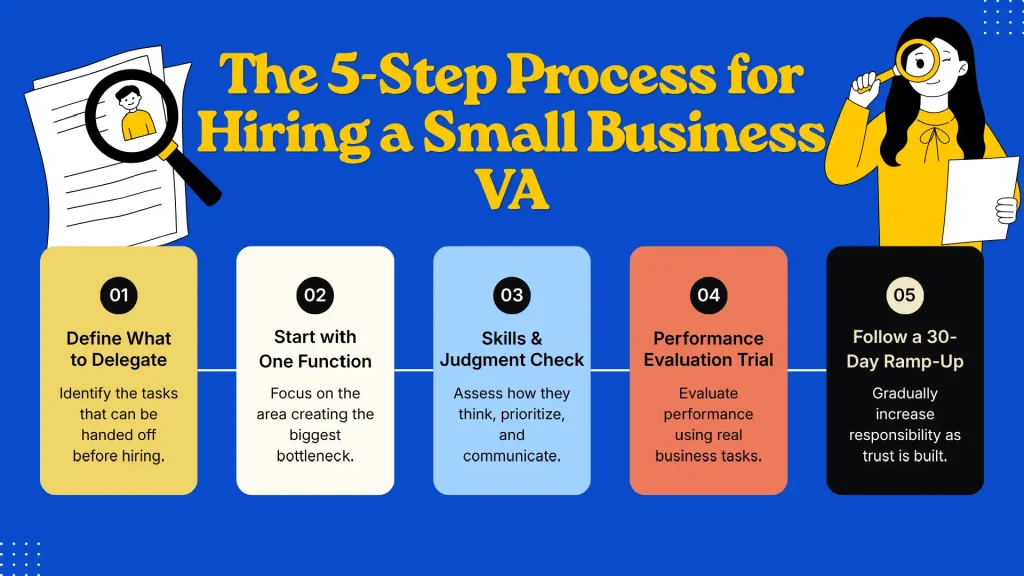
Step 1: Build Your Delegation List (Before You Screen Anyone)
Spend 30 minutes listing every task you did last week. Categorize into three buckets:
- Only I can do this: Strategy decisions, key client relationships, final approvals, investor meetings.
- Someone else could do this with context: Email responses, scheduling, follow-ups, CRM updates, social media, research.
- Anyone organized could do this: Data entry, file management, appointment booking, and invoice processing.
Buckets 2 and 3 become the VA’s job description. Most small business owners discover 60–70% of their week falls into these two buckets.
Step 2: Pick Your Starting Function
Don’t delegate everything at once. Pick the ONE function that costs you the most time or the most money:
- If you’re drowning in email: Start with inbox management + scheduling.
- If you’re losing leads: Start with CRM management + lead follow-up.
- If your social media is dead: Start with content creation + posting + engagement.
- If your books are a mess: Start with invoice processing + expense categorization.
One function. One clear win. Then expand after month 1.
Step 3: Screen for Communication Quality and Judgment
For small business VAs, communication quality matters more than specific tool skills. Tools are trainable in days. Judgment takes months.
Test 1: Send them an ambiguous email from a “client” and ask them to draft a response on your behalf. Does the response sound professional? Does it ask clarifying questions rather than guessing?
Test 2: Give them 5 competing tasks with a tight deadline. How do they prioritize? Do they communicate trade-offs or just start working top-to-bottom?
Test 3: Ask them to research 3 vendors for a service you need (e.g., email marketing platforms). Evaluate: Is the research organized? Are the comparisons fair? Did they make a recommendation with reasoning?
Step 4: Paid Test Week ($100–$200)
Assign real tasks from your starting function. Track: accuracy, speed, communication quality, and how many follow-up questions they need. The best VAs start anticipating your preferences by day 3. If they’re still asking basic questions on day 5, the fit isn’t right.
Step 5: 30-Day Ramp Structure
Week 1: VA handles the starting function only. You provide detailed instructions and review all output.
Week 2: VA handles the starting function with less oversight. You spot-check instead of reviewing everything.
Week 3: Add a second function. VA handles two areas simultaneously.
Week 4: VA is operating semi-independently across assigned functions. You shift to weekly check-ins instead of daily reviews.
According to VA Masters’ industry statistics, 67% of solo entrepreneurs use virtual assistants, and the average business recovers more value than the VA’s cost within 3.2 weeks. (external, dofollow, new tab) The 30-day ramp structure is what makes that fast ROI possible.
For detailed onboarding frameworks, our virtual assistant onboarding process guide covers the first 30 days step by step. For general VA hiring best practices, our hiring full time virtual assistants dos and donts covers common mistakes to avoid.
We’ve placed VAs for companies across every function. See the Tenant Planet case study for how we helped a small business find its A-player offshore. For cost comparisons, our virtual assistant cost guide has all-in pricing across models.
What a Small Business VA Costs
| U.S. Admin Hire | VA Company (MyOutDesk, Belay) | Freelance (Upwork) | Dedicated Offshore (Pavago) | |
|---|---|---|---|---|
| Monthly cost | $3,000–$5,000 + benefits | $1,800–$2,800 | $800–$2,000 variable | $800–$1,500 |
| Annual cost | $42K–$75K all-in | $21K–$34K | $10K–$24K (inconsistent) | $10K–$18K |
| Dedicated? | Yes | Usually yes | No (juggling clients) | Yes, 100% |
| Functions covered | Admin only (unless you hire multiple) | Admin primarily | Depends on who you find | Admin + marketing + CS + bookkeeping + sales support |
| Replacement | 3–6 month search | Company reassigns | Find someone new | Free, no time limit |
Frequently Asked Questions
How much does a virtual assistant for a small business cost?
U.S. admin: $3,000–$5,000/month. VA companies: $1,800–$2,800/month. Offshore dedicated through Pavago: $800–$1,500/month full-time.
What tasks should I delegate first?
The task that eats the most of your time or costs you the most money. For most owners: email/inbox management. For sales-driven businesses: lead follow-up and CRM. For product businesses: customer service.
How many hours per week does a small business VA work?
Full-time (40 hours/week) through Pavago. Part-time options exist through freelance platforms. If you have 15+ hours/week of delegatable work, full-time is more cost-effective than hourly.
Can a VA handle multiple functions?
Yes. Most Pavago-placed small business VAs handle 2–3 functions (e.g., admin + social media, or customer service + bookkeeping). Start with one and expand as trust builds.
How do I manage a remote VA?
Same tools as any remote team: Slack for communication, Asana/Monday for tasks, Zoom for weekly check-ins, Loom for async video instructions. Our guide on how to work with offshore teams covers the operational framework.
What if the VA doesn’t work out?
Through Pavago: free replacement, no time limit. The 5-step process above minimizes this risk, but if it happens, we place a new VA without additional cost.
The Hire That Changes Everything for Small Business Owners
The first VA hire is the inflection point for most small businesses. Before: the owner does everything, works 60–70 hour weeks, and the business grows at the speed of one person. After: the owner focuses on sales, strategy, and growth while the VA handles the rest. At $800–$1,500/month, it’s the cheapest inflection point in business.
Hire a Virtual Assistant for Your Small Business Through Pavago
50+ VAs placed for small businesses in the last 12 months. Admin, marketing, customer service, bookkeeping, and sales support. Multi-function VAs who handle 2–3 areas simultaneously.
Small business VAs from $800/month | Multi-function | Free replacements