
Why Skills Lists Don’t Help You Hire
Every article starts: HTML, CSS, JavaScript, React. That tells you nothing about whether the developer in front of you can actually build what you need.
The biggest mistake: cycling through developers on Upwork and Fiverr, evaluating on profiles alone, then discovering weeks later that the code is unusable. When you’re learning how to hire offshore software developers, the vetting process matters even more because you can’t rely on in-person signals.
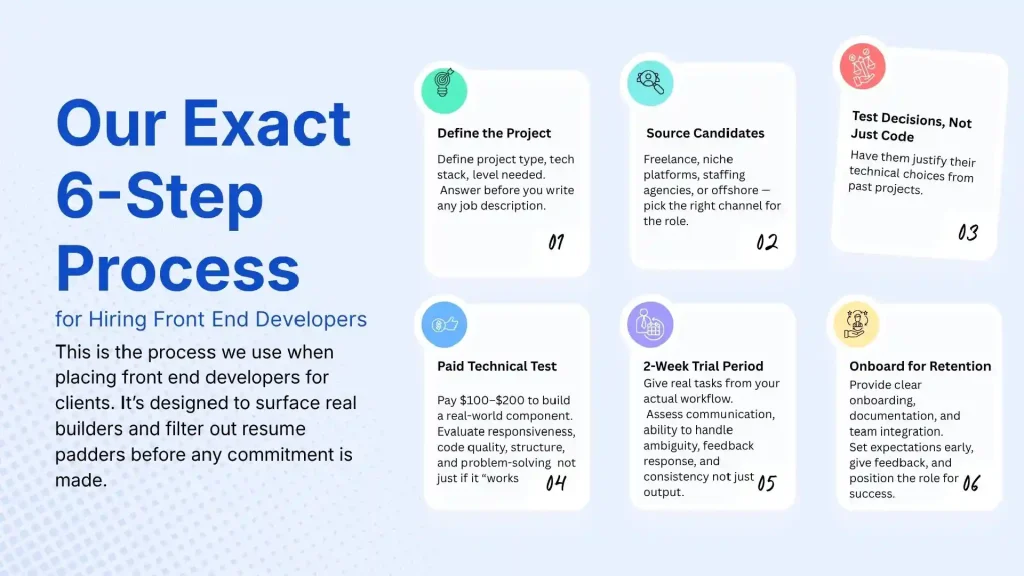
Our 6-Step Process for Hiring Front-End Developers
Step 1: Define the Project, Not the Job Title
- What are you building? Marketing site, SaaS dashboard, e-commerce frontend, component library?
- Tech stack? React? Next.js? Angular? Vue? The framework matters.
- Level needed? Junior builds a landing page. Senior architect’s systems.
- Collaboration? Working with designers and backend devs, or solo from mockups?
Step 2: Source From the Right Channel
| Channel | Best For | Cost Range | Watch Out For |
|---|---|---|---|
| Freelance (Upwork, Fiverr) | Short projects, landing pages | $20–$80/hr | Quality varies wildly. |
| Niche (Toptal, Arc) | Senior pre-vetted talent | $60–$150/hr | Premium pricing. |
| U.S. staffing | Enterprise, in-office | $80K–$140K/yr + fees | Overkill for SMBs. |
| Offshore recruitment (Pavago) | Dedicated full-time hires | $1,500–$4,000/mo | Requires proper onboarding. |
For SMBs needing ongoing front-end work, the offshore dedicated hire is usually right. For the structural decision, see offshore employees vs outsourcing.
Step 3: Screen for Decision-Making, Not Just Coding
This is where most processes fail.
Show the candidate their own portfolio work and ask: “Walk me through the technical decisions you made. Why this approach? What would you change now?”
The failure we see most often: portfolios look polished, but candidates can’t explain their own decisions. They can’t articulate why they chose React over Vue. Can’t explain component structure trade-offs. This matters because front end development is full of trade-off decisions.
Step 4: Paid Technical Test (2–4 Hours)
- Mid-level: Build a responsive component from a Figma mockup with interactive elements.
- Senior: Build a data-fetching component with loading states, error handling, and caching.
Pay $100–$200 for focused work. Candidates who refuse paid tests are usually overbooked or not confident.
Step 5: Evaluate Communication During Trial
2-week paid trial. Evaluate:
- Ambiguity handling: Do they ask smart questions or build the wrong thing?
- Progress communication: Daily updates or silent for 3 days?
- Feedback response: Defensive = red flag. Curious = green flag.
Communication predicts long-term success more than technical skill for remote hires. One of our clients, OneNine, needed global design and development talent. We placed professionals who integrated seamlessly. Read the OneNine case study for how that worked.
Step 6: Structure for Retention
A $3,000/month salary positions you as a premium employer in markets like Pakistan or LATAM. Set up structured onboarding with codebase access and design system documentation from day one. For the full 30/60/90 framework, see our hire remote engineering team guide.
What Does a Front End Developer Cost in 2026?
| Level | U.S. Salary | Offshore Monthly | Key Capabilities |
|---|---|---|---|
| Junior (0–2 yrs) | $55K–$75K | $800–$1,500 | HTML/CSS/JS, basic React/Vue |
| Mid (2–5 yrs) | $75K–$110K | $1,500–$3,000 | Framework proficiency, API integration |
| Senior (5+ yrs) | $110K–$150K+ | $3,000–$5,000 | Architecture, performance, mentoring |
Two strong mid-level offshore developers cost less than one junior U.S. developer. Explore our offshore front end developer page for available talent, or browse the full hire engineering category.
Skills That Actually Matter (Beyond the Checklist)
- Performance awareness. Core Web Vitals directly affect SEO. Can they explain layout shifts, lazy-loading, and bundle optimization?
- Accessibility. WCAG compliance is increasingly a legal requirement. Semantic HTML + ARIA saves expensive retrofitting.
- Design system fluency. Comfortable working within component library constraints.
- Debugging methodology. Diagnosing why checkout crashes on Safari but works on Chrome. That’s the skill that saves money.
Frequently Asked Questions
What does a front end developer do?
Builds user-facing interfaces using HTML, CSS, JavaScript, and modern frameworks (React, Angular, Vue). Handles responsive design, browser compatibility, API integration, and performance.
How much does it cost?
U.S.: $55K–$150K+/year. Freelance: $20–$150/hr. Offshore dedicated: $800–$5,000/month.
Front-end vs. full-stack?
Front end specialists produce better UI quality. Full stack handles both client and server. Our hire remote developers guide covers team structuring.
How to test skills?
Paid technical challenge mirroring real work. Component built from Figma mockup (mid). Data-fetching component with state management (senior). Always pay $100–$200.
Can I hire from another country?
Yes. Front-end dev is one of the most offshored roles. Pakistan, Ukraine, Poland, and LATAM all have strong pools. Vet for communication alongside technical skills. Visit Pavago to get started.
The Process Is the Product
How to hire a front end developer isn’t a skills question. It’s a process question. Define precisely. Source right. Test decision-making. Run a paid test. Evaluate communication. Structure retention. Skip any step, and you’re back to cycling through developers.
Hire Front End Developers Through Pavago
React, Angular, Vue, Next.js specialists. Multi-layer screening: AI-vetted profiles, technical assessment, decision-reasoning evaluation, communication testing.
Mid-level from $1,500/month | Senior from $3,000 | Free replacements