

How Retained Search Works
In a retained search, you engage one firm exclusively and pay part of the fee before any candidate appears. A common structure splits the fee into three installments: one at the start, one when a shortlist is presented, and one when the hire is made. The percentage is usually higher than contingency because the firm is committing dedicated time.
In return, you get a defined process. The recruiter researches the market, identifies people who fit, approaches them directly, assesses them in depth, and manages the offer. Retained firms often deliver a market map showing who exists in the space, a shortlist with detailed assessments, and support through negotiation.
How Contingency Search Works
In a contingency search, you pay only if you hire a candidate the recruiter introduced. Searches are often non-exclusive, so several agencies may work the same role at once, and the first to present the successful candidate is paid.
Because contingency recruiters are paid only on success, they spread effort across many clients and roles. They prioritise the ones most likely to fill quickly. For a role with plenty of active candidates, that model is efficient. For a hard role, it can mean your search gets less attention than you expect.
Side by Side
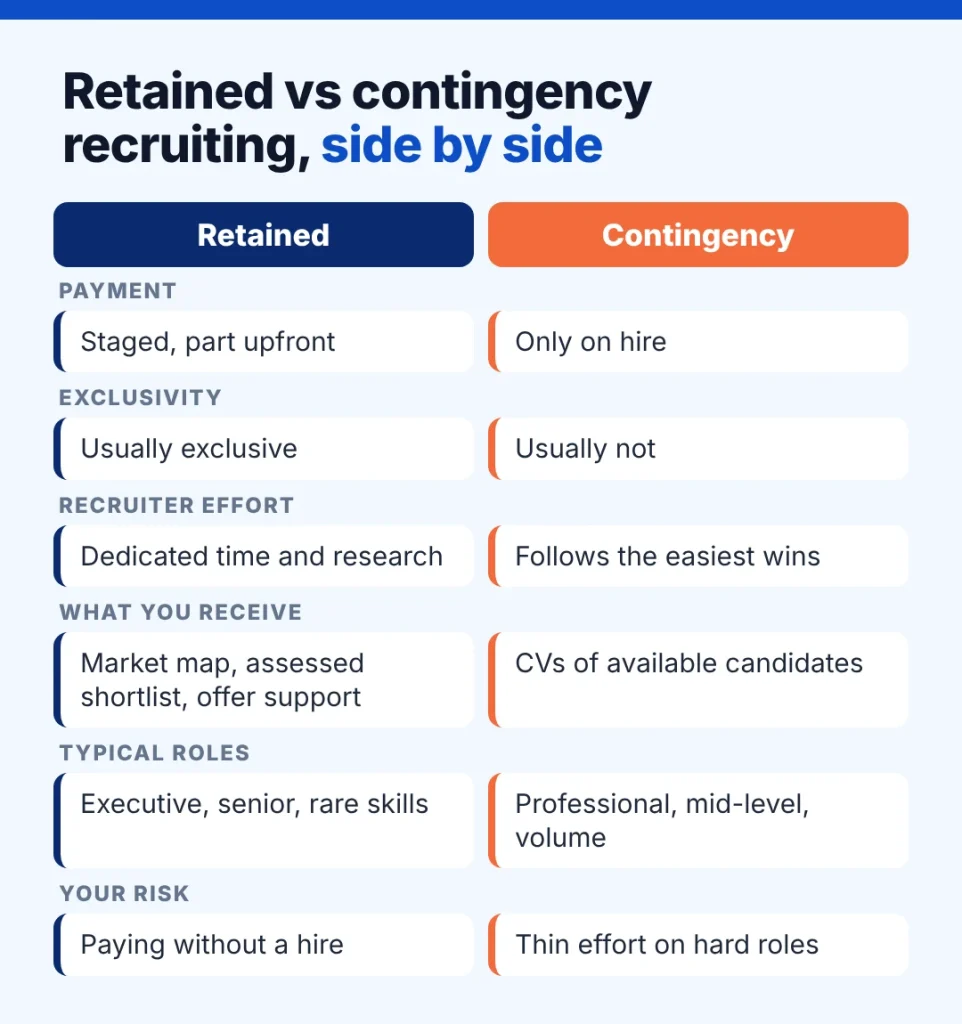
| Retained | Contingency | |
|---|---|---|
| Payment | Staged, part upfront | Only on hire |
| Exclusivity | Usually exclusive | Usually not |
| Recruiter commitment | Dedicated time and research | Effort follows the easiest wins |
| What you receive | Market map, assessed shortlist, offer support | CVs of available candidates |
| Typical roles | Executive, senior, rare skills | Professional, mid-level, high-volume |
| Your main risk | Paying without a hire | Thin effort on hard roles |
What a Retained Search Looks Like in Practice
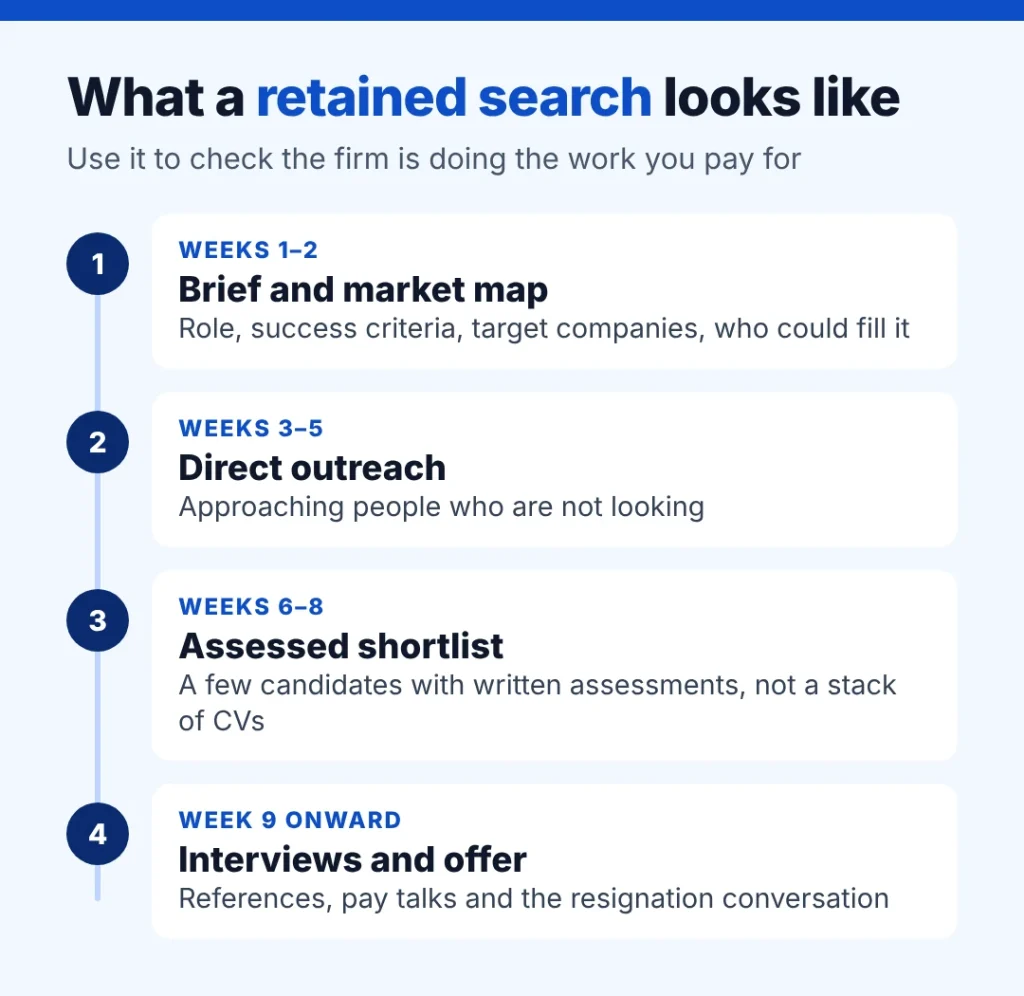
A retained search follows a defined sequence, and knowing it helps you judge whether the firm is doing the work you are paying for.
Weeks one and two: brief and market mapping. The firm agrees on the role, the success criteria, and the target companies, then builds a map of people who could plausibly fill it.
Weeks three to five: outreach. Recruiters approach people directly, most of whom are not looking. This is the part a job advert cannot do.
Weeks six to eight: shortlist and assessment. You receive a small number of candidates, each with a written assessment, rather than a stack of CVs.
Weeks nine onward: interviews and offer. The firm manages references, compensation discussions and the resignation conversation with the candidate’s current employer.
What a Contingency Search Looks Like in Practice
Contingency moves faster at the start. CVs often arrive within days, drawn from the recruiter’s existing database and people actively applying. The volume can be high and the screening lighter, because the recruiter’s incentive is to present someone you might hire before a competing agency does.
That speed is genuinely useful for common roles. It becomes a problem when the right person is not in anyone’s database and has to be found and persuaded.
Signs Your Search Is Not Working
Retained: no market map after two weeks, or a shortlist that looks like candidates you could have found yourself. You are paying for research that is not happening.
Contingency: the same CVs arriving from several agencies, or candidates who clearly do not match the brief. That usually means the role is too hard for the model, and moving to retained or changing approach will save time.
Either model: strong candidates dropping out late. That is often a salary, process speed, or brief problem on your side, not the recruiter’s.
The Deciding Variable: How Scarce Is the Candidate
Ask one question: how many people could actually do this job well, and are they actively looking?
- Rare and not looking. A senior engineering leader, a specialist in a narrow regulated field. Finding them takes research and persuasion. Retained fits, because a contingency recruiter will not invest that time without a guaranteed fee.
- Plentiful and active. Accountants, support staff, many technical and operational roles. Contingency fits, because the work is matching rather than hunting.
- Plentiful, and you can evaluate them yourself. Neither is necessary. Direct access to vetted candidates removes the fee for work you can do.
Whichever route you choose, hiring carries internal cost. ADP’s analysis of hiring costs cites SHRM data putting the average cost to fill a position at $4,129 and 42 days, before any agency fee.
Other Factors That Shift the Choice
Confidentiality. Replacing someone still in the role points to retained, where one firm handles it discreetly.
Volume. Filling ten similar roles points to contingency or a direct platform, not ten retained searches.
Urgency. Contingency agencies with existing networks can move faster on common roles.
Budget certainty. Retained gives a predictable cost; contingency costs you only on success.
Market conditions. In a tight market where good people have options, the persuasion retained firms do becomes more valuable.
Common Mistakes When Choosing
Putting a hard role on contingency with several agencies
It looks like more coverage. In practice, each agency sees a low chance of being paid and puts in minimal effort. You receive whoever happens to be available, not the best person in the market.
Paying retained rates for a plentiful role
If qualified candidates are applying anyway, a retainer pays for research you do not need.
Engaging without a clear brief
Both models fail when the role is vague. A recruiter cannot find the right person if nobody has agreed on what right means.
How the Fees Compare in Practice
On paper, retained looks more expensive because the percentage is higher and part of it is paid before anyone is hired. In practice, the comparison depends on outcome. A retained search that fills a hard senior role well can cost less overall than a contingency search that drags on, produces a mediocre hire, and has to be repeated. A contingency search for a common role, filled in two weeks, is almost always cheaper than a retained search would have been. Judge the fee against the likelihood of getting the right person, not against the percentage alone.
The Hybrid: Container Search
Some firms offer a middle option, sometimes called container or engaged search. You pay a smaller upfront amount to secure commitment, with the balance due on hire. It suits specialist roles where pure contingency gets too little attention and full retained feels excessive.
The Third Route
When the candidate pool is large and you know the role, paying either a retainer or a contingency percentage buys judgement you already have. A low-fee platform gives you access to vetted people and leaves the decision with you. Pavago’s placement is 3% of first-year salary, with free search, messaging and interviews, all on the pricing page.
You can test whether the pool fits your role by browsing the client portal before engaging any recruiter.
If you hire continuously, an in-house option may beat both models. The recruiter role covers dedicated recruiting support.
Related operations roles sit in the wider admin and operations pool.
For the fee side of contingency search, our breakdown of how much recruiters charge covers percentages, guarantees and contract clauses.
Our guide to outsourcing recruitment compares RPO, agencies and platforms.
FLLR Consulting built hiring capability directly rather than relying on retained searches, and the FLLR Consulting case study covers how.
How to Brief Either Kind of Recruiter
Define what success looks like after a year. Outcomes, not a list of duties.
Name the must-haves and the nice-to-haves separately. Long wish lists shrink the pool to nobody.
Share the real salary range. Recruiters cannot close candidates on a number they do not know.
Commit to fast feedback. Slow responses lose good candidates in either model.
More on how a 3% placement fee works is on the Pavago homepage.
Frequently Asked Questions
What is the difference between retained and contingency recruiting?
Retained recruiters are paid in stages for an exclusive search, regardless of outcome. Contingency recruiters are paid only when you hire their candidate.
Which is more expensive?
Retained fees are usually higher as a percentage and partly paid upfront. Contingency is only charged on success, but the percentage still applies to every hire.
When should I use a retained recruiter?
For senior, rare or confidential roles where finding the candidate takes research and persuasion.
Why do contingency recruiters work several clients at once?
Because they are only paid on success, so they spread effort to maximise placements.
Can I use both?
Yes. Many companies use retained search for leadership roles and contingency or direct hiring for everything else.
Pick the route that fits the role
Search the pool free. Messaging and interviews are free. 3% of first-year salary on placement, 60-day replacement.