

You want marketing off your plate, so you start collecting quotes. An agency wants $3,000 a month. A fractional CMO wants $8,000. A remote marketer asks $3,500. Any of them could be the answer, and none of the quotes include what the channel itself needs: the ad budget, the video production, the links that make SEO work.
That’s where most outsourcing decisions go wrong. Agency or hire is the second question. The first is how much you can put behind marketing, and whether any channel is bringing in customers yet. Answer those two and the right setup is usually clear.
Below is what each option gets you, what it really costs, and which one fits where you are, with rates from top-rated marketers on Pavago.
Your options for outsourcing marketing, and what each one gets you
Outsourced marketing means paying someone outside your core staff to run some or all of your marketing. There are four ways to do it. Hiring locally is the last row, as the benchmark.
| Option | What you get | Typical cost | Best for |
|---|---|---|---|
| Agency | A specialist team’s time, shared with their other clients | $1,000–$3,000 minimum retainer per channel, or about 15% of ad spend | Launching one channel you can fund properly |
| Freelancer | One person for a defined job | Priced per job or per hour | One-off work like tracking setup or a batch of video edits |
| Fractional CMO | Senior strategy for 10 to 20 hours a week | $3,000–$15,000 a month | Direction for a team that can already execute |
| Dedicated remote hire | 40 hours a week on your business only | $2,800–$4,500 a month for a top-rated marketing lead | Testing on a tight budget, or scaling channels that work |
| Local hire | The same, in your time zone and in the room | About $13,900 a month at the US median, before benefits | Roles that need someone present, like on-camera video |
Sources: Credo pricing survey of PPC firms; MarketerHire, 2026; US Bureau of Labor Statistics, marketing managers ($166,790 a year, May 2025); Pavago candidate data, October 2026.
The options differ less in price than in what you’re buying. An agency sells expert hours: people who’ve run your channel for many clients, with tools and playbooks already in place. At typical rates of $138 to $185 an hour, a $5,000 retainer buys six to eight of those hours a week, split across your account team. A full-time hire sells focus: about 40 hours a week on your business alone, and the context that builds up over months. Early on, expertise matters more. Once something works, focus usually wins.
When I say “your own team” below, I mean people who work only for you, full-time, wherever they live.
Budget for the channel, not just the people
Every quote above pays for people. The channel needs its own money, and that’s the budget most small businesses forget. A great marketer can’t fix a channel that doesn’t have enough spend to learn.
There’s no standard number for that spend. It depends on your industry, your prices, your offer and how well your ads and pages convert. LocaliQ’s Google Ads benchmarks put the average cost per lead anywhere from about $27 in arts and entertainment to $132 in legal services, and your own results can land far from your industry’s average. So work it out backwards, from what a customer is worth to you:
- Work out what you can afford to pay for a customer. Start with the gross profit a customer brings in over the time they stay. A common rule of thumb is to spend no more than a third of that to win them. If cash is tight, use what a customer brings in during their first few months instead, so the channel pays for itself sooner.
- Turn that into the most you can pay for a lead. Multiply by your close rate. If you can pay $2,000 for a customer and you close one in ten leads, you can afford up to $200 a lead.
- Check what a lead will actually cost. Use the platform’s estimates (Google’s Keyword Planner shows bid ranges for your keywords), an agency’s projection or a small first test. If the estimate is above your limit, the channel doesn’t work for you yet. Pick another one, or improve your close rate first.
- Decide how many leads you need before you judge the channel. Enough that one lucky or bad week doesn’t decide for you. Cost per lead times that number is your monthly ad spend.
- Budget for the learning period. Ad platforms need time and data before they deliver well. Google says its automated bidding can take one to two conversion cycles to settle, and Meta’s guidance is about 50 conversions per ad set in a week before its system finishes learning. Your marketer is learning too: which keywords, audiences and ads work for you. Expect the first month or so to cost more per lead than your estimate, and don’t judge the channel on it. Big changes to budget or targeting can restart the learning, so avoid tinkering every few days.
Then add the people and multiply by the three to six months you’ll give it. That total is your real commitment.
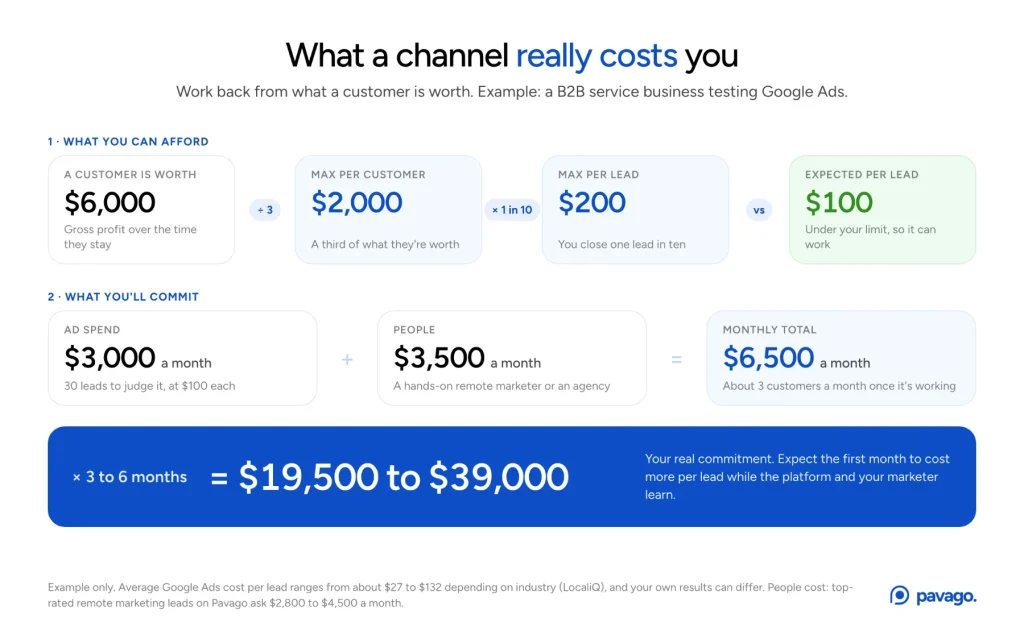
The example shows one more thing. On ad spend alone, each customer costs $1,000, half the $2,000 limit. Add the marketer’s pay and it’s about $2,170, just over it. That’s normal while testing. The people cost stays flat as spend grows, and a hands-on marketer can spread it across more than one channel, so the full cost per customer comes down as a channel scales.
If the total is more than you can afford to lose, don’t run the channel on less. Pick a cheaper channel or test one thing at a time. On paid channels, watch one ratio: if you’re paying more to manage the ads than you spend on them, the channel is underfunded.
Organic isn’t free either. Social needs video, and generic video doesn’t work, so you pay for production and a plan behind it. SEO needs links and press releases on top of content, which I break down in our guide to outsourcing SEO.
Decide what you can put behind the channel before you decide who runs it. Good people improve your odds, but nobody can guarantee a result.
Two questions decide which setup fits you
- Is any channel bringing in paying customers right now?
- Can you fund a paid channel properly, with money you could lose without hurting the business?
| Where you are | What to do |
|---|---|
| No working channel, money to invest | Give one channel to an agency someone you trust has used |
| No working channel, tight budget | Hire one hands-on marketer full-time |
| One channel working | Hire a head of marketing to own it and plan the next one |
| Two or three channels working | Build a team around them, with one specialist per channel |
No working channel, but money to invest: one channel, one referred agency
Pick one channel and go deep. Five channels on a small budget means none of them gets enough money or attention to work. Where you start depends on how you sell:
| Your business | Usually start with | Why |
|---|---|---|
| Consumer brand or e-commerce | Meta or TikTok ads, Google Shopping | Buyers find products in the feed, so creative matters more than keywords |
| Local service business | Google Search and Maps | People search when they need you, and local clicks are cheap enough to test |
| B2B selling to small businesses | Google Search on high-intent terms, or cold email | You reach people already looking for a solution |
| B2B selling to larger companies | LinkedIn, plus outbound to target accounts | Fewer buyers and bigger deals, so you go after specific people |
Then hand that channel to an agency. You’re buying experience. A good agency has launched your channel dozens of times, so it gets you live faster and wastes less of your budget on beginner mistakes.
One condition first: your offer has to convert. If you can’t yet close customers through referrals or your own sales calls, ads just show a weak offer to more people, faster, and you’ll wrongly decide the channel doesn’t work. No agency can fix that.
Agency pricing shows who this route is for. In Credo’s survey, about half of PPC firms set minimum retainers of $1,000 to $3,000 a month, and a common fee is 15% of ad spend. At 15%, a $1,500 fee assumes you’re spending about $10,000 a month. On a $2,000 ad budget, the same fee adds 75% on top. Some agencies charge less for small accounts, but the fee is still a big share of a small budget, and the next route is usually the better one.
How to choose the agency:
- Go by referral. Ask people you trust who’ve had real results with one. A lot of agencies overpromise, and marketing is risky enough without a bad partner.
- Pay what they ask. Haggle a great agency down and you risk getting their junior team. The ones that want you long term will make room for your needs.
- Agree on the number before they start: customer acquisition cost, not impressions or clicks.
No working channel and a tight budget: one hands-on marketer
Without much ad money, you need channels that cost time more than money: cold email, content and SEO, founder-led social and small ad tests. That takes someone who does the work, not someone who plans it for a team you don’t have yet.
| The strategist | The hands-on marketer | |
|---|---|---|
| Strengths | Sets direction, makes the calls, sets the quality bar | Sets direction and does the work across several channels |
| Works best when | There’s a team to execute the plan | Nothing is figured out and the budget is small |
| Struggles when | They have to do the work themselves | The team grows and they need to manage specialists |
Hire the hands-on one. That’s how we found our channels at Pavago. The marketer before me was hands-on with paid ads. When I came in, I ran content, cold email, go-to-market tools, paid ads and SEO myself, so we could test a lot quickly and keep what worked.
This doesn’t break the one-channel rule. One person can test a few cheap channels at small scale to see which gets a response, then put the effort behind the one that does. Running several channels that already work is a different job, and that’s when you need specialists.
A top-rated remote marketing lead asks $2,800 to $4,500 a month on Pavago, so the person plus a small test budget costs less than one local marketing salary. In the interview, ask them to walk you through a campaign they built and ran themselves, not one they managed.
Takeaway: If you can fund a paid channel properly, buy an agency’s experience. If you can’t, hire one person who does the work across cheaper channels until one of them works.
Once channels work, build your own team around them
When marketing brings in revenue on its own, you’re no longer buying experience to get started. You’re trying to get more out of what works, and that takes hours and focus.
Start with a head of marketing, one person who owns the strategy, makes the calls and sets the quality and taste bar. Now that there’s something to manage, the strategist type fits.
Then add one specialist per channel. A lot of founders believe one good marketer can do it all. They can’t. Every channel needs dedicated time and its own skills to get the most out of it.
This is where your own team starts to beat agencies. Compare them at the same budget: $10,000 to $15,000 a month buys six full-time remote marketers, about 240 hours a week, or roughly 12 to 25 agency hours a week. Hours aren’t results, but at this stage the work is testing and improving what already works, and that needs people who know your business and have the time to try things.
Celebrate Dental, a seven-location dental group in Texas, made this switch. They were paying agencies $7,000 to $13,000 a month for paid ads and SEO, and re-explaining context every time an account manager changed. They replaced both with two full-time remote specialists hired through Pavago, and estimate a 40 to 60% cut in fixed marketing costs.
Your own team has costs an agency hides: tools the agency would bring, your time managing people, a few weeks of ramp-up and the risk of a bad hire. Budget for them. Once channels are working, the focus and the context your team keeps usually make up for it.
Grow from one channel into several that feed each other. Early on you can grow on demand capture, reaching people already searching for what you sell. That pool runs out. In B2B, research from the Ehrenberg-Bass Institute, published by LinkedIn’s B2B Institute, suggests only about 5% of buyers are in the market at any time. So if Google Ads is working, add SEO for the long term, a second paid channel (Meta for consumer brands, LinkedIn for B2B), and organic social that gives your ads better creative and gives buyers a reason to remember you.
The SEO side is covered in how to outsource SEO and the social side in how to hire a social media manager. Depending on your niche, video editors may do more for you than a graphic designer.
Keep agencies for skills you don’t have. Outsource a channel only when you lack the expertise and building it isn’t worth your team’s time. At Pavago, we knew Google Ads wasn’t something we’d be best at scaling ourselves, so we gave it to an agency.
Use freelancers for one-off jobs only: marketing automations, Google Tag Manager or server-side tracking, or a batch of video edits when you don’t have an editor. Find them through people you know. For ongoing work like SEO, content or paid ads, the problem is that you’re one of their many clients, so you get their time when they have it. Ongoing work belongs with people who work only for you.
Most of this can be remote. Video is the exception when you need someone in the room. If you find a local head of marketing who’ll make videos with you, keep them local and hire the rest remotely.
Why I’d hire a full-time head over a fractional CMO
A fractional CMO gives you 10 to 20 hours a week of senior thinking for $3,000 to $15,000 a month. A top-rated remote head of marketing asks $2,800 to $4,500 for 40 hours a week. You may give up some seniority, but you get someone in the work every day, testing and executing, which is what most small businesses need. A fractional CMO makes sense when you already have a capable team that only needs direction.
What a dedicated remote marketing team costs
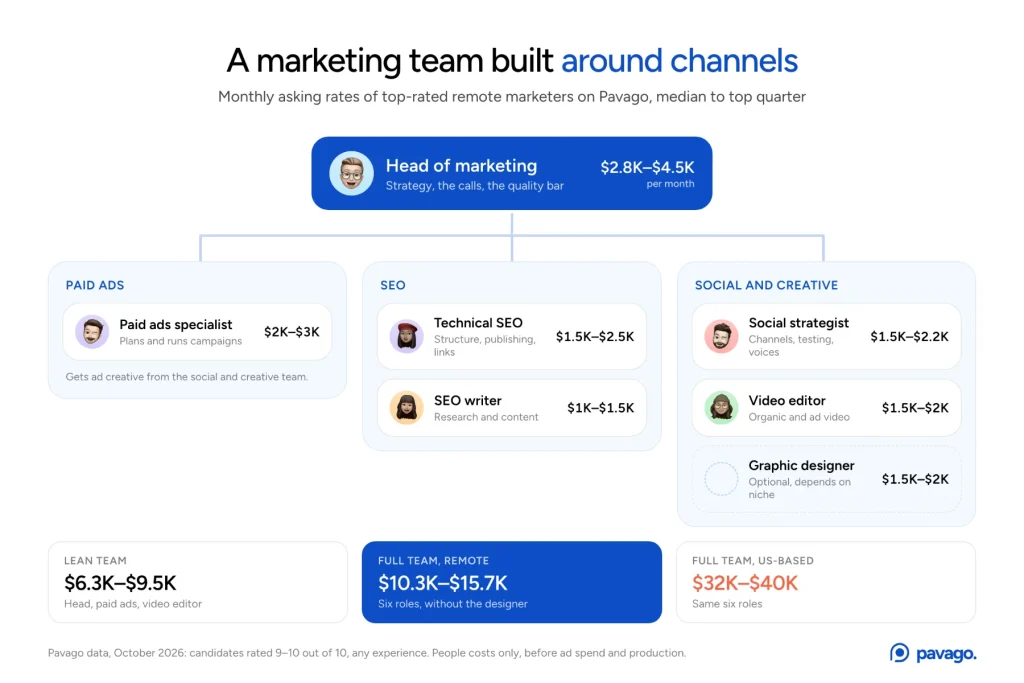
We looked at what top-rated marketers on Pavago ask: almost 2,800 people our system rates 9 or 10 out of 10 for fit with the role, at any experience level. Ranges run from the median to the top quarter.
| Role | Remote, outside the US | US-based, on Pavago |
|---|---|---|
| Head of marketing | $2,800–$4,500 a month | $6,000–$7,750 |
| Paid ads specialist | $2,000–$3,000 | $5,000–$7,400 |
| Technical SEO specialist | $1,500–$2,500 | About $6,150 (small sample) |
| SEO content writer | $1,000–$1,500 | About $5,000 |
| Social media strategist | $1,500–$2,200 | $5,000–$6,150 |
| Video editor | $1,500–$2,000 | $4,800–$5,500 |
| Lean team: head, paid ads, video editor | $6,300–$9,500 | $15,800–$20,600 |
| Full team: all six roles | $10,300–$15,700 | $32,000–$38,000 |
Pavago data: self-reported monthly asking rates of candidates rated 9–10 out of 10 for role fit, October 2026. Rates are negotiable and don’t include Pavago’s fee. US candidates on Pavago ask less than the BLS median, which includes large-company roles.
Two things stood out:
- The best-fit candidates ask almost exactly what everyone else does: a median of $1,800 for those rated 9 or 10, against $1,750 for those rated 8. Price won’t tell you who’s great. Your vetting will.
- The head of marketing is where location matters most. Top-rated heads of marketing ask a median of $3,500 in Latin America, $2,600 in Southeast Asia, $2,500 in Africa and $1,600 in South Asia, against $6,000 in the US and Canada.
For a like-for-like check, take the two channels Celebrate Dental gave to agencies. Covering paid ads and SEO with top-rated remote hires (a paid ads specialist, a technical SEO specialist and a writer), plus a head of marketing to lead them, costs $7,300 to $11,500 a month. They were paying $7,000 to $13,000 for agency hours alone. Add ad spend and production on top either way.
How to tell if it’s working, whoever runs it
Impressions, clicks and likes don’t pay salaries. Before anyone starts, agree to judge marketing on customer acquisition cost, retention (and for e-commerce, how often customers buy again), referrals and revenue by channel.
Cost per lead matters to the person running your ads, but it can mislead you. A $10 lead that ends in a $1,000 customer acquisition cost is worse than a $500 lead that ends in a $500 one. Optimize for good customers, not cheap leads.
Then give it time. You’ll see early signals within weeks, but expect three to six months before a paid channel proves itself. SEO takes longer, often around a year.
Where Pavago fits
If you have no working channel and real money for ads, start with a referred agency. Pavago fits the other routes: hiring a hands-on marketer when the budget is tight, and building the team once channels work.
You can search heads of marketing, paid ads specialists, SEO specialists, writers, social media strategists and video editors from around the world, see their rates, and watch a short intro video before you talk to anyone. Browsing, messaging and interviews are free, and you pay 3% of first-year salary when you hire.
Browse remote digital marketing managers, performance marketers and video editors on Pavago.
Going the agency route for now? Start with our list of B2B marketing outsourcing companies.
FAQ
What does outsourced marketing do?
It hands some or all of your marketing, like strategy, paid ads, SEO, content or social, to people outside your core staff. That can be an agency, a freelancer, a fractional CMO or a dedicated remote team.
How much does it cost to outsource marketing?
Agency retainers commonly start at $1,000 to $3,000 a month per channel, and a fractional CMO runs $3,000 to $15,000 a month. A top-rated remote head of marketing asks $2,800 to $4,500 a month on Pavago. Budget for ad spend and production on top.
What is an outsourced CMO?
An outsourced or fractional CMO is a senior marketer who works with you part-time, usually 10 to 20 hours a week, for $3,000 to $15,000 a month. They set strategy but rarely do the work, so they suit businesses that already have a capable team. A full-time remote head of marketing often costs less.
Should a small business outsource marketing or hire in-house?
Use a referred agency to launch your first paid channel if you can fund it properly. Hire your own people, local or remote, when budget is tight and you need someone hands-on, or when two or three channels are working and you want to scale them.
Your next step
Write down two answers: which channel brought in paying customers in the last 90 days, and how much you could spend on marketing over the next six months and lose without hurting the business. Find your row in the two-question table and make that one move first.