

What Direct Hire Recruiting Means
A recruiter or platform finds a candidate, you hire them as your own employee or direct contractor, and you pay a one-time placement fee. There is no ongoing margin and no agency between you and the person once they start. They work for you, report to you, and are paid by you.
The term exists mainly to distinguish it from staffing arrangements where the agency stays involved. If you have only ever hired directly, it can sound redundant. If you have used temp or contract staffing, the distinction is the whole point.
How Direct Hire Differs From the Alternatives
| Model | Who employs the worker | How you pay | When it fits |
|---|---|---|---|
| Direct hire | You | One placement fee | Permanent roles |
| Temporary staffing | The agency | Hourly markup for the whole assignment | Short-term or seasonal work |
| Contract to hire | The agency, then you | Markup during trial, then often a conversion fee | Uncertain roles needing a trial |
| Co-employment (PEO) | Shared | Per-employee fee | Outsourcing HR administration |
| RPO | You | Retainer or per-hire for an outsourced recruiting function | Continuous, high-volume hiring |
Co-employment is a separate structure entirely. NAPEO’s overview of PEOs explains how a professional employer organisation shares employer responsibilities with you, which is about HR administration rather than how you find people.
How a Direct Hire Search Works
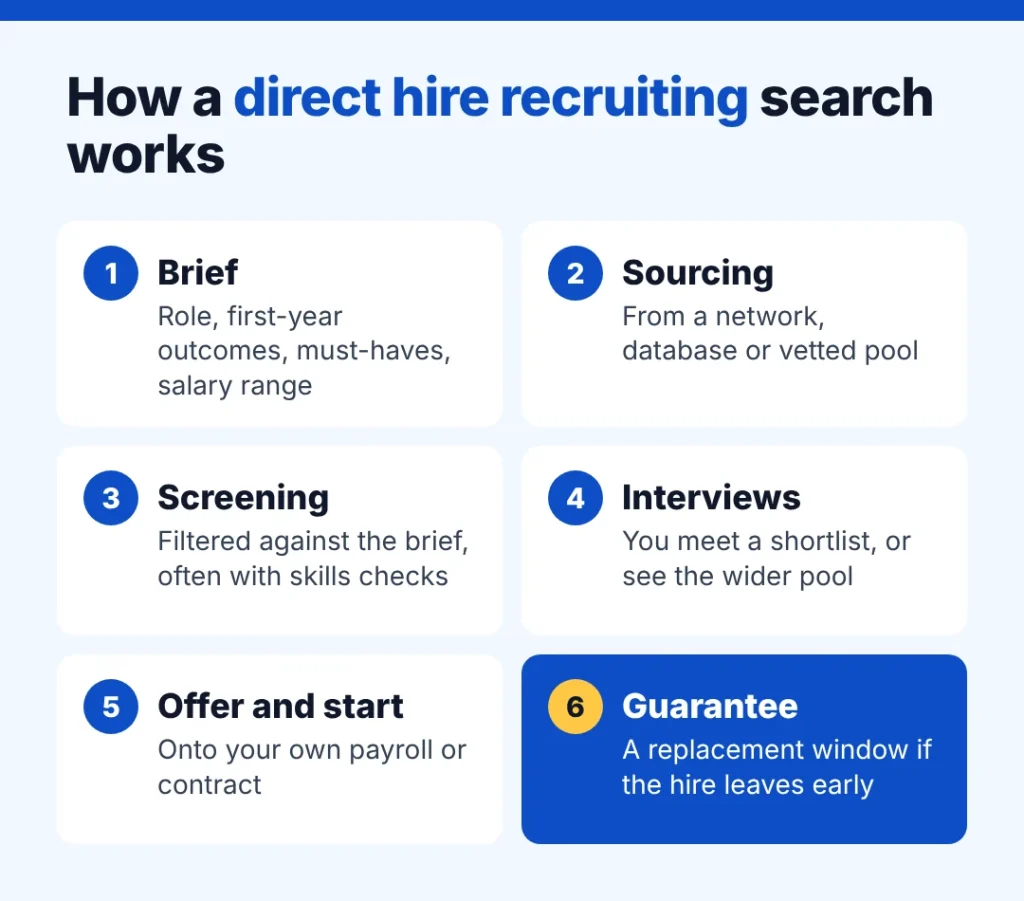
Brief. You agree the role, the outcomes expected in the first year, must-have skills and the salary range.
Sourcing. The recruiter or platform draws candidates from its network, database or vetted pool.
Screening. Candidates are filtered against the brief, often with skills checks or assessments.
Interviews. You meet a shortlist and decide. On some platforms you see the wider pool rather than only a shortlist.
Offer and start. You make the offer and onboard the person onto your own payroll or contract.
Guarantee. If the hire leaves early, a replacement window usually applies.
How Direct Hire Is Priced
Direct hire fees come in two main shapes. Traditional agencies usually charge a percentage of first-year salary, which means the fee rises with the salary. Some platforms and specialist recruiters charge a flat fee or a much smaller percentage, which keeps the cost low as roles get more senior.
Our breakdown of how much recruiters charge covers percentages, guarantees and contract clauses in detail.
Pavago’s model is direct hire with a low fee: searching, messaging and interviews are free, and placement is 3% of first-year salary, with a 60-day replacement window. The terms are on the pricing page.
Where the Threshold Sits
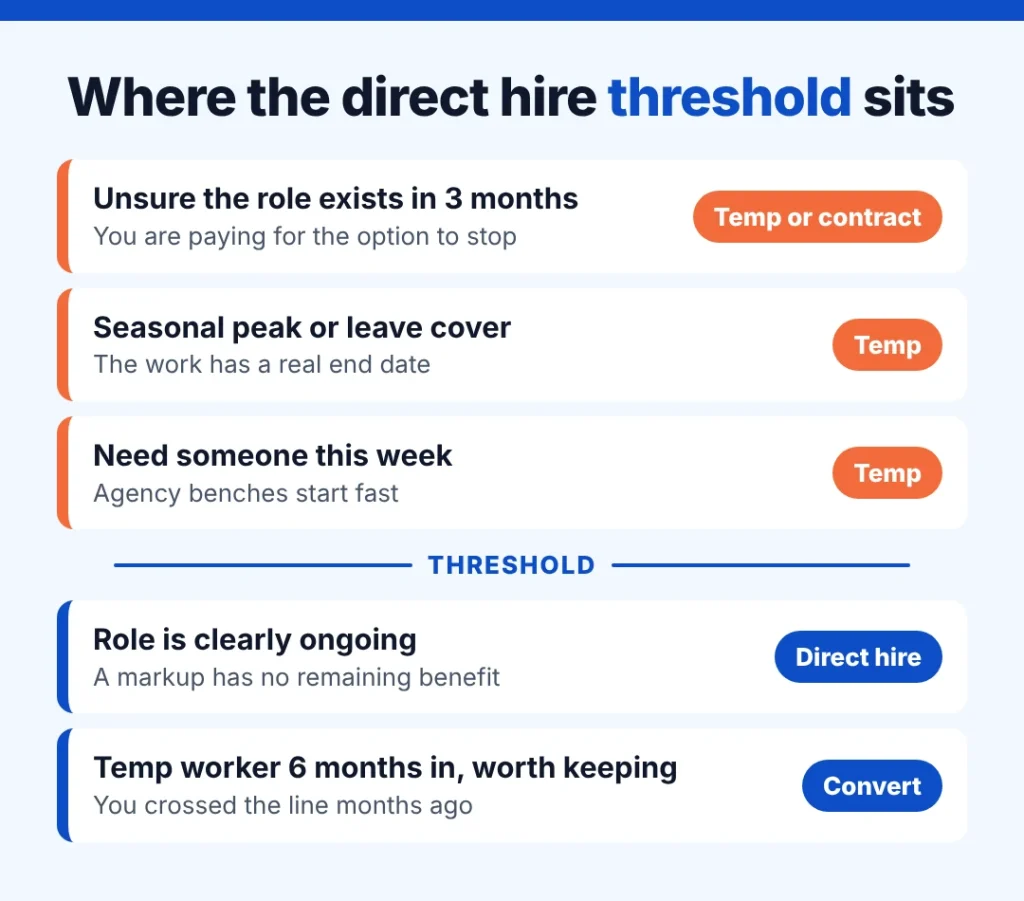
| Your situation | Better fit | Why |
|---|---|---|
| Unsure the role will exist in three months | Temporary or contract | You are paying for the option to stop |
| Seasonal peak or cover for leave | Temporary | The work has a real end date |
| Need someone this week, no time to recruit | Temporary | Agencies with benches start fast |
| Role is clearly ongoing | Direct hire | An ongoing markup has no remaining benefit |
| Temp worker has been there six months and you want to keep them | Direct hire, via conversion | You crossed the threshold months ago |
The Extension Trap
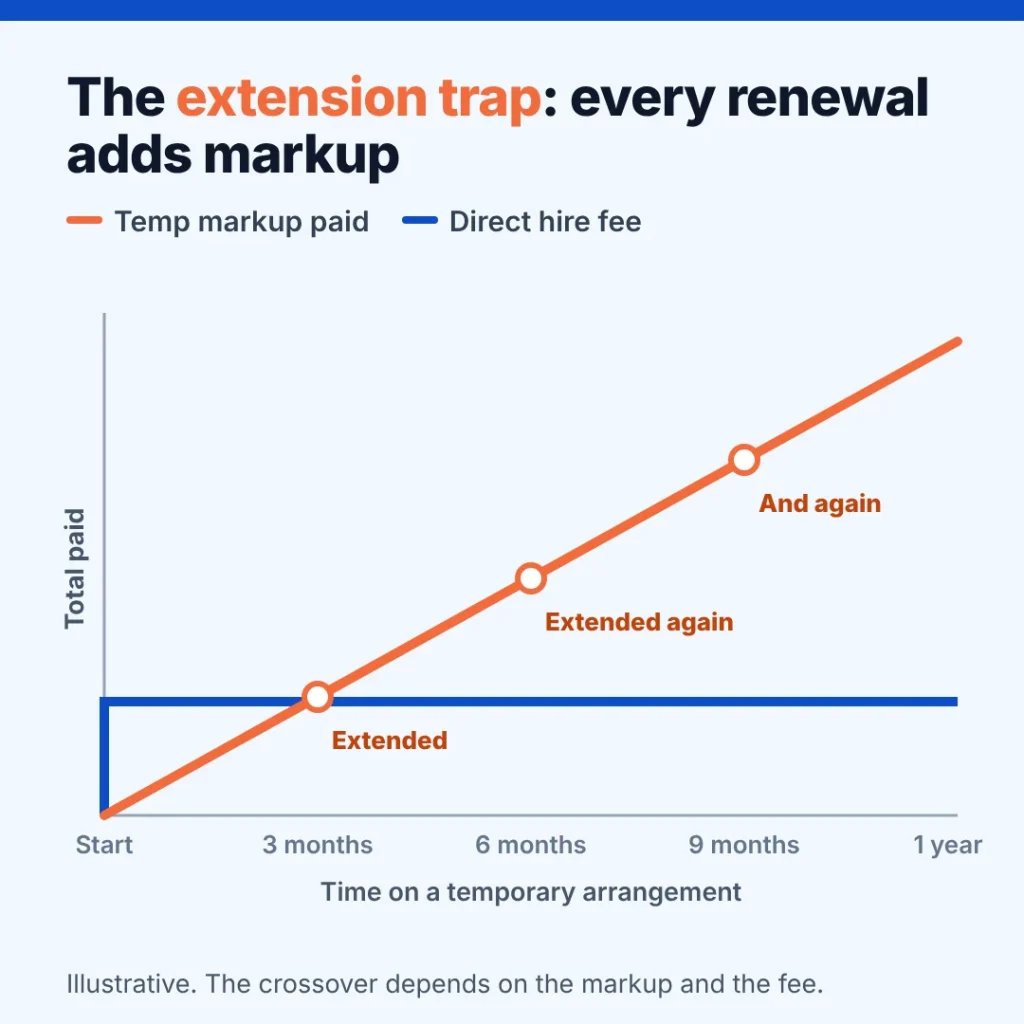
The last row in that table is the common one, and it rarely feels like a decision. A three-month contract is extended because a project runs long. It is extended again because the person has become useful. Each extension is small and reasonable on its own. Nobody adds up the total markup paid across a year or more, and by the time someone does, it has exceeded what a placement fee would have cost several times over.
Our explanation of how staffing agencies make money shows exactly where that markup goes.
What Direct Hire Gets You Beyond Cost
- Better candidates. People in stable jobs rarely leave for temporary work, so a permanent offer reaches a wider pool.
- Commitment both ways. A direct hire invests in learning your business because they expect to stay.
- Simpler management. One relationship, not a worker plus an agency account manager.
- Knowledge that stays. Process knowledge builds inside your team instead of leaving when an assignment ends.
The Risks, and How to Reduce Them
Direct hire is not risk-free. The main risk is hiring the wrong person with no trial period built in. It can be reduced substantially.
Use a paid trial task before the offer. A few hours of real work tells you most of what a three-month contract would.
Write a 60-day plan. Clear early goals make a mismatch obvious and fixable rather than slow and ambiguous.
Check the replacement terms. Know what triggers it and whether fault has to be proved.
Onboard properly. Many early departures come from poor onboarding rather than a bad hire.
Our comparison of contract to hire and direct hire covers the trial-period question in more depth.
Direct Hire for Remote and International Roles
Direct hire is not limited to people who live near your office. Many companies now hire remote professionals in other countries directly, usually as contractors engaged under the worker’s local law.
The structure stays the same: one placement fee, then the person works for you. What changes is the practical detail. You need a contractor agreement suited to cross-border work, a way to pay in the worker’s currency or through an international payment service, and enough timezone overlap for the role to function. None of these is a barrier, but each needs deciding before the offer rather than after.
The cost case is often stronger internationally, because a 15–30% fee on a domestic salary is replaced by a small fee on a role that can be filled from a much wider pool.
How Long a Direct Hire Search Takes
For common professional roles, a direct hire search through a platform or contingency recruiter can produce candidates within days and a hire within a few weeks. Senior and specialist roles take longer, often several weeks of sourcing before a shortlist exists.
The biggest delays are usually on the hiring side: slow feedback, a vague brief, or a salary range that does not match the market. Fixing those shortens almost any search more than changing recruiters does.
Questions to Ask Before Starting a Search
Is this role genuinely permanent? If the answer is not clearly yes, a temporary arrangement may be the honest choice.
Can we evaluate candidates ourselves? If yes, a low-fee platform may be enough. If not, pay for judgement.
What does success look like at twelve months? Write it down before the first interview.
Who owns onboarding? A good hire with poor onboarding often leaves within the guarantee period.
What to Look For in a Direct Hire Partner
A clear fee in dollars. Percentage or flat, stated before the search starts.
A real replacement guarantee. Long enough to cover the period when problems actually appear.
Visibility of the candidate pool. Seeing beyond a shortlist helps you judge whether you are getting the best options or simply the fastest.
Speed to first candidates. A direct hire process should not take months for a common role.
You can browse candidates in the client portal before committing.
For international searches, our guide to offshore recruitment services compares delegated search with self-directed hiring.
OPW Commercial Services made a direct hire for a client-facing role, and the OPW case study covers how it was structured.
If you plan to run direct hiring yourself, the recruiter role covers in-house recruiting support.
Related operations roles sit in the wider admin and operations pool.
More about the model is on the Pavago homepage.
Frequently Asked Questions
What is direct hire recruiting?
A placement where the candidate joins your payroll or contract directly from day one, with a one-time fee paid to the recruiter or platform.
How is direct hire different from temp staffing?
Temp staffing keeps the worker employed by the agency, which bills you an hourly markup for the whole assignment. Direct hire is a single fee and the person works for you.
How much does direct hire recruiting cost?
Agencies commonly charge 15–30% of first-year salary. Platforms charge far less: Pavago takes 3%.
When should I use direct hire instead of temp?
When the role is clearly permanent. Temporary staffing suits uncertain, seasonal or urgent needs.
Is there a guarantee with direct hire?
Most providers offer a replacement window if the hire leaves early. Terms vary, so check what triggers it.
Hire directly once the role is real
Search the pool free. Messaging and interviews are free. 3% of first-year salary on placement, 60-day replacement.