

Why the Published Numbers Skew Low
Not because anyone is misleading you. Because of where the data comes from.
Freelance marketplaces publish rates publicly. Profiles show hourly figures, job posts show budgets, and all of it is scrapeable. So rate guides are built from marketplace data, because marketplace data is the data that exists.
The problem is what marketplace pricing is. It is a bidding mechanism. Multiple providers compete on the same posted job, and the structural pressure on price is downward. That is the design, not a flaw. A rate derived from that environment describes the floor of the cheapest market, not the value of the work.
Then there is the platform cut on top. A commission taken from what you earn means the published rate and what you receive are different numbers, and guides rarely distinguish them.
The Three Markets
| Marketplace bidding | Direct hire | Specialist | |
|---|---|---|---|
| How price is set | Competitive bidding against a global pool | Negotiated once, then fixed monthly | Scarcity of the specific skill |
| Direction of pressure | Downward. Someone always bids lower. | Stable. Set relative to the role. | Upward, where the skill is rare |
| Platform cut | Typically a percentage of earnings | None on a direct-hire platform | None |
| Engagement | Project by project, gaps unpaid | Ongoing monthly | Ongoing or retained |
| What determines your rate | What others will accept | The role and your evidence | Your specific capability |
| Where guides get data | Here, almost entirely | Rarely published | Almost never published |
Read the last row. The two markets paying more are the two with no public rate data, which is exactly why published guides describe the lowest one. Absence of data is being read as absence of market. We break down how much virtual assistants make in each of those markets separately.
What Actually Moves Your Rate
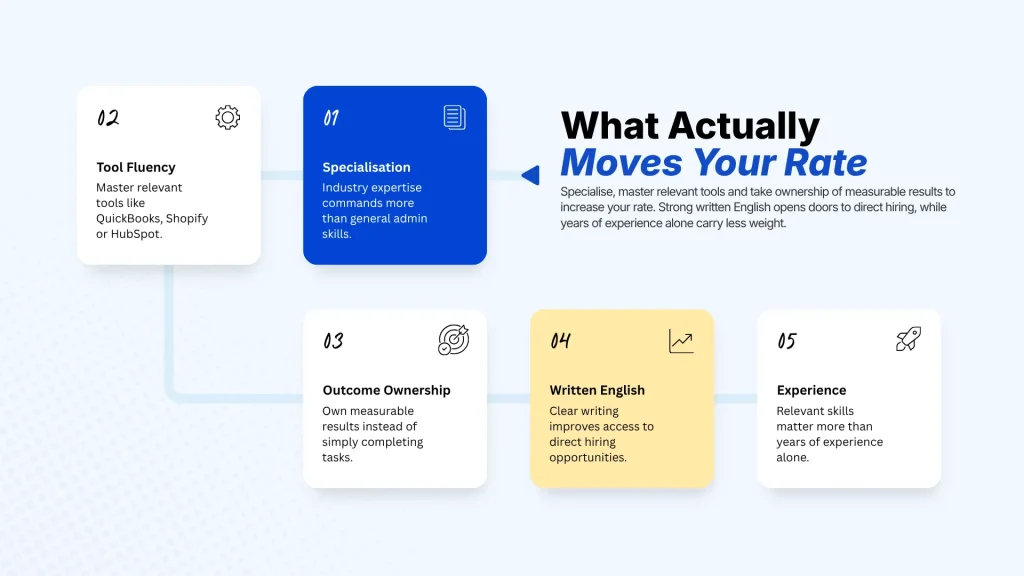
Within any of the three, the variables are narrower than general advice suggests and mostly acquirable.
- Specialisation over general admin. Real estate, ecommerce, insurance, legal and healthcare admin all price above general VA work, because each carries workflows that general experience does not cover.
- Named tool fluency. QuickBooks, Xero, Shopify, Zendesk, HubSpot. Certifications for most are free and take days. This is the fastest available move.
- Owning an outcome rather than a task list. Someone who manages the inbox is priced differently from someone who owns inbox response time and is measured on it.
- Written English. Assessed constantly and involuntarily from first contact. It gates access to the direct-hire market more than any certification does.
- Years of experience. Matters, and less than the four above. Experience inside the marketplace does not transfer into a better rate elsewhere.
The pattern is that market selection outranks seniority. Moving markets does more for your rate than another year in the one you are in. Our guide to virtual assistant skills covers which of these employers can verify before hiring.
How to Set a Rate Without a Published Benchmark
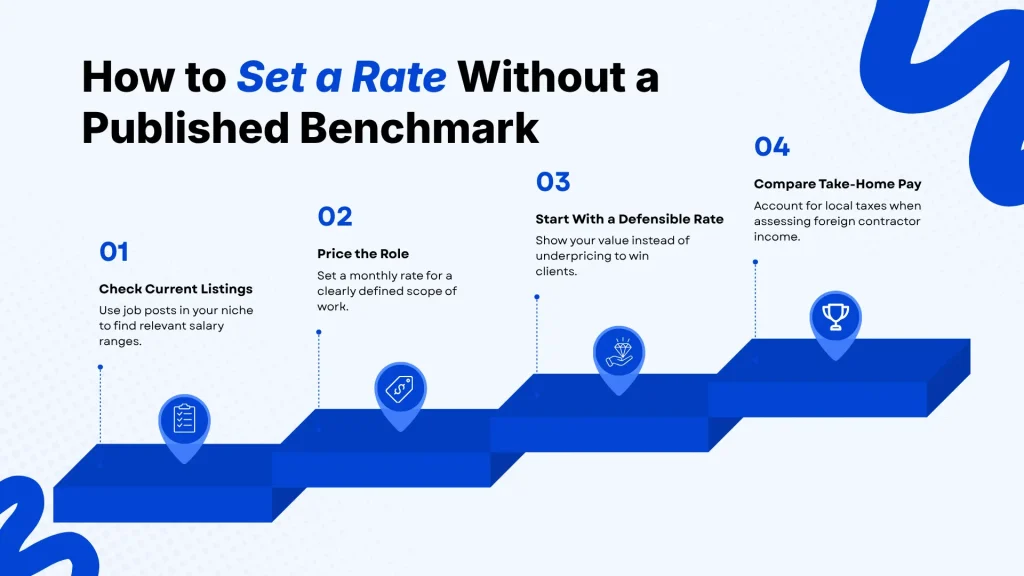
If the public data describes the wrong market, you need a different method.
Work from the listings, not the guides. Read current job posts for your niche. Many state a range. That range is the direct-hire market, and it is more accurate for your purposes than any aggregated figure.
Price the role, not your hours. A monthly rate for owning a defined scope is a different negotiation from an hourly rate for availability, and it is usually a better one.
Do not anchor low to win the first client. It sets a number you then have to negotiate up from, which is harder than starting at a defensible one. Specificity about what you do wins work more reliably than price does.
Compare gross against your local net. Most cross-border arrangements are contractor relationships where you receive gross and handle tax locally. Comparing a foreign gross to your local gross overstates the gap.
Reading live listings is the most reliable research available, because it describes the market you are actually entering. You can see current roles and what they ask for on the candidate portal.
Why the Direct-Hire Rate Exists At All
It is reasonable to ask why a company would pay above the marketplace floor when the floor exists. The answer is that they are not comparing against the marketplace. They are comparing against hiring domestically, and that gap is much larger.
Employer costs sit well above salary. According to the U.S. Bureau of Labor Statistics, benefits account for roughly 30 percent of total employer compensation costs. A company hiring remotely can pay meaningfully above the marketplace floor and still land far below their domestic alternative.
That is the mechanism. Two cost structures meeting somewhere that neither market’s published average describes. It is also why the rate is negotiable in a way a bid is not.
Where the Markets Are
Freelance marketplaces have the most volume and the most downward pressure, which makes them a reasonable place to build an initial track record and a poor place to stay. General job boards rarely filter for international candidates. Talent platforms vet once and make you visible to companies hiring specifically for remote roles.
Pavago is free for candidates permanently, and you keep your full rate, with nothing deducted from what the company pays you. Browse open roles, or your region: South Asia, Southeast Asia, Africa, LATAM, Europe. You can also search by country: Pakistan, India, Bangladesh or Sri Lanka.
If you are earlier and still building evidence, our guide to getting clients as a virtual assistant covers the sequence before rate becomes the question.
Frequently Asked Questions
What are typical virtual assistant rates?
Published figures are aggregated almost entirely from freelance marketplaces, where pricing is set by competitive bidding and pushed downward by design. That describes one market of at least three, and it is the lowest. Direct-hire and specialist rates are rarely published, which is why guides do not include them.
Why do VA rates vary so much?
Because the figures come from markets that do not overlap. Marketplace bidding, direct hire by a company, and specialist engagements set prices by entirely different mechanisms. Averaging them produces a number describing none of them.
Should I charge hourly or monthly?
Monthly for ongoing scope, hourly for defined short tasks. A monthly rate for owning an outcome is a different negotiation from an hourly rate for availability, and it is usually the better one for both sides.
How do I raise my rate?
Specialise in an industry, add named tool certifications, and move from owning tasks to owning an outcome. Changing which market you are in does more than another year of experience within the same one.
Should I lower my rate to win my first client?
No. It sets an anchor you then have to negotiate up from. Specificity about what you do and one piece of documented work win work more reliably than a lower number does.
Price against the right market
Free for candidates, always. You keep your full rate, with nothing deducted from what the company pays you. Companies search the pool and message you directly.