

The Main Fee Structures
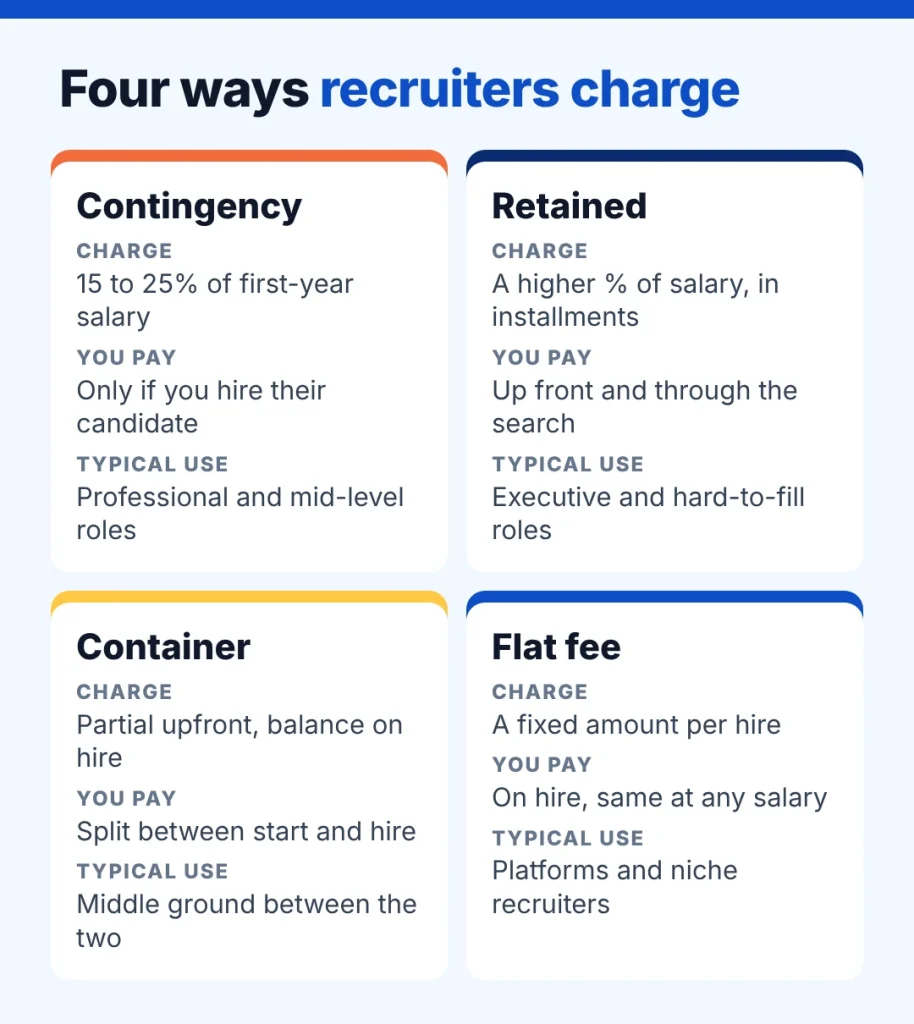
| Model | How it is charged | When you pay | Typical use |
|---|---|---|---|
| Contingency | Percentage of first-year salary, commonly 15 to 25 percent | Only if you hire their candidate | Most professional and mid-level roles |
| Retained | Percentage of first-year salary, commonly higher, paid in installments | Up front and through the search | Executive and hard-to-fill senior roles |
| Container or engaged | Partial upfront payment, balance on hire | Split | Middle ground between the two |
| Flat fee | A fixed amount per hire | On hire | Platforms and some niche recruiters |
The ranges above are commonly cited across the industry rather than fixed rules. Fees move with role difficulty, seniority, location and how badly the agency wants the account.
Typical Fees by Role Level
Percentages tend to rise with seniority, because senior searches have smaller pools and take longer. These are commonly quoted ranges, not fixed rules.
| Role level | Common fee model | Commonly quoted fee |
|---|---|---|
| Entry-level and administrative | Contingency or flat fee | The low end of the contingency range, or a fixed amount |
| Mid-level professional | Contingency | 15 to 25 percent of first-year salary |
| Senior specialist, such as engineering, finance or sales leadership | Contingency or container | 20 to 30 percent |
| Executive | Retained search | Often around one-third of first-year cash compensation |
Check what “salary” means in the contract. Some agreements calculate the fee on base pay only. Others include signing or guaranteed bonuses, which can add thousands to the fee.
Hourly, Project and RPO Pricing
Not every recruiter charges per hire. Some sell part of the process, such as sourcing a shortlist or running first-round screens, for an hourly rate or a fixed project fee.
Companies hiring in volume often use recruitment process outsourcing, or RPO, where a provider runs part or all of your hiring for a monthly fee. Once you are filling many roles a year, that can work out cheaper per hire. Our list of RPO companies compares providers.
What the Percentage Leaves Out
The fee rises with salary, the work does not
A recruiter filling a $45,000 role and a $75,000 role often runs the same sourcing, the same screening and the same number of interviews. At 20 percent, the second fee is $6,000 higher for comparable work. Hiring a stronger candidate costs you more for that reason alone.
Your internal hiring cost still exists
A recruiter fee is added to what hiring already costs you in time. G2’s cost-per-hire analysis tracks SHRM’s average cost per hire at $4,700 as of 2023. Interviews, coordination and onboarding do not disappear because an agency found the candidate.
The guarantee is shorter than the risk
Most contingency agreements offer a replacement or partial refund if the hire leaves within 30 to 90 days, often only if the departure is not caused by the employer. Problems that surface in month four are yours. Read what voids the guarantee before anything else in the contract.
Off-limits and buyout clauses
Some agreements restrict hiring other candidates the agency introduced for a set period, or charge a fee if you later hire someone they presented. These clauses are standard and rarely discussed in the sales conversation.
What It Looks Like on Real Numbers
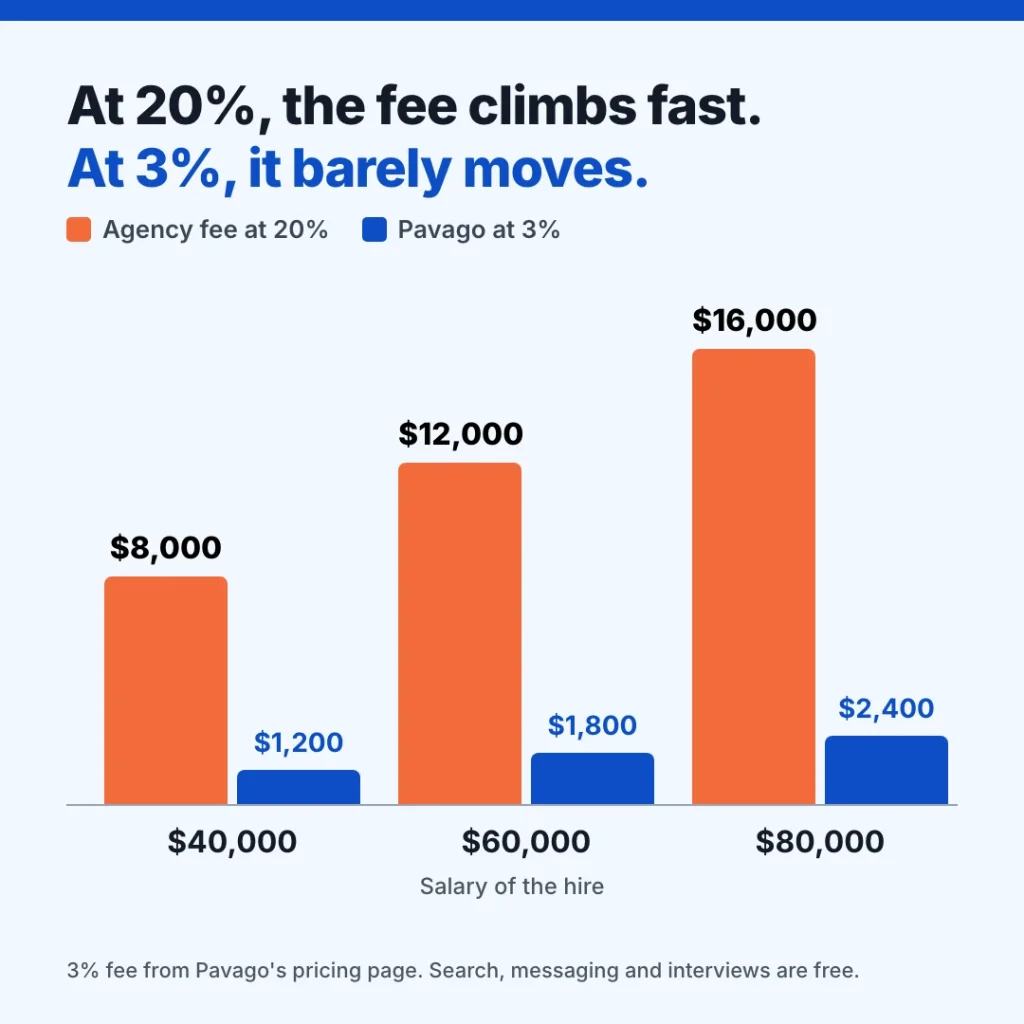
Pavago’s own pricing page uses a simple comparison: a recruitment agency at 20 percent of a $40,000 salary is $8,000, against Pavago’s 3%, which is $1,200. At a higher salary the gap widens, because 20 percent grows much faster than 3 percent.
| Salary of the hire | Fee at 20 percent | Pavago at 3 percent |
|---|---|---|
| $40,000 | $8,000 | $1,200 |
| $60,000 | $12,000 | $1,800 |
| $80,000 | $16,000 | $2,400 |
The full structure, including free search, messaging and interviews and the 60-day replacement window, is on the pricing page.
When the Percentage Is Worth Paying
- Senior or executive roles. Smaller candidate pools and harder searches justify the fee.
- Roles you cannot evaluate yourself. If you cannot tell a strong candidate from a plausible one, you are paying for judgement.
- Confidential replacements. Replacing someone still in the role cannot be done through an open search.
- Deep niche networks. Some recruiters sell access to people who are not looking.
Outside those, you are often paying a percentage for matching work you could do with direct access to vetted candidates. Our guide to outsourcing recruitment compares the models in more depth.
What Recruiters Charge for Offshore Hires
The percentage model works the same way for international hires. Lower salaries make the fee smaller in dollars, but it is still a percentage. Some offshore agencies skip the placement fee and instead add a monthly markup to the worker’s salary for as long as they work for you, the same time-based cost explained in our breakdown of how staffing agencies make money.
To compare offshore options fairly, add up each one’s total cost over the first two years. Our comparison of offshore recruitment services walks through the models side by side.
Questions to Ask Before You Sign
What is the fee in dollars for this role? A specific number, not a range.
Does the fee change if I hire above the planned salary? With a percentage, it does.
What voids the guarantee? Ask for the exact clause.
Are there off-limits or buyout terms? Find them before the first candidate arrives.
If you want to compare the alternative before talking to an agency, you can browse vetted candidates on Pavago.
Full profiles open in the client portal once you are ready to message.
For building recruiting capability in-house instead, the recruiter role covers dedicated recruiters.
Adjacent roles sit in the wider admin and operations pool.
Tenant Planet hired directly rather than through a percentage-fee agency, and the Tenant Planet case study covers how the placement worked.
For the same fee logic applied to finance roles, our look at accounting staffing agency costs runs the numbers over three years.
Frequently Asked Questions
How much do recruiters charge per hire?
Contingency recruiters commonly charge 15 to 25 percent of first-year salary, payable on hire. Retained search for senior roles is typically higher and paid in installments. Flat-fee models charge a fixed amount regardless of salary.
Who pays the recruiter, the employer or the candidate?
In legitimate agency recruiting, the employer pays. Candidates should not be charged a placement fee.
Is a recruiter fee negotiable?
Often, especially for multiple hires or ongoing relationships. Agencies may lower the percentage, extend the guarantee or move to a flat fee.
What happens if the hire leaves early?
Most agreements offer a replacement or partial refund within a guarantee period, commonly 30 to 90 days, with conditions. Read what voids it before signing.
Is a low percentage or flat fee cheaper than a recruiter’s 20 percent?
At most salary levels, yes, and the gap grows as salary rises. On a $60,000 hire, 20 percent is $12,000; Pavago’s 3 percent is $1,800.
What is a typical executive search fee?
Retained executive search commonly costs around one-third of the hire’s first-year cash compensation, usually paid in installments during the search. Terms vary by firm.
Is a recruiter fee based on base salary or total compensation?
It depends on the agreement. Many contracts use first-year base salary, but some include signing or guaranteed bonuses. Check the definition before signing.
Compare the fee before you sign
Search vetted candidates free. Messaging and interviews are free. 3% of first-year salary on placement, 60-day replacement.