

The Two Revenue Models
| Temporary or contract staffing | Direct hire or permanent placement | |
|---|---|---|
| How they earn | Bill rate minus pay rate, every hour | One-time fee on hire |
| How long it lasts | As long as the assignment runs | Once |
| Typical structure | Markup on the worker’s hourly pay | Percentage of first-year salary, or flat |
| Who employs the worker | The agency | You |
How the Markup Works
On a contract assignment, the agency pays the worker an hourly wage. It then bills you a higher hourly rate. The gap between the two covers three things.
- Employer costs. Payroll taxes, workers’ compensation, unemployment insurance, and any benefits the agency provides as the legal employer.
- Overhead. Recruiters, account managers, payroll processing, compliance.
- Profit. What is left after the first two.
Employer costs are substantial on their own. The U.S. Bureau of Labor Statistics reports that benefits make up roughly 30 percent of total employer compensation costs, which explains why markups are much higher than the profit an agency actually keeps.
A Bill Rate, Line by Line
Here is a simplified example for an office role. It is illustrative, because tax rates and insurance costs vary by state and job type.
| What the bill rate covers | Per hour |
|---|---|
| Worker’s pay | $25.00 |
| Social Security and Medicare, 7.65 percent | $1.91 |
| Federal and state unemployment insurance, varies by state | about $0.60 |
| Workers’ compensation insurance, low for office work | about $0.30 |
| Agency’s gross profit | about $12.19 |
| Bill rate to you, a 60 percent markup | $40.00 |
Of the $15 gap between pay rate and bill rate, about $2.81 is employer cost. The other $12 or so is the agency’s gross profit, roughly 30 percent of the bill rate. Recruiter commissions, sales, payroll staff and offices all come out of that before anything counts as net profit.
Over a full-time year of about 2,080 hours, that $15 gap adds up to around $31,200 for one worker. That is the number to set against a one-time placement fee.
Why the Markup Surprises Buyers
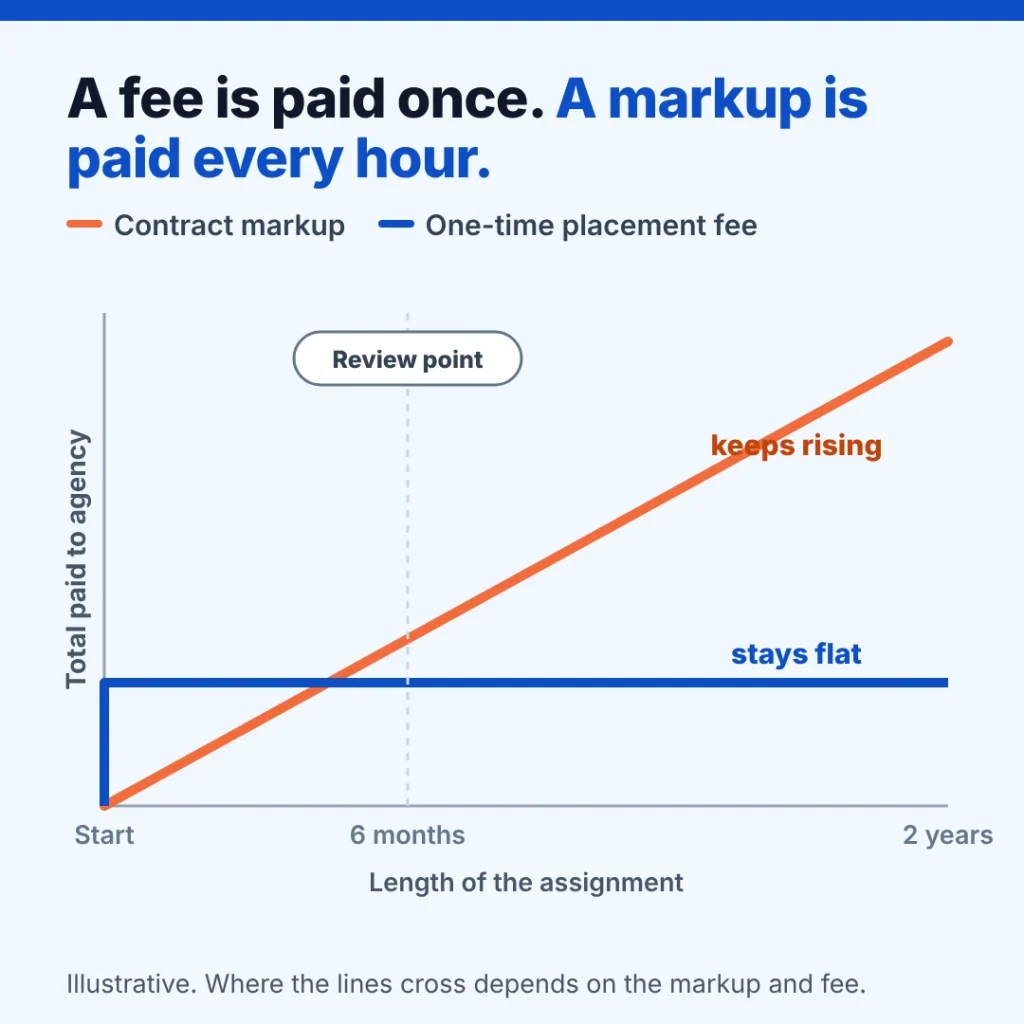
The correction worth making: the markup is not a fee. It is a rate, and rates compound with time.
A three-month assignment at a modest markup is reasonable for flexibility. The same worker kept on through the agency for two years means paying that margin on every hour for two years. Nobody signs up for that deliberately. It happens because the assignment keeps getting extended and nobody re-runs the numbers.
Pavago’s pricing page puts staff augmentation at $8,000 to $15,000 a month for as long as someone is embedded, against a one-time placement fee of 3% of first-year salary. The difference is entirely about the time dimension.
What Moves the Markup Up or Down
| Factor | Effect on the markup |
|---|---|
| Workers’ compensation risk | Higher for warehouse, construction and industrial roles, lower for office work |
| Skill scarcity | Higher for hard-to-fill specialist IT, engineering and healthcare roles |
| Benefits the agency provides | Higher if the agency offers health cover or paid time off |
| Volume and length | Lower for large contracts and long assignments, which agencies discount to win |
| Who found the worker | Much lower for payrolling, where you bring the worker and the agency only employs them |
With this many variables, a single “typical markup” figure is not much use. The better habit is to ask for the pay rate and do the subtraction yourself.
Other Ways Agencies Earn
Hourly markups and placement fees are the bulk of it, but most agencies have other revenue lines.
- Conversion fees. Charged when you move a contract worker onto your own payroll early.
- Payrolling. You recruit the person, and the agency employs and pays them for a smaller markup. Often used to avoid setting up payroll in a new state.
- Managed services. Large employers pay a fee for the agency to run their whole contingent workforce, including other suppliers.
- Recruitment process outsourcing. A monthly or per-hire fee to run your permanent hiring. Our guide to recruitment process outsourcing explains the model.
How Profitable Is a Staffing Agency?
Less than the markup suggests. Gross margin is what remains after the worker’s pay and employer costs, and it has to cover the entire business. Large publicly listed staffing companies typically report net profit margins in the single digits.
Profit grows with hours billed, so agencies prefer long assignments to short ones. That is why extensions are easy to arrange and conversions usually carry a fee. It is also a reason to set your own review point rather than letting an assignment renew by default.
What Buyers Should Do With This
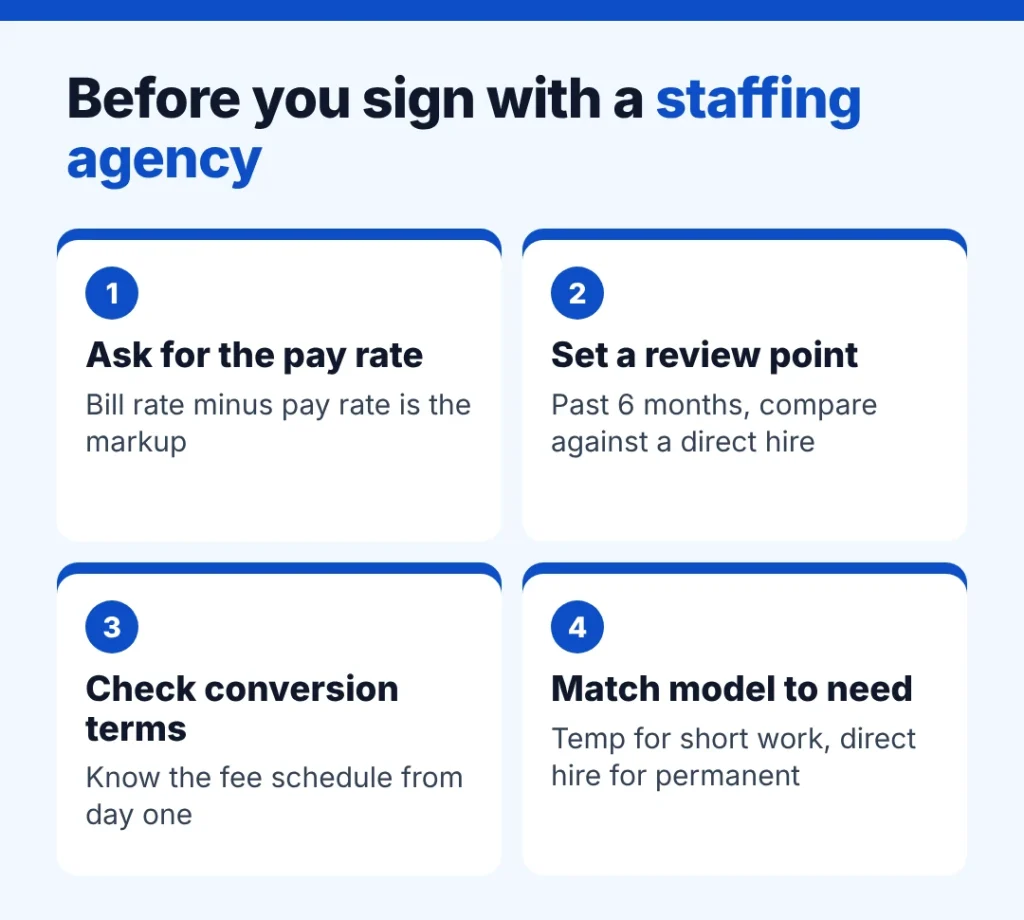
Ask for the pay rate as well as the bill rate. The gap is the markup. Agencies are often reluctant to share it, and that reluctance tells you something.
Set a review point. If an assignment passes six months, compare the cumulative markup against a conversion or a direct hire. If you are deciding before the assignment starts, compare contract to hire and direct hire on hiring risk first.
Check the conversion terms. Many agreements charge a fee to convert, reducing after a minimum period. Know the schedule from day one.
Match the model to the need. Temporary staffing is genuinely good for short projects, seasonal peaks and cover. It is expensive for permanent work.
When Paying the Markup Makes Sense
- Seasonal or short-term demand. Flexibility has a real value when the work ends.
- Compliance across many locations. The agency takes on employer obligations you would otherwise handle yourself.
- Immediate starts. Agencies with ready workers can fill gaps within days.
For permanent roles, a one-time placement is usually cheaper. The structure is on the pricing page.
You can browse candidates on the client portal.
Our breakdown of how much recruiters charge covers the permanent-placement side.
Our analysis of accounting staffing agency costs shows how the markup adds up over three years in one function.
Sudberry Southern made a direct placement rather than running an ongoing agency assignment, and the Sudberry Southern case study covers the role.
If you would rather run recruiting yourself, see the recruiter role.
More on how hiring works is on the Pavago homepage.
Frequently Asked Questions
How do staffing agencies make money?
Mainly through a markup on contract and temporary workers, billing you more per hour than they pay the worker, and through one-time fees on permanent placements.
What is a typical staffing agency markup?
It varies widely by role, location, and employer costs. Much of it covers payroll taxes, insurance, and overhead rather than profit.
Do staffing agencies take money from the worker’s pay?
Legitimate agencies do not deduct a fee from the worker. They bill the client a higher rate than they pay the worker.
Is it cheaper to hire directly than through a staffing agency?
For permanent roles, usually yes, because a one-time fee replaces an hourly markup that continues as long as the assignment does.
Can I convert an agency worker to my own employee?
Usually, subject to a conversion fee or a minimum assignment period. Check the agreement before the assignment starts.
How profitable is a staffing agency?
After paying the worker, employer taxes, insurance and its own overhead, a staffing agency keeps a fairly small share of revenue. Large listed staffing companies typically report single-digit net profit margins.
What is payrolling?
Payrolling is when you find the worker yourself and a staffing agency acts as their legal employer, handling payroll, taxes and insurance for a lower markup than a full recruiting assignment.
What are the downsides of using a staffing agency?
The ongoing hourly markup, conversion fees if you want to keep the worker, and a smaller candidate pool for roles that might end. For permanent roles these usually cost more than a one-time placement fee.
Pay once, not every hour
Search the pool free. Messaging and interviews are free. 3% of first-year salary on placement, 60-day replacement.