

How Each Model Works
Contract to hire. The worker is employed by a staffing agency and billed to you hourly at a markup while they work for you, usually three to six months. If you want to keep them, you convert them to your payroll, often for a conversion fee unless the minimum contract period has passed.
Direct hire. You hire the person onto your own payroll or contract from the start. An agency or platform charges a one-time fee for the placement, typically with a replacement window if it does not work out.
Contract, Contract to Hire and Direct Hire
Agencies usually offer three arrangements, and the first two are easy to confuse.
- Contract (temporary). The agency employs the worker for a fixed period or project, with no plan to convert them. You pay an hourly bill rate until the assignment ends.
- Contract to hire. The same hourly arrangement, plus an agreed option to move the worker onto your payroll after a trial period.
- Direct hire. The person joins your payroll from day one, and the agency or platform charges a single placement fee.
So contract to hire is a temporary contract with a planned conversion at the end. The rest of this guide compares it with direct hire, because those are the two options most employers weigh for a permanent role.
Side by Side
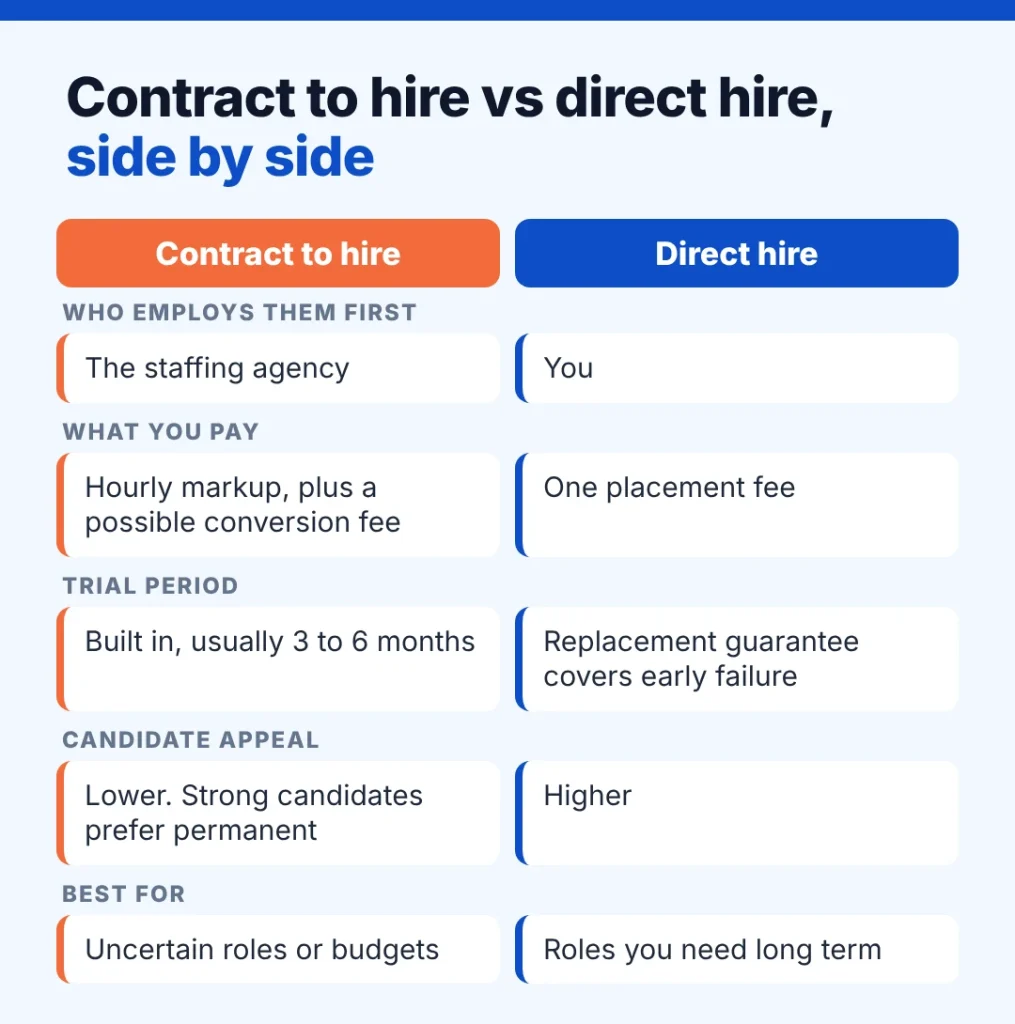
| Contract to hire | Direct hire | |
|---|---|---|
| Who employs them at first | The staffing agency | You |
| What you pay | Hourly markup for the whole trial, plus a possible conversion fee | One placement fee |
| Trial period | Built in, usually 3 to 6 months | None formally; a replacement guarantee covers early failure |
| Candidate appeal | Lower. Strong candidates often prefer permanent offers. | Higher |
| Commitment and benefits | Delayed until conversion | From day one |
| Best for | Uncertain roles, uncertain budget, project-based starts | Roles you know you need long term |
Classification is part of the picture. The IRS guidance on worker classification turns on behavioural control, financial control and the relationship, which is why the agency usually acts as the legal employer during the contract period rather than you.
Where the Trial Costs More Than It Saves
The appeal of contract to hire is the try-before-you-buy period. Three things work against it.
- You pay the markup the whole time. Every hour of the trial carries the agency margin, not just the first week.
- Conversion fees. Converting early often triggers a fee calculated on salary or weeks of billing.
- Candidate quality. Many strong candidates who already have permanent jobs will not leave for a contract that might end. The pool narrows to people who need work now.
A direct hire with a real replacement guarantee protects against the same core risk, a bad fit, without the ongoing markup. Pavago’s placement is 3% of first-year salary with a 60-day replacement window, details are on the pricing page.
What a Six-Month Trial Actually Costs
Here is a worked example. It is illustrative, because markups vary widely by role, location and agency.
| Contract to hire | Direct hire | |
|---|---|---|
| Salary the role is worth | $60,000 a year, about $28.85 an hour | $60,000 a year |
| What you pay | $43.27 an hour to the agency, assuming a 50 percent markup | A one-time placement fee |
| Over six months, about 1,040 hours | About $45,000 billed, of which about $30,000 is the worker’s pay | Six months of salary, paid directly |
| Paid on top of the worker’s pay | About $15,000 | $12,000 at a 20 percent recruiter fee, or 3% of first-year salary with Pavago |
Not all of that $15,000 is agency profit. Roughly $2,500 is payroll tax you would owe as the employer anyway. The remaining $12,500 or so covers the agency’s overhead and margin. That is already more than a typical 20 percent recruiter fee, before any conversion fee, and the gap widens every month the trial runs.
How Conversion Fees Usually Work
The conversion fee is what the agency charges to release the worker onto your payroll. Agreements tend to use one of three structures.
- A sliding fee. A percentage of salary that shrinks the longer the worker has been billed, and falls away after a set number of hours.
- A minimum billing period. No fee, as long as the worker has been billed for an agreed number of hours or weeks first, often around three months.
- A flat fee. One fixed amount, whenever you convert.
All three are negotiable, and the time to negotiate is before the assignment starts, when you have the most leverage. Get the schedule in writing, and check it before you offer an early conversion to someone you want to keep.
What It Looks Like From the Candidate’s Side
During the contract period the worker is the agency’s employee. That usually means the agency’s benefits rather than yours, often limited paid time off, and no promise of a job when the contract ends.
That is why strong candidates who already have permanent jobs rarely accept contract-to-hire roles. If the person you want is employed and not actively looking, a direct offer is the realistic way to reach them. Our guide to direct hire recruiting covers when that approach pays off.
When Contract to Hire Genuinely Wins
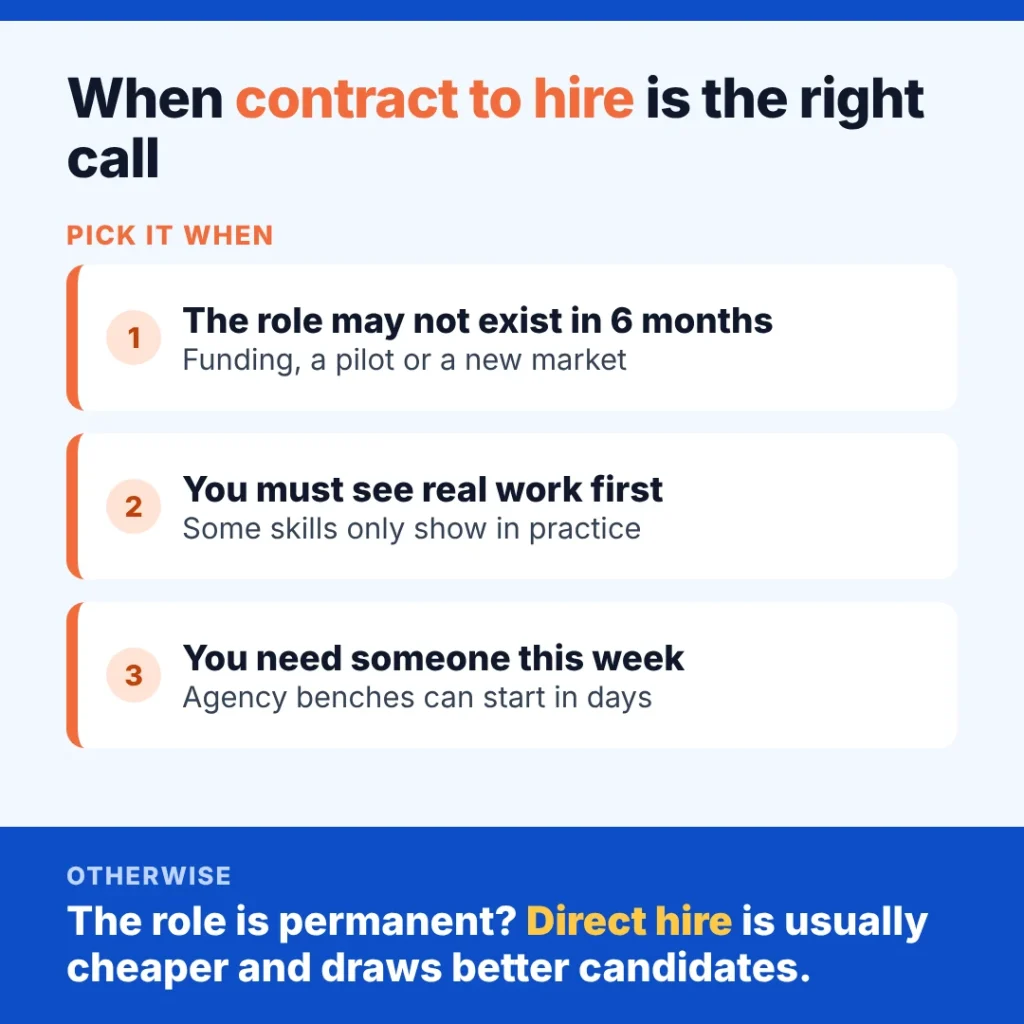
- You are not sure the role will exist in six months. Funding, a pilot, a new market. A contract matches the uncertainty.
- You cannot evaluate the skill without seeing real work. Some roles only reveal themselves in practice.
- You need someone immediately and cannot run a process. Agencies with benches can start people within days.
Outside those, if you know the role is permanent, direct hire is usually cheaper and attracts better candidates. Our guide to remote staffing services covers the contingent-labour model behind contract arrangements in more detail.
Making Direct Hire Less Risky
Use a paid trial task before the offer. A few hours of real work tells you most of what a three-month contract would.
Define the first 60 days in writing. Clear expectations make an early mismatch obvious and fixable.
Check the replacement terms. What triggers it, and whether fault has to be proved.
You can browse candidates and open profiles in the client portal before deciding which model fits the role.
Pavago’s recruiting talent sits under the recruiter role if you want to run hiring in-house.
Rovira Property Management made a direct hire rather than running a trial contract, and the Rovira case study covers the result.
For the staffing economics behind contract roles, our guide to offshore staffing services breaks down the pricing.
More on how Pavago works is on the Pavago homepage.
Contract to Hire for Remote and Offshore Roles
Contract to hire assumes a domestic agency that can act as the legal employer. That rarely works for international hires. Remote hires abroad are usually engaged as contractors or through an employer of record, so there is no agency payroll to convert from.
For international roles, the practical replacement for the trial period is a paid test task before the offer, a written 60-day plan, and a replacement guarantee. That is how Pavago works. Searching, messaging and interviews are free, and a placement is 3% of first-year salary with a 60-day replacement window. For the agency side of the comparison, see how staffing agencies make money.
Frequently Asked Questions
What is the difference between contract to hire and direct hire?
Contract to hire starts with the worker employed by an agency for a trial period before converting to your payroll. Direct hire puts them on your payroll or contract from day one, with a one-time placement fee.
Is contract to hire cheaper than direct hire?
Usually not. You pay an hourly markup throughout the trial and often a conversion fee. Direct hire is typically a single fee.
Why do candidates avoid contract-to-hire roles?
Because there is no guarantee of a permanent job, and people already employed rarely leave a stable role for one.
How long is a typical contract-to-hire period?
Commonly three to six months, depending on the agency agreement.
When should I choose contract to hire?
When the role itself is uncertain, when you must see real work before committing, or when you need someone immediately.
What does contract to hire mean?
It is a temporary contract through an agency with a planned option to hire the worker permanently at the end. The agency employs and pays the worker during the trial, and you pay the agency an hourly bill rate.
Do contract-to-hire workers get benefits?
During the contract they get whatever benefits the agency provides as their employer, which are often limited. Your company’s benefits usually start only after conversion.
Can I negotiate the conversion fee?
Usually, yes, and the best time is before the assignment starts. Ask for the fee schedule in writing, including when it reduces and when it falls away entirely.
Hire directly, with a safety net
Search the pool free. Messaging and interviews are free. 3% of first-year salary on placement, 60-day replacement.