

Most companies hire a social media manager to “do social.” Three months later they have a full content calendar, a few hundred new followers and no new customers, and they decide social doesn’t work for their business.
Usually social isn’t the problem. The hire is. The company needed someone to decide what to say, where and to whom, and it hired someone to post. Or it expected that person to become the voice of the brand, which no hire can do for you.
Getting it right comes down to four decisions: whether you need a social media manager yet (that depends mostly on whether you sell to consumers or to businesses), what kind of person to hire, what they own versus what you keep, and how you judge them. This guide walks through each one, with real rates from top-rated social media candidates on Pavago.
Do you need a social media manager? It depends on how you sell
Social matters more than it did a few years ago, and it’s also harder. AI has made a lot of content sound the same, so a real point of view stands out. But everyone is posting, and organic engagement keeps sliding: Socialinsider’s data shows Instagram engagement fell across every major format again in Q2 2026. Doing social “a bit” doesn’t work anymore. It needs an owner and a plan.
Whether that owner should be a dedicated hire, and when, depends on your business model:
| Your business | Do you need one? | When to hire | Start with |
|---|---|---|---|
| D2C, e-commerce or consumer app | Yes. It’s a core channel. | Early, often one of your first marketing hires | Instagram and TikTok |
| B2B, selling to small and midsize companies | Yes, once you have traction | When revenue is steady (around $30,000 to $40,000 a month is a fair marker) | LinkedIn and X |
| B2B, selling to enterprise | Yes, but it’s a different job | Once you know your target accounts | LinkedIn, through your founder, execs and employees |
D2C and consumer brands: hire early
If you sell to consumers, social isn’t a channel you add later. It’s where people discover products, check whether a brand is real, and more and more often, where they buy. eMarketer expects US social commerce sales to pass $100 billion in 2026.
That makes a social media manager one of your first marketing hires, alongside paid ads, because the two feed each other. Organic posts show you which ideas and hooks people respond to, and ads scale the winners. For a consumer brand, look for someone highly creative who tests constantly, thinks video-first, and can run creators and user-generated content (UGC).
B2B: earn traction first, then hire
If you sell to businesses and you’re early, your first customers will come from outbound, referrals or ads, not from posts. Put your hours there. Document the journey on your own accounts if you enjoy it, but don’t put more than about 10 hours a week or real budget into social yet.
Once revenue is steady, social starts to compound. In B2B it works mostly as a trust channel: buyers watch your thinking for months, then reach out. Start on LinkedIn and X, where business buyers spend their time and where networking (replying and commenting) often gets you further than posting. Instagram and Facebook usually earn their keep in B2B as ad channels rather than organic ones. That’s how it played out for us at Pavago: money spent on LinkedIn and X returned more than Instagram or TikTok would have.
Enterprise B2B: a different job
If you sell to a short list of large accounts, follower counts barely matter. The job is making sure the right few hundred people at your target accounts keep seeing your founder’s and executives’ thinking, mostly on LinkedIn, and getting employees to post their own angle. Hire someone who has run executive and employee content programs, not someone who has only grown a brand account.
Hire a strategist, not a poster
The most common hiring mistake is hiring for execution: someone to design graphics, schedule posts and reply to comments. Execution matters, but it’s the easy part. Strategy is what decides whether social works, so look for someone who is about 70% strategist and 30% executor.
A good strategist answers four questions:
- Which channels matter for your business, and which to skip for now.
- Where you need to be consistent, and what consistent means on each channel.
- Where your founder and execs should spend their limited time. On LinkedIn and X, that’s often in other people’s comments, not just in their own posts.
- What to test next, and how you’ll know if it worked.
They also make sure each channel tells your story in its own way, instead of cross-posting the same clip everywhere. At Pavago, for example, LinkedIn and X carry ideas about hiring and growth, while our upcoming Instagram plan is to show real searches on Pavago every day, filmed on Meta glasses.
The data makes this decision easy. Even among top-rated candidates on Pavago, social media managers and strategists outside the US ask a median of $1,500 a month, exactly the same as social media assistants. Strategy costs no more than execution, so hire for strategy.
What you can’t hand off
No hire can be the face of your company. If you try to fully outsource founder-led content, it won’t work, because people trust people and it isn’t you.
What you can hand off is everything around your voice. Your social media manager takes your point of view and turns it into a plan, posts and videos, then tests what lands. You spend a few hours a week supplying ideas and showing up in the comments. The content is still yours. They shape it.
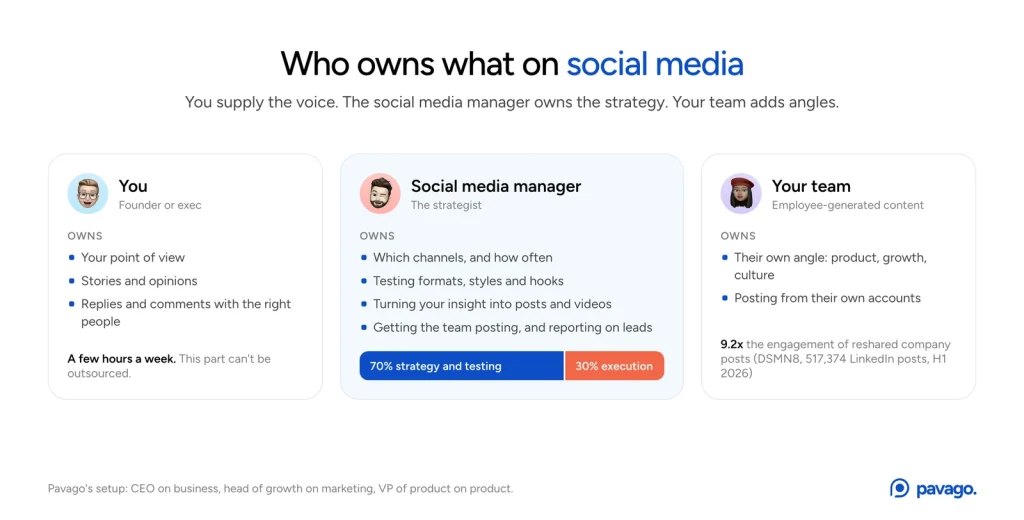
| You (founder or exec) | Social media manager | Your team | |
|---|---|---|---|
| Owns | Your point of view, stories and opinions | Strategy, channels, testing, planning, polish, reporting | Their own angle on the business |
| Time | A few hours a week | Full-time | An hour or two a week |
Add your team’s voices next
Once the founder’s content is working, get your team posting. Employee-generated content (EGC) is one of the strongest plays right now. DSMN8 analyzed 517,374 LinkedIn posts from the first half of 2026 and found that original posts written by employees earned more than nine times the engagement of reshared company posts.
Wispr Flow is a good example: Hector, who built their content team, posts openly about how he built it, and others on their team have started posting too. At Pavago, our CEO covers the business, I cover growth and marketing, and our VP of product is about to cover the product. The strategist’s job is to give each person an angle and make posting easy for them.
Which kind of social media hire do you need?
Every role below is in Pavago’s marketing talent pool, so you can compare them side by side.
“Social media manager” covers several different jobs. Match the hire to your gap:
| Your situation | Who to hire |
|---|---|
| Nobody owns social, and you can give it a few hours a week | A social media manager (strategist) |
| You have a strategy but no time to execute it | A social media assistant or VA |
| You love making content and need production help | A content creator or video editor |
| You’re a consumer brand that needs a lot of video | Content or UGC creators, with a strategist directing them |
| You’re B2B and still finding traction | Nobody yet. Post yourself and focus on outbound. |
What a social media manager costs
We looked at what top-rated social media talent on Pavago asks for: 303 managers, assistants and content creators our system rates 9 or 10 out of 10. We didn’t filter by years of experience, because some of the best social media people are new to the job.
| Role (outside the US) | Typical top performer | Top quarter | Top 10% | US-based top performer |
|---|---|---|---|---|
| Social media manager or strategist | $1,500 a month (about $9 an hour) | $2,200+ | $3,000+ | $5,000 (salary sites: $5,300 to $6,000) |
| Social media assistant or VA | $1,500 | $2,100+ | $2,500+ | Too few to report |
| Content creator | $1,400 | $2,000+ | $3,000+ | About $5,000 |
Pavago data: self-reported monthly asking rates of candidates rated 9–10 out of 10, October 2026. Rates are negotiable. “Typical” is the median; the US content creator figure comes from a small sample. US salary sites put social media managers at $64,000 to $71,000 a year (Indeed, Glassdoor), or about $5,300 to $6,000 a month.
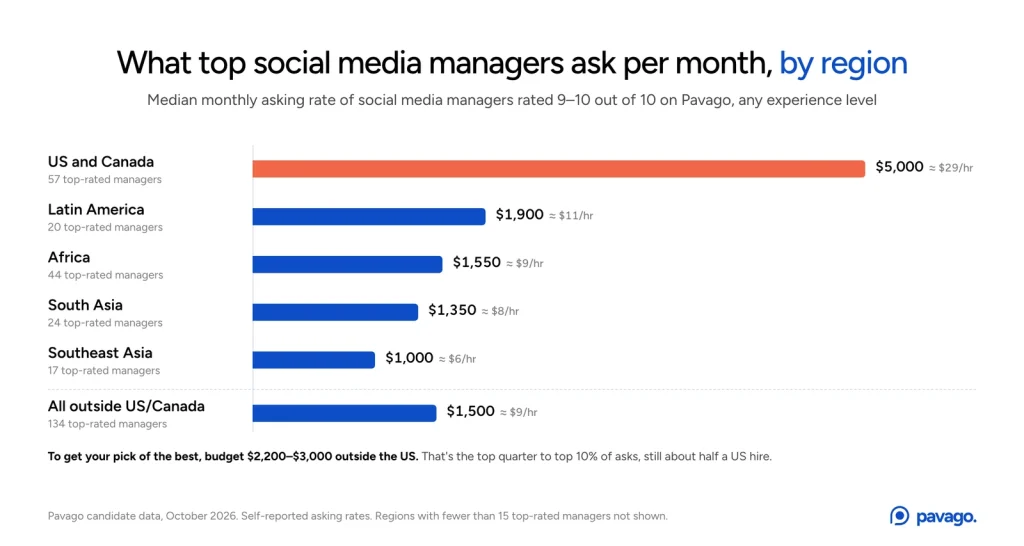
All of these rates come from profiles you can browse yourself with a free client account, filtered by role, region and rating.
What stood out in the data:
- Price won’t tell you who’s great. Our top-rated candidates ask barely more than everyone else (a $1,500 median against $1,400 for the rest), and there’s no shortcut score for creativity. You find the great ones by looking at their work and giving them a test, not by paying more.
- Budget for the top of the range anyway. To get your pick of the best people, plan on $2,200 to $3,000 a month outside the US. That’s still about half of what a US hire costs.
- Regional medians for top-rated managers: Latin America $1,900, Africa $1,550, South Asia $1,350 and Southeast Asia $1,000. In the US and Canada, it’s $5,000. Some regional samples are small (17 managers in Southeast Asia, 20 in Latin America), so treat them as rough guides.
How to vet a social media manager
Ask for proof first. Have they grown an account before? It doesn’t have to be their own, but they should be able to show a business account they grew and explain what they changed. Judge the work, not the years: some of the best social media people are new to the job, and their creativity shows in what they’ve made.
Then match them to your market.
- Consumer brands: hire the most creative person you can find. Look for testing volume, video instincts and experience working with creators.
- B2B: look for clarity and value over polish. Simple videos work. Some of the best B2B videos are someone talking into their phone in the car, and they work because the idea is good. Hector’s videos for Wispr Flow are a good example: nothing fancy, and they perform.
Ask questions like these:
- “What’s the best way to grow on [channel]?” A red flag is a plan built on single static images, or “post every day.” On Instagram, single images are the weakest format: Socialinsider’s Q2 2026 data puts them at 0.33% engagement, against 0.48% for Reels and 0.50% for carousels. A good answer starts with your business and how each channel can tell its story.
- “Which platforms would you start us on, and why?” For most B2B companies, a strong candidate picks LinkedIn and X before Instagram, and asks about your customers before answering. For a consumer brand, they should go straight to Instagram and TikTok.
- “How would you figure out what works for us?” Prefer the person who wants to test over the person who says “I know exactly what works.” No strategy works for everyone.
- “Audit our last 30 days of posts. What would you stop, start and test?” This one shows how they think, not just what they can make.
Red flags: posting for the sake of posting, random content with no plan or story, and anyone who measures success only in followers.
Their first 30 days, and the first six months
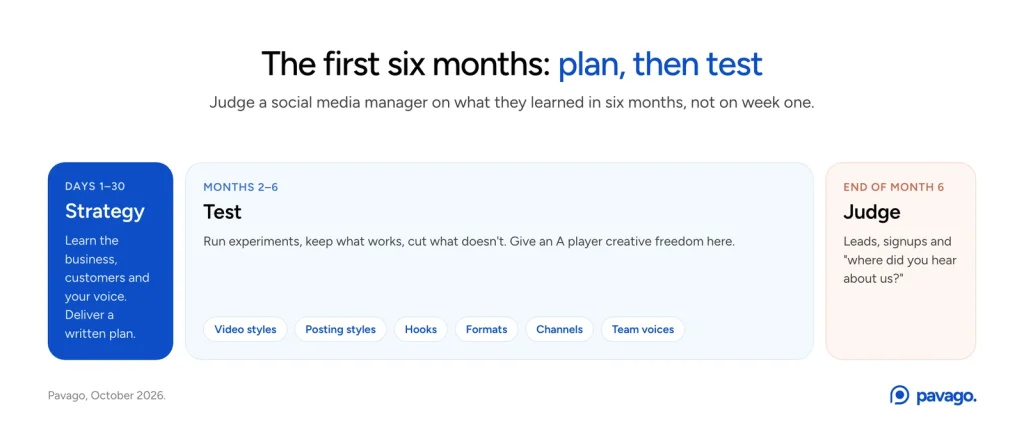
Days 1 to 30: strategy, not execution. Your new hire should spend the first month learning your business, your customers and your voice, and turn that into a written plan. Some execution is fine, but the deliverable of month one is the strategy.
Months 2 to 6: test. Give them room to experiment with video styles, posting styles, hooks, formats and channels. Six months is a fair window to find what works for you. If you’ve hired an A player, give them creative freedom. That’s where the wins come from.
How to measure a social media manager
Views and engagement tell you whether the content is valuable. If nobody engages, it isn’t helping anyone. Treat them as signals, not the goal. The goal depends on how you sell:
- Consumer brands: sales you can trace to social (tracked links, creator codes, in-app shop sales), plus which organic posts go on to become your best ads.
- B2B: leads, booked calls and revenue. Ask “Where did you hear about us?” on every call and in your signup form. If people say LinkedIn or X, that’s your signal.
In B2B especially, much of social’s impact is indirect. People watch your posts for months, then search for you and book a call. That’s hard to track, which is why the “where did you hear about us?” question matters so much.
Where Pavago fits
Pavago is a hiring marketplace built to take the friction out of hiring. You can search social media managers, assistants and content creators from around the world for free, see their rates and work history, and watch a short intro video before you talk to anyone. For a role that’s all about communication, that video tells you a lot.
Messaging and interviews are free, with 3% of first-year salary fee when you hire (see pricing).
Browse remote social media managers and video content creators on Pavago.
Building out a full team? Our guide on how to build a content marketing team covers the other roles.
If you’d rather use an agency, start with outsourcing social media management.
For help with execution only, see hiring a social media virtual assistant.
FAQ
How much do you pay a social media manager per hour?
On Pavago, a top-rated social media manager outside the US asks a median of about $9 an hour ($1,500 a month), and the top quarter asks $13 an hour or more ($2,200+). Top-rated US candidates ask about $29 an hour, and US salary sites put the average at $31 to $34 an hour.
Is it worth it to hire a social media manager?
For consumer brands, yes, and early. For B2B companies, yes once revenue is steady. Before that, founders should post themselves and focus on outbound.
What is the 5-3-1 rule on social media?
It’s a daily engagement routine, mostly used on Instagram. The usual version: interact with five accounts, leave three thoughtful comments, and make one new connection, like a follow or a DM. The numbers vary, but the idea holds: engaging with others grows an account faster than posting alone.
Should I hire a freelance or full-time social media manager?
A freelancer works for execution, like scheduling and editing. Strategy and testing need months of context about your business, so for that, hire someone dedicated.
What does a social media manager do?
They own your social strategy: which channels to use, what to post, how often and what to test. They turn your team’s insight into content, track what works, and report on the sales or leads it drives.
Where to start
Before you hire anyone, write down three things you know that your customers don’t. If you can’t, you’re not ready for a social media manager yet. If you can, that list is the first brief your new hire works from.