

What a Google Ads Specialist Actually Does
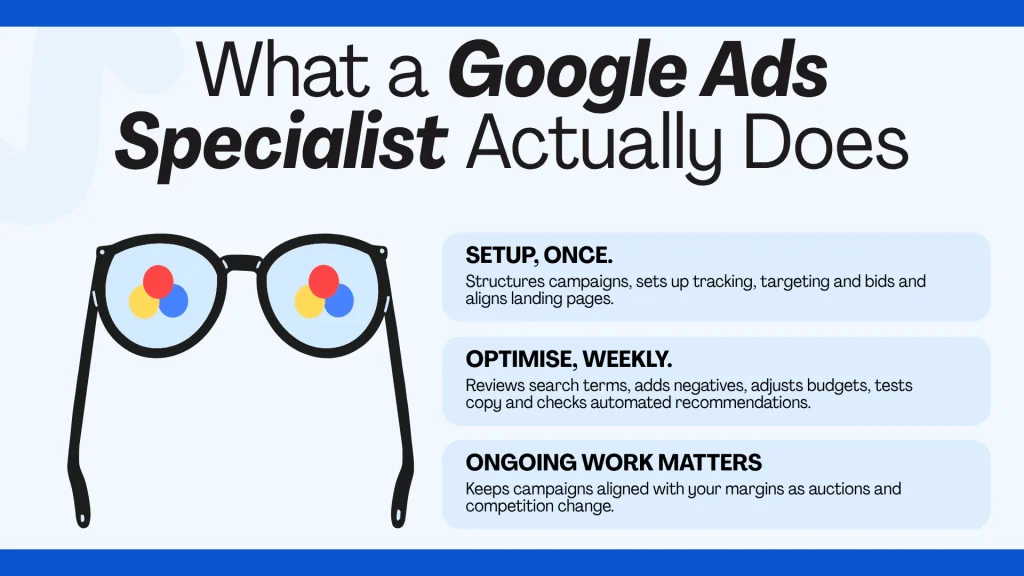
Worth being specific, because the perception is that they build campaigns, and the reality is that building is the smallest part.
Setup, once: account structure, conversion tracking that actually fires, audience and negative keyword foundations, bid strategy selection, and the landing page alignment that determines whether any of it converts.
Ongoing, weekly: search term review and negative keyword additions, bid and budget reallocation between what is working and what is not, ad copy testing, and catching the automated recommendations Google surfaces that would quietly broaden your targeting.
The ongoing half is where the money is. A well-built campaign left alone for three months drifts, because the auction changes, competitors enter, and the platform defaults toward spending your budget rather than toward your margin.
Why the Fee Is the Wrong Thing to Judge
A management fee is a fixed cost. Wasted spend is a percentage of a variable one. Those behave differently as you grow, and the comparison that matters is between them rather than between the fee and zero.
| Monthly spend | What waste costs you at a modest waste rate | What management costs | Which is larger |
|---|---|---|---|
| $1,000 | Small, in absolute terms | A fee, fixed | The fee |
| $5,000 | Material | The same fee | Roughly even |
| $15,000 | Substantial | Still the same fee | The waste |
| $40,000+ | Large enough to fund a team | Still the same fee | The waste, by a wide margin |
Read the right-hand column rather than the numbers. The crossover is structural. Waste rises with spend, the fee does not, so there is necessarily a point where they cross. Where exactly depends on your waste rate, which depends on how badly the account is currently configured.
The reason this is hard to see from inside is that wasted spend does not arrive as a separate line. It arrives as a slightly worse cost per acquisition every month, and nobody is comparing against the counterfactual.
Where the Line Sits in Practice
Four signals, and any two together usually mean you are past it.
- You are spending more than a few thousand a month, and nobody reviews search terms weekly. Search term review is the single highest-return recurring task in a Google Ads account, and it is the first thing a busy owner stops doing.
- Conversion tracking is unverified. If you cannot state confidently what a conversion is recorded as and whether it deduplicates, you are optimising on numbers you have not checked. This is more common than it sounds.
- You have accepted Google’s automated recommendations without reviewing them. Several of them broaden targeting, which increases spend. The platform’s defaults are not aligned with your margin.
- Your cost per acquisition has risen over two quarters, and nobody can say why. That is drift. It is what an unmanaged account does.
Marketing budgets are under more scrutiny than they were, which raises the cost of unexamined waste. Gartner’s research on marketing budgets tracks marketing spend as a share of revenue remaining under sustained pressure, which means paid channels increasingly have to justify themselves line by line rather than in aggregate.
Specialist, Agency, or Keep It In-House
Three options, and they fail differently.
In-house, self-managed. Defensible below the threshold. The hidden cost is your attention, and the reason it fails is not incompetence, it is that search term review is a weekly discipline that loses to everything urgent.
Agency retainer. Often priced as a percentage of spend, which creates an incentive worth noticing: the fee rises as your spend rises, whether or not the additional spend was a good idea. Ask how the fee is calculated before anything else.
Dedicated specialist. A fixed cost that does not scale with your budget, working only on your accounts. The trade is that you supply the strategic direction about what you are selling and to whom, which an agency would otherwise bundle in.
The percentage-of-spend question is the one to press on. For the same structural problem in recruitment pricing, our analysis of accounting staffing agency costs covers how percentage fees behave as the underlying number grows.
What to Screen For
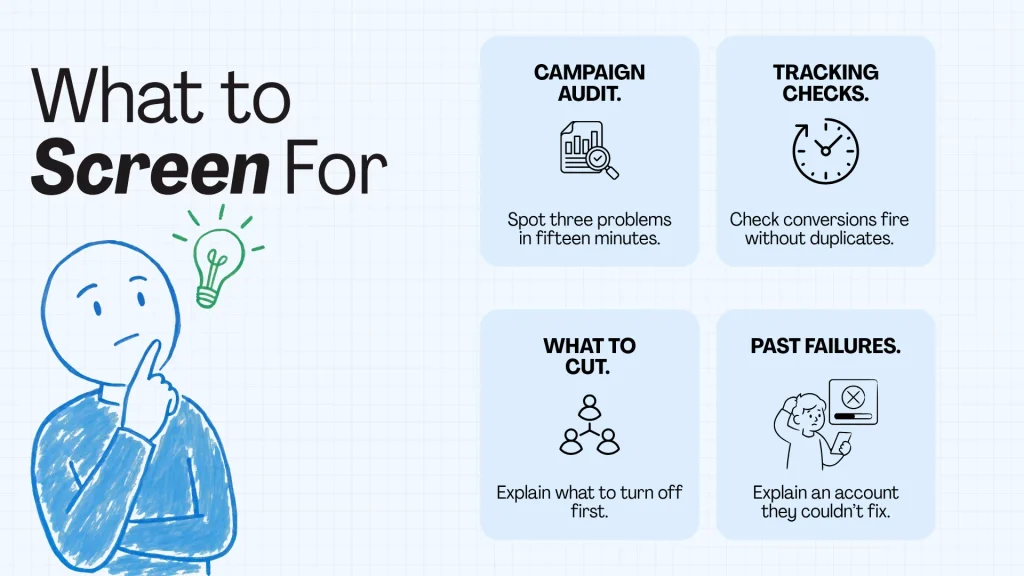
Ask them to audit one of your campaigns on a call. Give read access beforehand. Someone competent names three specific problems within fifteen minutes. This single exercise outperforms any portfolio.
Ask how they verify conversion tracking. If the answer does not involve checking what fires and whether it deduplicates, they are optimising toward a number they have not validated.
Ask what they would turn off first. A specialist who only ever adds is not managing, they are spending. The useful answer names something to cut.
Ask about an account they could not fix. Everyone has one. The answer reveals whether they diagnose or just execute.
Pavago places paid specialists through the Google Ads specialist role, with the wider marketing talent pool covering adjacent paid and performance roles.
Search, messaging and interviews are free, and placement is 3% of first-year salary. Terms on the pricing page.
You can search the pool and open profiles in the client portal before deciding whether you are past the threshold.
When Not to Hire One
- Spend below a few thousand a month and convert acceptably. The waste is small in absolute terms, and a fixed cost would dominate it.
- You are not sure paid search is the right channel. Hiring a specialist to validate a channel means paying someone to find out whether their own role is justified. Test it cheaply first.
- Your landing pages are the bottleneck. No amount of campaign management fixes a page that does not convert. Fix the destination before paying someone to send more traffic to it.
Celebrate Dental built out a paid marketing function rather than rotating through agencies; the Celebrate Dental case study covers how the team was assembled.
Frequently Asked Questions
When should I hire a Google Ads specialist?
When wasted spend exceeds what management costs, which happens at a lower monthly budget than most businesses assume. The practical signals are spend above a few thousand monthly with nobody reviewing search terms weekly, unverified conversion tracking, and a cost per acquisition that has drifted upward without explanation.
Is a Google Ads specialist worth it for a small budget?
Below a few thousand a month, usually not, because a fixed management cost dominates the absolute waste. The calculation changes as spend grows, since waste is proportional to budget while the fee is not.
Should I use an agency or hire a specialist?
An agency if you also need channel strategy and creative. A dedicated specialist if you know what you are selling and to whom. Check how the agency fee is calculated, because percentage-of-spend pricing means their fee rises when your spend rises, regardless of whether the increase was wise.
What does a Google Ads specialist do weekly?
Search term review and negative keyword additions, budget and bid reallocation, ad copy testing, and reviewing the platform’s automated recommendations. The weekly work matters more than the initial build, because accounts drift as auctions and competitors change.
Can Google Ads be managed remotely?
Yes. The work happens entirely inside the Google Ads interface and analytics, granted by user permission. What matters is familiarity with your market and enough overlap to discuss performance, not location.
Run the comparison before the next invoice
Search the pool free. Messaging and interviews are free. 3% of first-year salary on placement, 60-day replacement.
Pavago is a hiring marketplace, so you run the search yourself. Tell it the role, your budget and the region, and you get matched with vetted remote candidates in under a minute. Watch their video intros, message the ones you like, and hire straight from the app. No sales call, no job post, no recruiter in the middle. It’s the most frictionless way we know to hire.