
If your business is growing, your finances are probably getting harder to manage.
What used to be a simple set of invoices and reports is now a web of accounts, payrolls, reconciliations, and integrations… and it’s slowing you down.
This is when most business owners realize QuickBooks alone isn’t enough.
You don’t just need someone to use QuickBooks – you need someone who can customize it to how your business actually runs.
A skilled QuickBooks developer can automate repetitive tasks, fix messy integrations, and build reports tailored to your goals, making it easier for you to stay on top of your finances.
The problem? Hiring a qualified QuickBooks developer locally costs a fortune, and freelancers are not really a reliable option.
So, how do you actually hire QuickBooks developers who know their stuff and won’t bankrupt you in the process? That’s what we’re covering here.
In this guide, we’ll break down where to find reliable QuickBooks developers without spending $5K/month and how to decide which option makes sense for your business.
Want to cut to the chase?
Pavago connects growing businesses with A-player QuickBooks developers – vetted, reliable, and matched in under a minute.
What a QuickBooks Developer Actually Does
Most business owners assume “QuickBooks person = bookkeeper.” That’s not quite right.
A QuickBooks developer bridges accounting and technology. They transform your financial system from a basic recording tool into something more intelligent and efficient.
Here’s what they typically handle:
- Building custom automations for invoices, payroll, and reconciliation processes
- Integrating QuickBooks with other business tools like Shopify, Stripe, HubSpot, or your CRM
- Managing data migration and cleanup from legacy systems
- Creating custom dashboards and analytics reports tailored to your needs
- Troubleshooting system errors, automating reporting, and improving data accuracy

Bookkeeper vs. Developer: What’s the Difference?
Most people think these are the same thing. They’re not.
A bookkeeper records your transactions, reconciles accounts, and makes sure your books are clean. They’re really good at categorizing expenses, managing payables/receivables, and keeping everything organized.
A QuickBooks developer builds systems. They automate workflows, connect QuickBooks to your other tools, create custom reports, and fix technical problems. They usually have a background in accounting but also know how to code and work with APIs.
Think of it this way: a bookkeeper keeps your books accurate. A developer makes your entire financial system smarter.
Here’s a quick breakdown:
| Bookkeeper handles: | QuickBooks Developer handles: |
|---|---|
| – Transaction entry and categorization – Bank reconciliations – Invoice and bill management – Basic reporting (P&L, balance sheet) – Accounts payable/receivable – Month-end close procedures | – Automating repetitive processes- Integrating QuickBooks with Shopify, Stripe, your CRM, etc. – Building custom dashboards and reports – Data migration from old systems – Troubleshooting technical issues – Creating multi-entity consolidations – Advanced workflow automation |
Signs You Need to Hire A QuickBooks Developer (Not A Bookkeeper)
Not sure which one you should hire? Don’t worry, we’ll help you.
You should hire a QuickBooks developer if:
- Your team wastes hours every week on manual data entry that should be automated
- QuickBooks isn’t integrated with your other systems (and you’re stuck copying data between them)
- You constantly export to Excel because QuickBooks reports don’t show what you need
- Reconciliation takes days instead of hours
- You’re dealing with multiple entities or complex reporting structures
- Tax season reveals major discrepancies that take weeks to sort out
- You’ve hired someone whose main job is “managing QuickBooks.”
You’re probably fine with a bookkeeper if:
- Your main need is to keep up with transaction entry
- Your QuickBooks setup is pretty standard
- You just need monthly reconciliations and basic reports
- The manual processes you have aren’t eating up tons of time
Quick reality check: If you’re doing more than $2-3M in revenue or have complex operations, you probably need both.
The bookkeeper handles the day-to-day transaction work, while the developer builds the systems that make everything efficient.
Where to Find and Hire QuickBooks Developers Under $5K/Month?
You’ve got four main options. Each has some tradeoffs depending on what you actually need.
1. Offshore Platforms (Pavago, Lemon.io, Terminal, etc.)
Cost: $2,000-3,500/month developer salary + platform fee
Total yearly cost (approx): $36,000-54,000/year
How it works:
You tell the platform what you need. They match you with pre-vetted candidates from their network (usually Latin America, Asia, Eastern Europe, or Asia). You shortlist 3-4 candidates, the company interviews them, and then you select one. All payroll, compliance, and HR is handled by the platform, and the developer works as your dedicated team member.
The reality:
This model has exploded in the last 5 years because it actually works. You get similar quality to local hires at 40-60% of the cost. The reason it’s cheaper isn’t lower quality – it’s lower cost of living. A senior QuickBooks developer in Argentina has the same skills as one in California, but different salary expectations because their rent is $1,000 instead of $3,000.
| Pros | Cons |
|---|---|
| – Access to a global talent pool (not limited by your geography) – Pre-vetted talent pool (platforms screen heavily) Significantly more affordable – Contracts and payroll built in (on Pavago, contracts are e-signed in the app and payroll runs through Plane) – Replacement guarantees (on Pavago, a free replacement in the first 60 days) – Fast hiring (on Pavago, matches in under a minute) – Can easily scale up or down | – Timezone difference (Pavago ensures complete overlap, though) – Not in-person (but honestly, how often do you need your QuickBooks developer sitting next to you?) – You manage all HR, benefits, payroll, and equipment – Will have to incur benefits and overhead costs – Limited talent pool in your area |
Best for:
Most businesses need ongoing QuickBooks development work. Especially good for startups and SMBs ($1M-20M revenue) that need quality work but have to be smart about budget. Also great for companies that want to test offshore before building their own international hiring infrastructure.
2. Staffing Agencies
Cost: $4,000-7,000/month with markup
Total yearly cost: $48,000-$84,000
How it works:
You tell the agency you want to hire a QuickBooks developer. They source candidates from their network, do initial screening, and send you 2-5 candidates to interview. You pick someone, they handle payroll and HR, and you pay a monthly fee that’s marked up from the actual salary.
The reality:
Agencies make money on the spread between what they pay the contractor and what they charge you. They’re incentivized to fill the role quickly, not necessarily with the perfect person. The quality of screening varies dramatically between agencies.
| Pros | Cons |
|---|---|
| – Expensive markup (you pay $6K, person gets $4K or less) – Quality of vetting varies by agency – Less flexible than other options (often 3-6 month minimum contracts) – The agency’s incentive is filling the role, not a perfect fit – Hidden fees (replacement fees, early termination penalties) | – Expensive markup (you pay $6K, person gets $4K or less) – Quality of vetting varies by agency – Less flexible than other options (often 3-6 month minimum contracts) – The agency’s incentive is filling the role, not a perfect fit – Hidden fees (replacement fees, early termination penalties) |
Best for:
Enterprises with established vendor relationships, companies that need temp-to-hire to reduce risk, or businesses with procurement processes that require working through agencies.
Related: 10 Best Remote Staffing Agencies to Hire Top Global Talent
3. Freelance Platforms (Upwork, Fiverr, Freelancer)
Cost: $15-50/hour (average around $25/hour)
Realistic monthly cost for full-time: $4,000-8,000
How it works:
You post your job, wade through 20-50 applications (many irrelevant), interview a handful of candidates, and hope you pick someone good. Payment goes through the platform. You’re the one managing everything.
The reality:
Most of the profiles oversell their actual skills. You’ll probably interview 5-10 people to find 1-2 decent candidates. Many “QuickBooks developers” are actually bookkeepers who know basic QuickBooks but can’t build integrations or automations.
| Pros | Cons |
|---|---|
| – Can start immediately (post today, get responses within hours) – Pay only for hours worked – No long-term commitment – Easy to switch if someone doesn’t work out – Good for testing if you even need a developer | – Quality varies wildly (from genuinely skilled to completely unqualified) – You spend at least 3-4 days just finding someone decent – You handle all contracts, payments, and tax documents – Troubleshooting technical issues – Platform takes 10-20% cut (either from you or them) |
Best for:
Small one-off projects ($500-2,000 range) where you’re testing someone out or need quick tactical help. Not great for ongoing critical work unless you get really lucky.
Why Offshore Is Your Best Bet
Most people think they have to choose between three options to hire a QuickBooks developer: overpaying for local talent, gambling on freelancers, or dealing with expensive staffing agencies.
Offshore through a good platform is actually better than all three. Here’s why:
vs. Staffing Agencies:
Agencies charge you $6,000/month and pay the person $4,200. You’re paying a 30% markup for them to do basic screening and handle payroll.
Offshore platforms cost you $2,000-3,500/month in salary, plus a one-off fee (on Pavago, 3% of first-year salary per hire). Same quality of talent (often better because you’re hiring from a global pool). The admin stays light too: on Pavago, contracts are e-signed in the app and payroll runs through Plane. You’re just not paying a massive markup.
The only reason to use an agency is if your procurement department requires it. Otherwise, you’re literally paying $2,000-3,000/month extra for the same outcome.
vs. Freelance Platforms:
Freelancers are cheap upfront, but expensive in hidden costs. You spend 10-15 hours screening people. You hire 2-3 duds before finding someone decent. They ghost you mid-project. Knowledge walks out the door when they leave.
When you hire QuickBooks developers through offshore platforms, someone else did the vetting. They’re not going to disappear because their reputation is on the line. And if they do leave, you get a replacement instead of starting over on Upwork.
You’re paying a bit more per month ($2,000-3,500 vs. $1,000-2,000 for a freelancer), but you’re saving 15+ hours of your time and getting way more reliability.
vs. Local Hiring:
Local hiring costs $8,000-10,000/month all-in. For QuickBooks development work that can be done remotely, you’re paying a “geography premium” that doesn’t actually get you better work.
The developer in Colombia who costs $3,000/month has the same skills as the one in California who costs $10,000/month. The difference is rent and cost of living, not capability.
Unless you genuinely need someone in the office daily (and for QuickBooks work, you probably don’t), you’re just burning money.
The math:
- Freelancer: Cheap but risky, high management overhead
- Agency: $4,000-7,000/month for talent you could hire for $2,000-3,500
- Local: $8,000-10,000/month for the same work
- Offshore platform: $2,000-3,500/month, vetted talent, managed infrastructure
For most businesses, offshore through a platform is obviously the right call.
Why Pavago is Specifically for Offshore Teams
If you’re going offshore (and you should be), here’s why Pavago is your best option:
We help you hire A-players across multiple roles. Yes, we can get you a killer QuickBooks developer. But we also handle marketing, product, and sales – pretty much any role that can be done remotely.
The upside? Once you hire a QuickBooks developer through us and see how well it works, you can scale your entire team the same way. One platform, one process, massive cost savings across the board.
We actually vet people properly. Our acceptance rate is around 4%. We reject 96% of applicants because most people aren’t good enough.
Every candidate you talk to has already passed technical assessments, role-specific evaluations, and communication tests. You’re not wasting time interviewing unqualified people.
60-day replacement guarantee. If someone leaves or isn’t working out in the first 60 days, message your account manager and you get a replacement at no extra placement fee, and replacements stay free after that while you keep the optional $149/month per hire plan. Compare that to agencies (pay full placement fee again) or freelancers (back to square one on Upwork).
Transparent pricing. 3% of first-year salary per hire. Developer salary of $2,000-3,500/month, paid to them directly. After 60 days, an optional $149/month keeps Plane payroll running. No hidden fees, no markups, no surprises.
Fast turnaround. You get matched in under a minute and can start interviewing right away. No 6-8 weeks of sourcing like local hiring.
Contracts and payroll built in. You e-sign a locally compliant contract inside Pavago, and payroll runs through Plane, free for the first 60 days. You manage the work and pay your hire directly from your own Plane account.
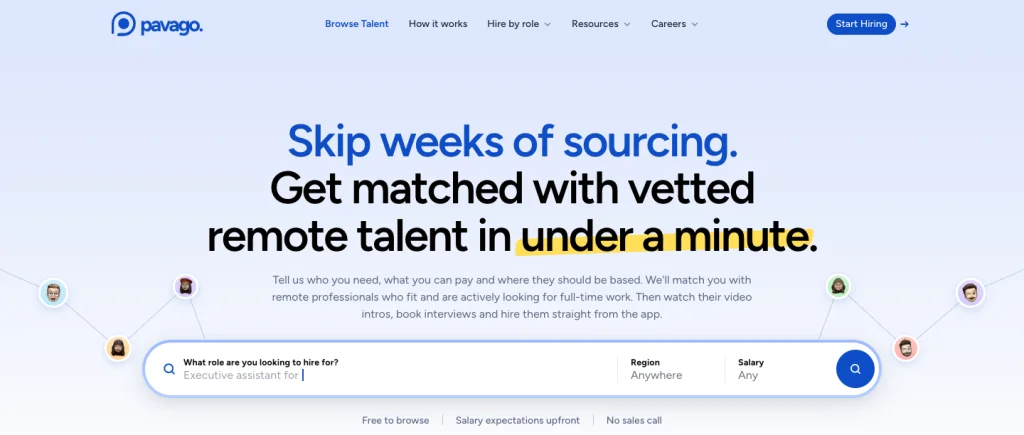
Ready to hire A-player QuickBooks developers? Pavago is a self-serve hiring marketplace. Search vetted developers yourself, get matched in under a minute, watch video intros and hire directly, with no sales call.
Conclusion
If your QuickBooks setup is holding your business back, you need someone who can actually fix it, not just maintain it.
Local hires are great if you have $8K-12K/month to spend and need someone in person. For most businesses, that doesn’t make sense.
Hiring freelance QuickBooks developers can work for small projects, but they’re risky for ongoing work, and you’re doing all the vetting yourself.
Offshore through a hiring marketplace (like Pavago) gets you qualified talent at $2,000-3,500/month in salary, plus 3% of first-year salary per hire, and you hire them directly with contracts and payroll built in. For most companies, this is the smart play.
The key is actually vetting people properly, setting up a good communication structure, and treating it like the real hire it is (not just farming out work to some random person on the internet).
If you do that, you can get the same quality work you’d get from a $10K/month local hire at a fraction of the cost.