

What Outsourcing Content Writing Covers
The term spans everything from bulk blog production to ghostwriting a founder’s newsletter, and the economics differ by what you hand over.
Research and drafting. The writer finds sources, structures the piece, and produces a draft. This is the part every quote prices.
Subject knowledge. Knowing your product, customers, and market well enough to say something specific. This is the part almost no quote prices, and the gap between writers is widest here.
Editing and publishing. Formatting, SEO fields, images, internal links, uploading. Sometimes included, often assumed to be yours.
The Four Ways to Buy It
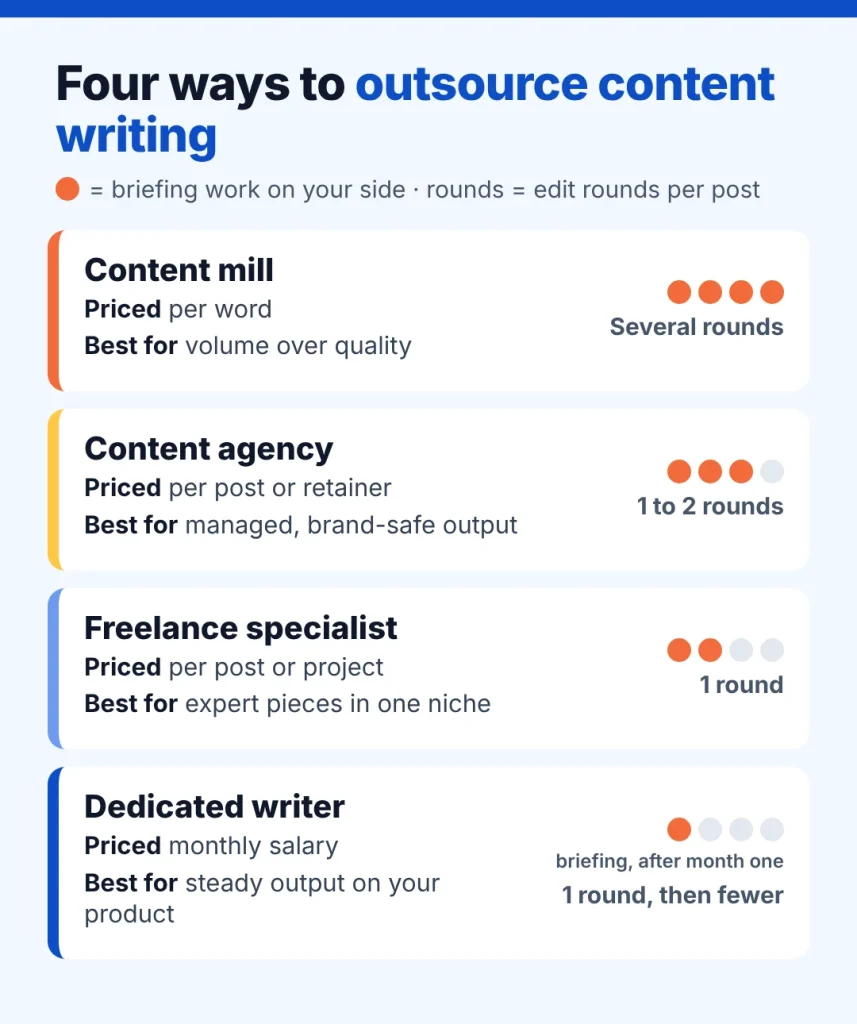
| Content mill or marketplace | Content agency | Freelance specialist | Dedicated writer | |
|---|---|---|---|---|
| Priced as | Per word | Per post or retainer | Per post or per project | Monthly salary |
| Subject knowledge | Low, rotates per order | Moderate, account manager mediates | High in their niche | Grows every month |
| Briefing needed | Heavy | Moderate | Light | Light after month one |
| Edit rounds, typical | Several | One or two | One | One, then fewer |
| Best for | Volume where quality is secondary | Brand-safe output with project management | Expert pieces in a defined niche | Steady output on your product |
The briefing row is where money disappears. A writer with no context needs a detailed brief for every piece. Writing that brief can take as long as writing a first draft yourself, and it never shows up in the quoted rate.
The Cost the Rate Hides
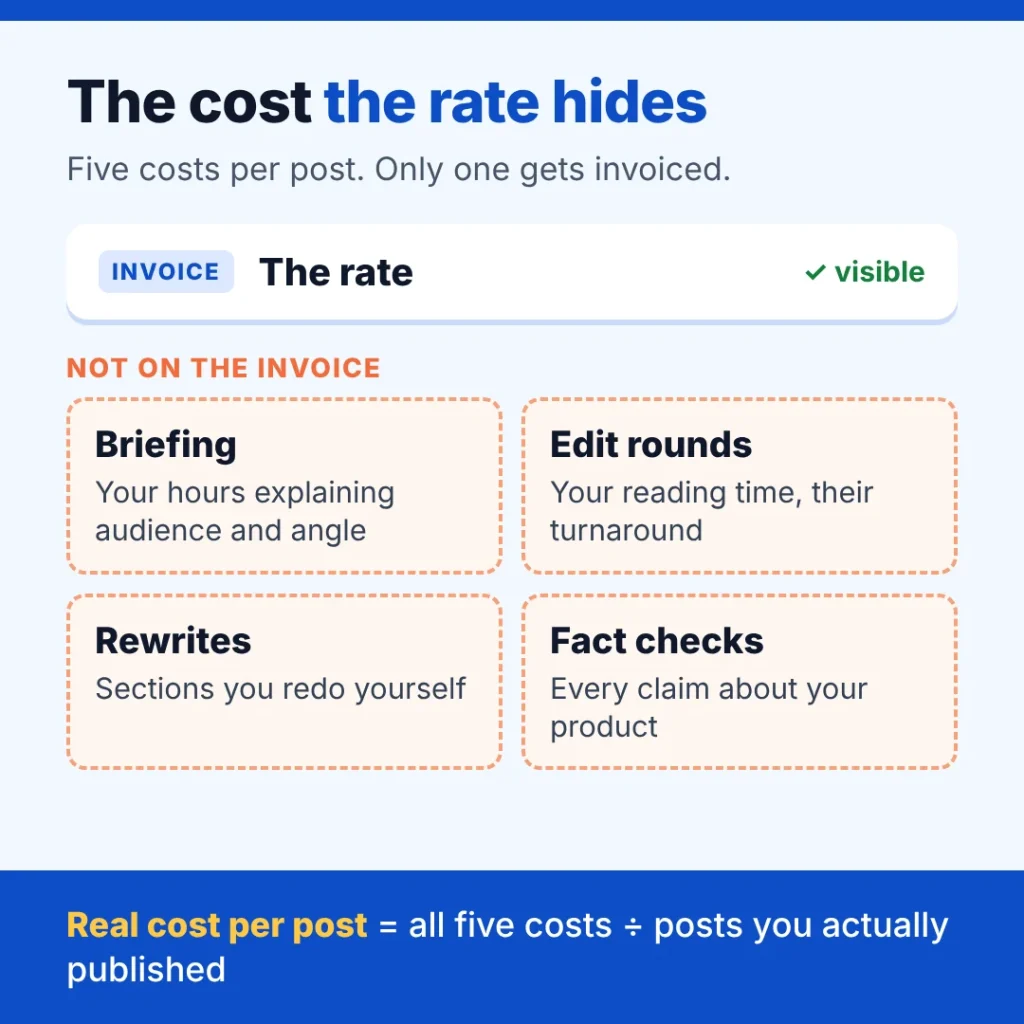
Five costs sit around every outsourced post. Only the first appears on an invoice.
- The rate itself. Visible, compared, negotiated.
- Briefing time. Your hours explaining the audience, angle, sources and what to avoid.
- Edit rounds. Each round costs your reading time and the writer’s turnaround. Three rounds turns a one-week piece into a month.
- Rewrites. The sections you rewrite yourself because explaining the fix takes longer than doing it.
- Fact and claim checking. A writer outside your business cannot know which claims are true for your product. Someone inside has to check every one.
Add those together and divide by the number of posts you actually published. That is the real unit cost. On a low per-word rate with heavy briefing and three rounds of edits, it is routinely higher than a premium writer who gets it right first time.
Why Cheap Content Gets Expensive in Search
There is a second cost that never appears in the comparison at all.
Generic content written by someone without subject knowledge reads like every other result for the same query, because it was assembled from them. It rarely earns links, rarely holds attention and rarely ranks. You pay for the post, then pay again in the opportunity cost of a slot that produced nothing.
The employment side of the comparison matters too. According to ADP’s breakdown of true hiring costs, benefits add roughly $14,950 to a $50,000 salary, taking employer cost to about $64,950. That figure is why domestic in-house writers price out most SMBs, and why the dedicated remote option changes the arithmetic rather than shaving it.
When an Agency or Marketplace Is the Right Call
- Volume where quality is secondary. Product descriptions, location pages, glossary entries. A mill is fine and a specialist would be wasted.
- A one-off expert piece. A whitepaper or a technical guide in a niche you do not cover. Buy the specialist for the project.
- No one internally can brief or review. An agency’s editor and account manager become the product. You are paying for the management layer and it is worth it.
Outside those, if you publish every week on your own product, you are paying to rebuild context on every piece. Our guide to outsourcing SEO covers the same structure for search work.
What a Dedicated Writer Changes
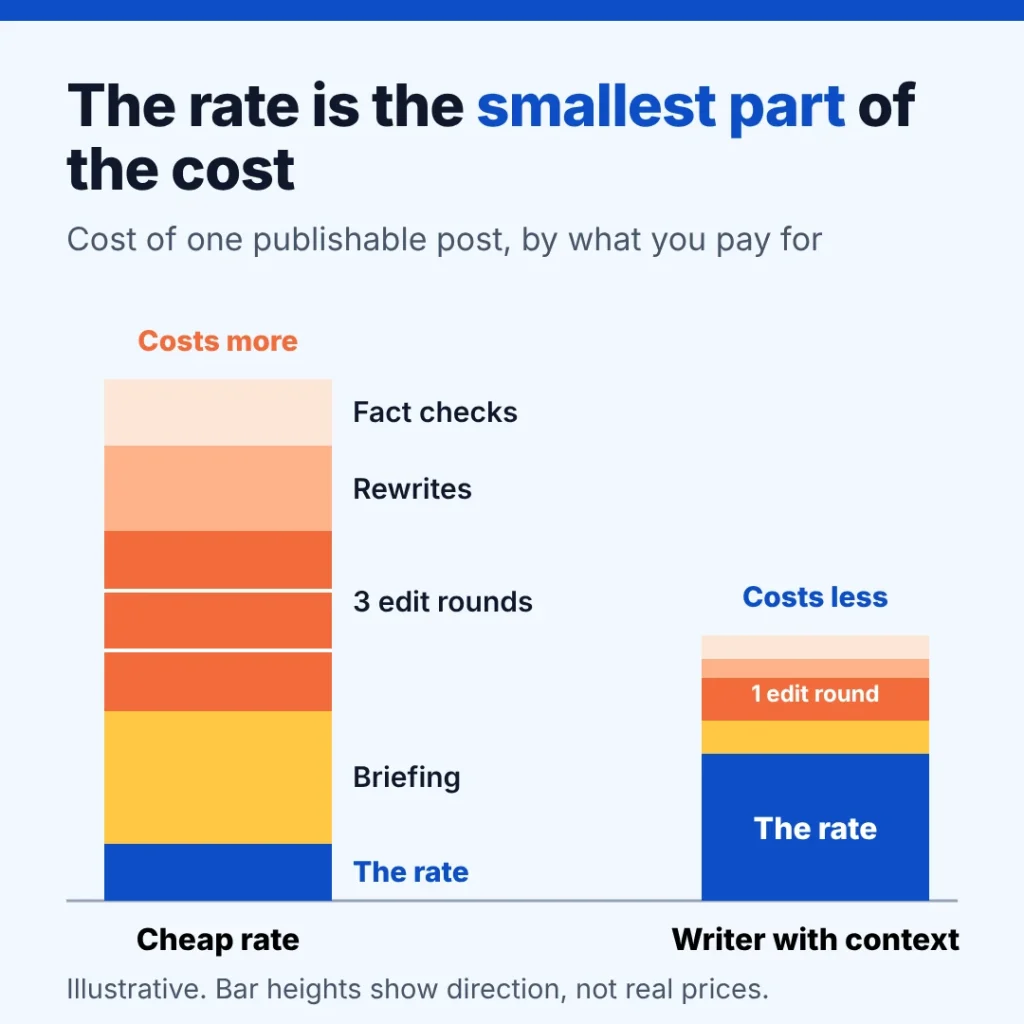
The main change is that briefing cost falls toward zero by month two. The writer has read your past posts, knows your customers and has learned which claims need checking. Edit rounds drop from three to one, then often to light polish.
At Pavago, placement is 3% of first-year salary. Searching, messaging and interviews are free. Terms are on the pricing page.
You can search writers and read their samples in the client portal before deciding which model fits.
The content marketing specialist role covers writers who handle strategy as well as drafting.
The wider marketing talent pool covers adjacent roles.
Ride the Wave made a senior marketing hire rather than continuing to buy content piece by piece, and the Ride the Wave case study covers how it was structured.
Our guide to freelance content creators covers the freelance side in more depth.
What to Screen For
Give a paid test on your actual topic. Writing samples show what someone produces under their own direction. A short paid brief shows what they produce under yours.
Count the questions they ask before starting. One or two good questions is a strong sign. None means they are about to guess.
Check one claim in their sample. If the facts in their portfolio do not hold up, the facts in your posts will not either.
How to Brief an Outsourced Writer
Most of the editing cost described above can be removed before the first draft is written. A strong brief takes longer to write once and saves hours on every piece after it.
State the reader and the problem. Who is reading, what they already know, and what they should be able to do after finishing.
Give the angle, not just the topic. A topic produces a generic article. An angle, such as a claim the piece should prove, produces something worth reading.
List the facts only you know. Product details, customer examples, numbers you can stand behind. Writers cannot invent these, and they should not try.
Share two examples of finished work you like. Showing tone is faster than describing it.
Say what to avoid. Claims you cannot make, competitors you do not name, phrases your brand never uses.
How to Tell Whether Outsourced Content Is Working
Output volume is the easiest number to track and the least useful. Three measures tell you far more.
Edit time per post. If it is not falling after the first month, either the brief or the writer is wrong.
Search performance over three to six months. Impressions, rankings and clicks for the posts, compared with your earlier content.
Use by your own team. Content your sales or support team actually sends to prospects is content that is doing a job.
More on how hiring works is on the Pavago homepage.
Common Mistakes When Outsourcing Content
Switching writers every few posts. Context resets each time, and so does the editing burden. Consistency with one writer is usually worth more than a slightly lower rate elsewhere.
Briefing by keyword alone. A keyword tells the writer what to rank for, not what to say. Posts briefed this way read like everything else on the first page.
Skipping the review of the first three pieces. The early posts are where tone and accuracy get calibrated. Rushing them locks in problems that cost more to fix later.
Frequently Asked Questions
How much does it cost to outsource content writing?
Rates vary widely by model: per word for mills and marketplaces, per post or retainer for agencies, per project for specialists, and salary for a dedicated writer. The more useful figure is cost per publishable post, which adds briefing, editing and rewrite time to the rate.
Is it cheaper to outsource content or hire a writer?
For occasional pieces, outsourcing. For weekly output on your own product, a dedicated writer usually costs less per publishable post, because briefing and editing time falls sharply once they know the business.
Why does outsourced content need so many edits?
Because the writer lacks subject knowledge and context. Without it, they assemble from existing content, which produces generic drafts and multiple edit rounds.
Should content writing be outsourced to an agency or a freelancer?
An agency when you need project management and nobody internally can review. A specialist freelancer for expert pieces in a defined niche. A dedicated writer for steady output on your product.
How do I reduce editing time on outsourced content?
Write one strong reference brief, share past posts you consider good, run a paid test before committing, and keep the same writer long enough for context to build.
Compare writers on cost per publishable post
Search the pool free. Messaging and interviews are free. 3% of first-year salary on placement, 60-day replacement.