

Why Starting With Outreach Fails
A sales assistant given a list and a template on day one is being asked to do the one part of sales that depends entirely on inputs they have not built.
The list is whatever was exported last quarter. Half the contacts have moved. The research is a company name and a job title. The template was written for a different segment. None of that is the assistant’s doing, and none of it is visible until the replies do not come.
What happens next is predictable. Response rates come in low, the founder concludes the assistant cannot sell, and the role is either cut or reduced to data entry. The actual problem was that outreach was the fourth job, and it was given first.
The Sequence
Stage one. CRM hygiene, weeks one to two
Before anything goes out, the assistant owns the state of the pipeline. Deduplicating records, updating job titles, removing contacts who have left, logging activity that never got logged, and closing deals that died months ago but still sit open.
This is unglamorous, and it is the highest-leverage two weeks of the role. Every later stage runs on this data, and it also teaches the assistant your pipeline faster than any briefing would.
Stage two. Research, weeks three to four
Now they build the lists rather than inherit them. Given a definition of who you sell to, they find companies that match, identify the right person, verify the contact, and record why each account qualified.
The last part matters more than the rest. An assistant who can articulate why an account is a fit has understood your market. One who cannot is pattern-matching on company size, and the list will look right and convert badly.
Stage three. Outreach support, weeks five to eight
Still not sending. Drafting sequences for your review, personalising first lines against the research from stage two, scheduling sends, tracking replies, and routing the ones that need a human.
You remain the sender. The assistant does everything around the send, which is most of the work. This is also where you find out whether their written English is strong enough for the next stage, on drafts you review rather than on live prospects.
Stage four. Owning the top of funnel, month three onward
Sending under their own name, handling initial replies, booking meetings into your calendar, and managing follow-up on anyone who went quiet.
By this point, they have cleaned the pipeline, built the lists, and drafted eight weeks of messaging you corrected. That is why outreach works now and did not in week one. Nothing about the person changed. The inputs did.
What to Hold Back Permanently
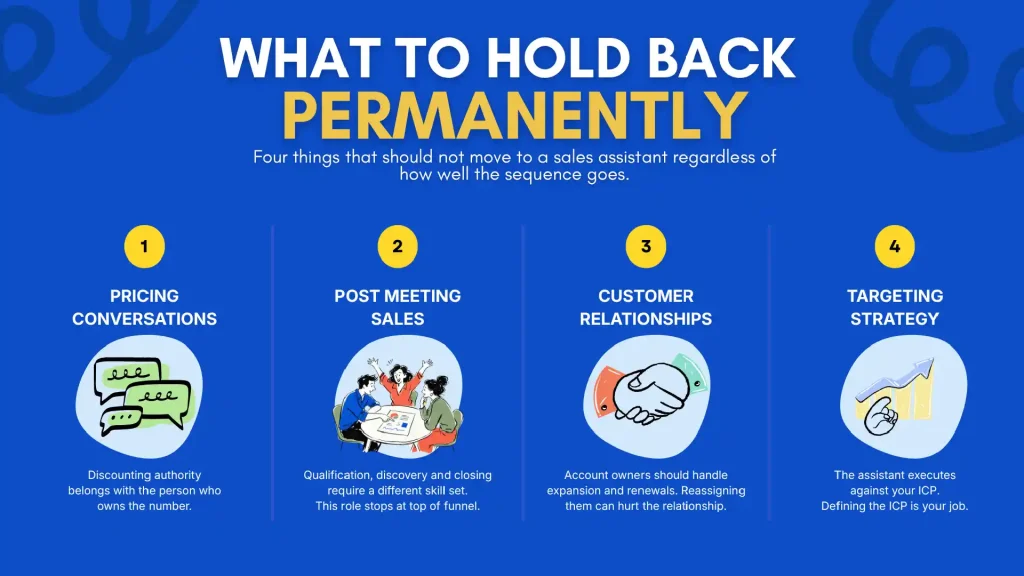
Four things that should not move to a sales assistant regardless of how well the sequence goes.
- Pricing conversations. Discounting authority sits with whoever owns the number. An assistant asked to negotiate will either concede too much or stall the deal.
- Anything after the first meeting. Qualification, discovery, and close are a different skill and a different hire. Top of funnel is the ceiling of this role.
- Existing customer relationships. Expansion and renewal conversations belong to whoever holds the account. Reassigning them to a coordinator reads as a demotion to the customer.
- Strategy on who to target. The assistant executes against an ICP. Defining it is your job, and delegating it produces lists that match a description nobody validated.
If you find yourself wanting to hand over the third or fourth item, the role you actually need is an SDR or an account executive, which is a different hire at a different level. Our comparison of SDR and BDR roles covers where those lines fall.
What This Role Is Worth
| Stage | Hours returned per week | What you stop doing |
|---|---|---|
| CRM hygiene | 2 to 4 | Updating records between calls, or not updating them |
| Research and list building | 5 to 8 | Building lists yourself at the start of every campaign |
| Outreach support | 4 to 6 | Drafting, personalising and scheduling every message |
| Top of funnel ownership | 6 to 10 | Chasing replies and booking meetings |
Those hours come back to whoever was doing sales, which in most SMBs is the founder. The value is not that the assistant sells. It is that the person who can sell stops spending their week on the work surrounding selling.
You can see who is available and what the role costs in the client portal, without creating anything.
Screening for the Sequence
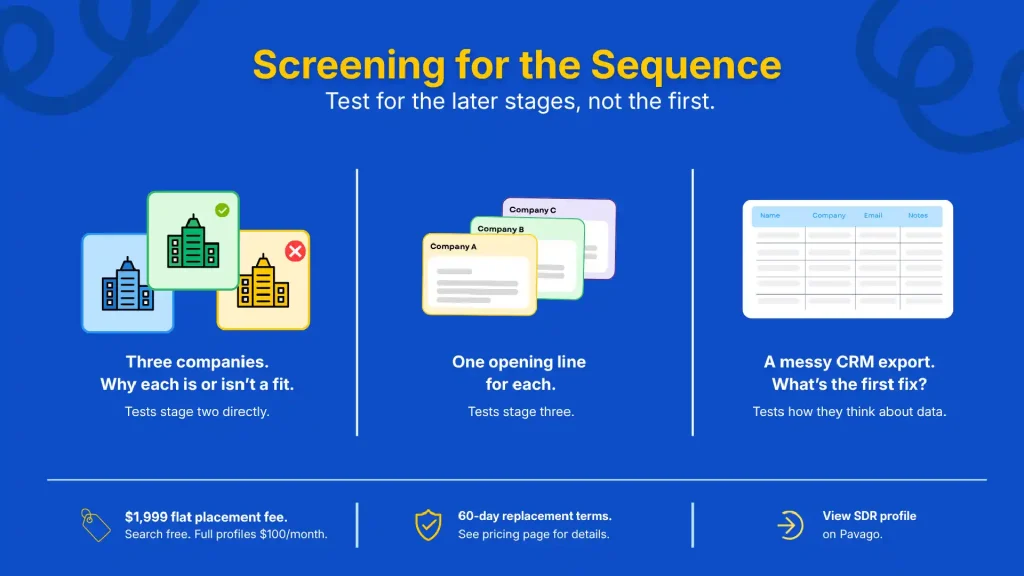
Because the role progresses through stages, screen for the later ones rather than the first. Anyone can deduplicate a CRM. Fewer can write a first line that does not read as automated.
- Give them three companies and ask why each is or is not a fit. Tests stage two directly. Look for reasoning about the business, not recitation of headcount.
- Ask them to write one opening line for each. Tests stage three. Anything that could be sent to all three fails.
- Show them a messy CRM export and ask what they would fix first. Tests whether they see data as something to interrogate or something to enter.
Pavago is a self-serve hiring marketplace: search vetted sales assistants yourself, get matched in under a minute, watch their video intros and hire directly, with no sales call. Searching, messaging and interviews are free, and each hire costs 3% of first-year salary. The pricing page carries the 60-day replacement terms.
The sales development representative role page shows the profiles that fit this sequence, and the wider sales talent category covers the roles above it.
OPW Commercial Services structured a client-facing sales placement rather than buying outreach as a service, and the OPW Commercial Services case study covers the arrangement.
Frequently Asked Questions
What does a virtual sales assistant do?
CRM maintenance, prospect research and list building, outreach drafting and scheduling, reply tracking, and meeting booking. In a mature arrangement, they own the top of the funnel. They do not qualify, negotiate, or close.
What should I delegate to a sales assistant first?
CRM hygiene, for two weeks. It is the least interesting work and the highest leverage, because every later stage depends on the data being accurate, and it teaches them your pipeline faster than a briefing.
How is a virtual sales assistant different from an SDR?
An SDR owns outreach and qualification and is measured on meetings booked. A sales assistant supports the whole top of funnel, including research and CRM work, and reaches out only after the earlier stages are working. The assistant is the earlier hire.
How long before a sales assistant produces results?
Eight to twelve weeks if the sequence is followed. Weeks one to four produce no visible output and make weeks five onward work. Compressing this is the most common reason the role is judged a failure.
Should a virtual sales assistant handle pricing conversations?
No. Discounting authority belongs with whoever owns the revenue number. An assistant placed in a pricing conversation will either concede too much or stall while they check, and both damage the deal.
Search sales talent before you commit
Free to search. Messaging and interviews are free. 3% of first-year salary on placement, 60-day replacement.